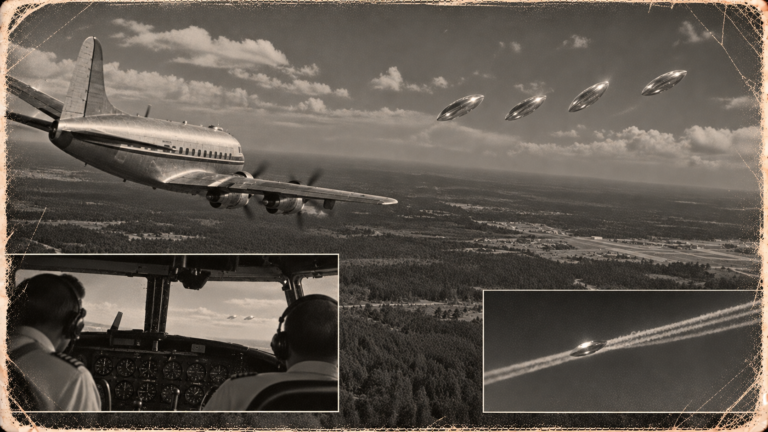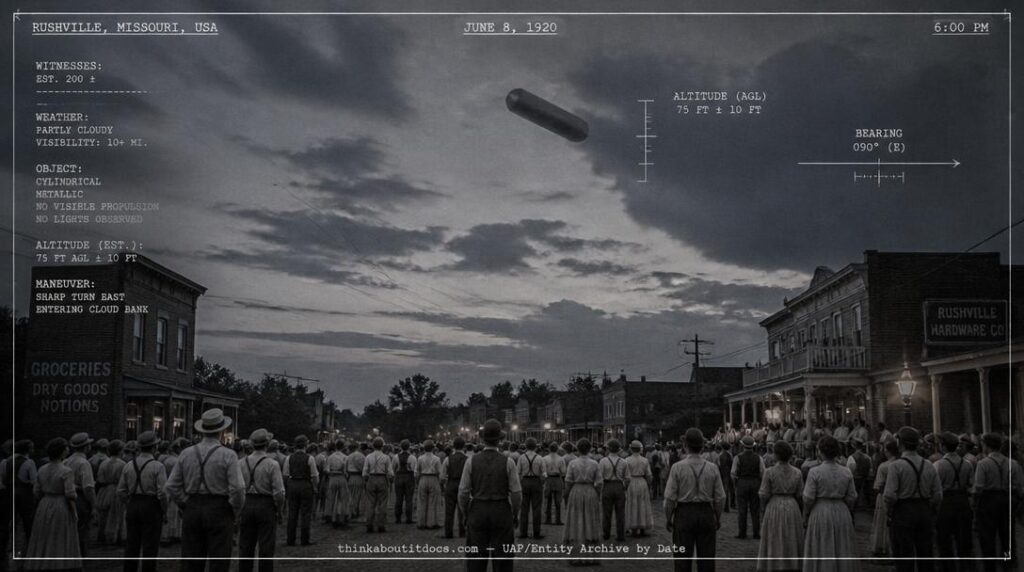
Rushville, Missouri, June 8, 1920 — a cylindrical object at 75 feet altitude, witnessed by approximately 200 people, turns east before vanishing into cloud.
THINK ABOUTIT UFO|UAP SIGHTINGS REPORT
Rushville Missouri 1920: 200-Witness Cylinder UFO Sighting
On the evening of June 8, 1920, a dark cylindrical object descended to an estimated 75 feet over Rushville, Missouri and held station in front of roughly two hundred people before executing a sharp, deliberate 90-degree turn to the east and vanishing into a bank of cloud — the best-witnessed structured-object maneuver anywhere in the pre-1947 American record for that year, and one documented with a precision of altitude, timing, and turn geometry that is rare for any case this early in the century.
Date: June 8, 1920
Sighting Time: 18:00 (6:00 PM)
Day/Night: Day (early evening, daylight)
Location: Rushville, Missouri
Urban or Rural: Rural (small town)
No. of Entity(‘s): 0 — no occupants reported
Entity Type: Not Applicable
Entity Description: Not Applicable
Hynek Classification: NL/DD (Nocturnal Light borderline Daylight Disc — low-altitude structured-object observation with maneuver, no close-approach or landing)
Duration: Undocumented (sufficient for a controlled 90-degree turn and cloud entry to be observed)
No. of Object(s): 1
Description of the Object(s): A single dark, structured cylindrical craft holding a stable, controlled low-altitude course before turning sharply and climbing into cloud cover
Shape of Object(s): Cylindrical
Size of Object(s): Undocumented
Color of Object(s): Undocumented (implied dark against sky)
Distance to Object(s): Directly overhead / near-vertical, consistent with the 75-foot altitude estimate
Height & Speed: Approximately 75 feet altitude; speed undocumented but sufficient to complete a sharp 90-degree turn before disappearing into cloud
Number of Witnesses: Approximately 200
Special Features/Characteristics: Precise, controlled 90-degree directional turn to the east at very low altitude, immediately followed by disappearance into cloud cover — a maneuver profile inconsistent with any known 1920-era aircraft, balloon, or airship
Case Status: Unexplained.
Source: Hall, Richard H. From Airships to Arnold: A Preliminary Catalogue of UFO Reports in the Early 20th Century (1900–1946), UFO Research Coalition, Fairfax, 2000, ISBN: 1-928957-01-3. Source Status: VERIFIED.
Summary/Description: At approximately 6:00 PM on June 8, 1920, an estimated two hundred residents of Rushville, Missouri observed a dark cylindrical object at roughly 75 feet altitude. The object executed a precise 90-degree turn to the east and disappeared into cloud cover. No mechanical sound, propulsion visible, or conventional aircraft characteristics were reported.
Related Cases: 1920: UFO|UAP & Alien Sightings Archive | 1920 Albert Coe / Mattawa River Ontario Encounter
Detailed Report
The Rushville case is documented through Richard Hall’s From Airships to Arnold: A Preliminary Catalogue of UFO Reports in the Early 20th Century (1900–1946), a specialist reference compiling pre-modern-era American sightings with an emphasis on original press and witness sourcing rather than secondhand paraphrase. The catalogue entry gives four independently verifiable data points: an approximate witness count (roughly 200), a precise altitude estimate (75 feet), a specific maneuver (a 90-degree turn to the east), and a resolution (disappearance into cloud). This level of internal consistency — altitude, direction, and endpoint all specified rather than vaguely gestured at — is unusual for a report this old, and it is what elevates Rushville above the other, thinner 1920 entries on nocturnal lights and unspecified aerial objects.
No newspaper transcript, named witness, or investigating body is preserved in the available secondary sourcing; Hall’s catalogue functions here as the sole documented chain back to whatever original local reporting existed in 1920. That is a real limitation — a crowd-scale sighting with this much internal detail would ordinarily leave a traceable newspaper record, and the absence of that primary layer in the currently available research means the case rests on the catalogue compiler’s fidelity to a source this archive has not independently located. The report is treated as credible on the strength of Hall’s documented research standards and the specificity of the detail, while flagging the missing primary layer as an open research item.
RESEARCHER’S NOTES
The Rushville Maneuver — 1920 and the Mass-Witness Threshold for Controlled Flight
- Classification Rationale: The case sits at the NL/DD boundary rather than cleanly in either category. It occurred at 6:00 PM — not fully dark, not full daylight — and the object is described only as “dark,” with no illumination noted. The controlled turn and cloud entry push it past a simple light-in-the-sky report toward a structured-object observation, which is why this archive treats it as the strongest of the page’s NL/DD-tier entries rather than a routine nocturnal light.
- Source Chain Assessment: Hall’s Airships to Arnold catalogue is a specialist secondary compilation built specifically to document early-20th-century American reports with research rigor; it is one of the more reliable single-source citations available for this era of the archive. The absence of a located primary newspaper account is noted as a gap rather than a disqualifier — this is common for 1920s local press coverage, much of which was never digitized or indexed.
- Pattern Context: Mass-witness sightings of structured objects performing deliberate maneuvers are rare in the pre-1947 American record outside the 1896–97 mystery airship wave and scattered WWI-era reports. Rushville’s 200-witness count places it among the largest-witnessed cases anywhere in the 1900–1946 archive window, alongside the Galveston, Texas formation sighting later the same year.
- Evidentiary Weight: No photographic, physical-trace, or instrument corroboration exists — the case rests entirely on the aggregate testimony implied by the catalogued witness count. That is a real limit on evidentiary strength even where the witness number is large, since the underlying individual accounts have not been independently traced or cross-verified by this archive.
Rushville, Missouri stands as 1920’s clearest example of a mass-witness structured-object report: a specific altitude, a specific maneuver, a specific resolution, and a crowd large enough that simple misperception of a known object seems an incomplete explanation on the details as catalogued — while the missing primary newspaper trail keeps the case honestly logged as Unexplained rather than definitively anomalous.
“Cylindrical object at 75′ altitude seen by 200 people. Made 90 degree turn to the east, disappeared into a cloud.”
From Richard H. Hall, From Airships to Arnold: A Preliminary Catalogue of UFO Reports in the Early 20th Century (1900–1946), 2000