The May 18, 1909 Caerphilly Mountain sighting — Charles Lethbridge's account of a landed airship and its fur-coated crew, later complicated by the discovery that its central physical evidence came from a motor car.
THINK ABOUTIT UFO ENCOUNTER REPORT
1909 Caerphilly Mountain “Airship”
Corrected: The Label Was From a Car
On the night of May 18, 1909, a Cardiff dock laborer named Charles Lethbridge was pushing his Punch and Judy show cart home over Caerphilly Mountain when he says he came upon a landed airship and its two fur-coated crew. Newspapers investigated the story the next day, journalists walked the site with him, and photographs were taken — a genuinely rare level of contemporaneous scrutiny for a phantom-airship report. That scrutiny also turned up an answer: the “physical trace evidence” long cited as this case’s strongest point was a label from a car tire valve, and the witness’s own account shifted over the following weeks to match an unrelated, unverified inventor’s competing claim. This page tells the whole story, not just the dramatic half of it.
Date: May 18, 1909
Sighting Time: About 11:00 PM
Day/Night: Night
Location: Caerphilly Mountain, near Cardiff, Wales
Urban or Rural: Rural (mountain roadside)
No. of Entity(s): 2
Entity Type: Human occupants of a landed craft
Entity Description: Two men in heavy fur coats and tight-fitting fur caps, speaking a “strange lingo” Lethbridge did not recognize as English
Hynek Classification: CE-III, as originally reported — see Case Status
Duration: Undocumented
No. of Object(s): 1
Description of the Object(s): A long, tube-shaped craft resting on the grass, with a small carriage suspended from it
Shape of Object(s): Tube-shaped
Size of Object(s): Undocumented
Color of Object(s): Undocumented
Distance to Object(s): Approximately 20 yards at closest approach
Height & Speed: Rose from the ground, cleared nearby telegraph lines, switched on two lights, and headed toward Cardiff
Number of Witnesses: 1 (Charles Lethbridge)
Special Features/Characteristics: Occupants “jabbered furiously” in an unrecognized language; craft initially described resting on “rockers,” later revised by the witness to “wheels” after a competing claim surfaced (see Researcher’s Notes); scattered debris found at the site, including a French label later identified as coming from a motor car tire valve
Case Status: Insufficient Data — the case’s central physical evidence has been identified as an ordinary motor-car part, and the witness’s own account changed over subsequent weeks
Source: Cardiff Evening Express; Manchester Guardian; Weekly Mail; research by historian Brett Holman
Summary/Description: Charles Lethbridge reported finding a landed tube-shaped craft on Caerphilly Mountain, with two fur-coated men speaking an unfamiliar language nearby. Journalists investigated the site the next day and found scattered debris, including a French label later identified as coming from a motor car. Lethbridge later revised a key detail of his account — rockers becoming wheels — to match an unrelated, unverified inventor’s competing airship claim.
Witnesses: Charles Lethbridge, a Cardiff dock laborer, confirmed by 1911 census records to have lived at 29 Roland Street, Cardiff — the sole witness to the encounter itself
Related Cases: Dr. M. B. Boyd’s unverified airship-invention claim, which surfaced roughly two months later and which Lethbridge’s revised account came to match
DETAILED REPORT
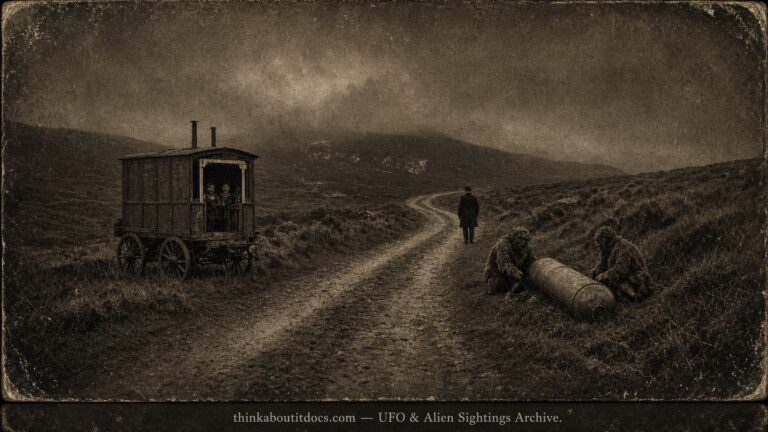
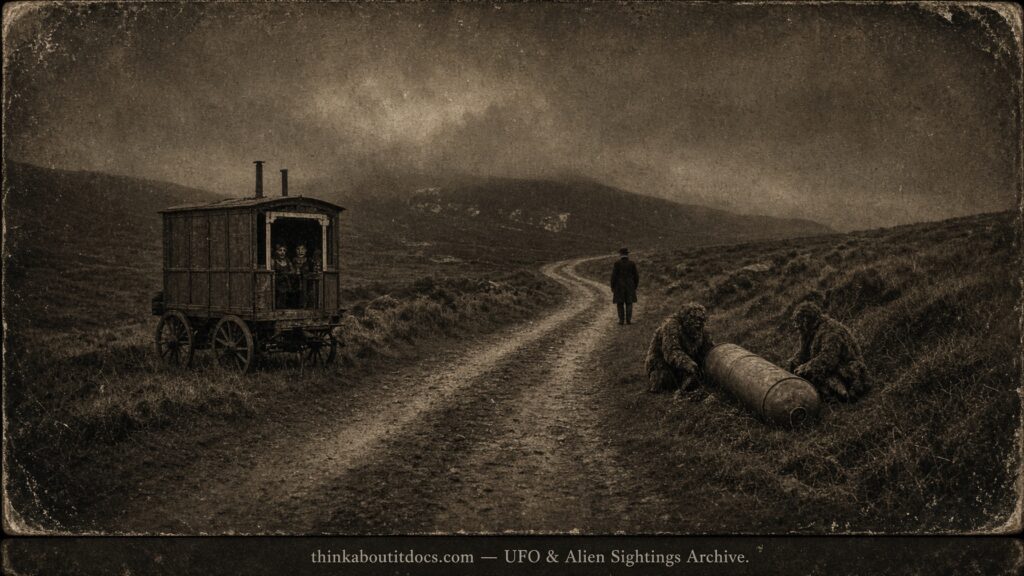
Lethbridge, walking home to Cardiff from a Punch and Judy performance, told the Cardiff Evening Express that at the top of Caerphilly Mountain he saw “a long, tube-shaped affair lying on the grass on the roadside, with two men busily engaged with something near by.” The men wore heavy fur coats and tight-fitting fur caps despite the summer weather. When Lethbridge got within about twenty yards, “they jumped up and jabbered furiously to each other in a strange lingo — Welsh, or something else; it was certainly not English.” They picked something up from the ground, and the object began to rise. The two men jumped into “a kind of little carriage suspended from it,” which Lethbridge described as resting on what he took to be rockers. After clearing some telegraph lines, the object switched on two lights and headed toward Cardiff.
What sets this case apart from most phantom-airship reports of the era is what happened next: journalists actually investigated it. The day after the story ran, a reporter accompanied Lethbridge back to the site. The ground was hard, but showed signs of disturbance, “as though a ploughshare or some such hard contrivance had been drawn across it.” Nearby, the party found a scattered collection of debris: a red label, in French, attached to a small chain and plug; torn stockbroker letterhead bearing faint typed phrases like “provincial centres” and “rest assured that we shall not”; newspaper scraps, most referencing airships or the German army; small pieces of blue paper with numbers and letters written in what the Manchester Guardian described as “a style distinctly different to that of the average English hand”; a wad of pulpy paper resembling a spent cartridge wadding; and an empty tin of metal polish.
The Manchester Guardian‘s own contemporary coverage was notably cautious about the ink on the stockbroker letterhead, observing dryly that “whatever kind of ink was used for this letter it certainly is not of an indelible nature” — a skeptical aside about how conveniently faded the “evidence” already was within a day of its discovery.
The most consequential detail came shortly afterward and outside Lethbridge’s own account entirely: historian Brett Holman’s research into the period’s follow-up newspaper coverage confirms that the red French label — the piece of evidence most often cited since as physical confirmation of the encounter — was subsequently identified as coming from a motor car, specifically related to a tire valve. Whatever else was scattered at that roadside spot, the single most tangible piece of “evidence” was mundane automotive debris, not confirmation of anything unexplained.
Nearly two months later, a Dr. M. B. Boyd came forward publicly claiming he had invented a small, powerful airship — more efficient than a Zeppelin — and that test flights of his invention were responsible for several phantom-airship sightings of the period, including Caerphilly. Boyd’s claimed invention was never independently verified; despite cautious coverage in the aviation journal Flight, no evidence exists that he ever produced an actual, functioning airship. A Weekly Mail journalist re-interviewed Lethbridge to ask whether Boyd’s claim matched what he’d seen. Lethbridge’s answer is worth quoting because of how it changed his own story:
“What, I thought were rockers upon which the airship was resting on the ground now appears to have been the wheels on which it was carried along after it came to earth. I am not a practical man in this respect, and, of course, cannot enter into the details from a scientific point of view… I say that Dr. Boyd’s story of his invention and his experiments bear out in their entirety my statement of what I saw on that evening.”
Boyd’s claimed airship had wheels. Lethbridge’s original account had described rockers. In the retelling, the rockers became wheels. Holman’s assessment of this shift is direct: Lethbridge “seems openly willing to modify his own account to match the description of Boyd’s airship.”
The same re-interview produced one more detail worth preserving honestly: Lethbridge, describing how his workmates at the docks had teased him relentlessly in the weeks since the story broke, volunteered that “I don’t drink to excess on any occasion, and I only had a sleever that night before I crossed the Caerphilly Mountain.” A “sleever” is a period term for a pint or a drink. He raised this himself, unprompted, apparently in response to being called “boozed” by his coworkers.
RESEARCHER’S NOTES
Caerphilly Mountain — What Actually Investigating a Case Looks Like
- This site’s earlier draft omitted the label identification entirely: presenting the case as one where “the grass was found depressed at the site after the object had flown off” and citing this as confirmed physical trace evidence, without mentioning that the specific physical item most associated with the case — the French label — was traced to a car tire valve. That is not a minor omission. It is the difference between “unexplained physical evidence” and “an identified mundane object that happened to be lying near a roadside disturbance.”
- The witness existed; what he saw is a separate question: Holman’s genealogical research confirming a real Charles Lethbridge at the address given is a genuine point in the case’s favor — this wasn’t an invented name attached to a hoax story after the fact. But a real witness can still misperceive, exaggerate, drink before an encounter, or reshape a story to fit later information, and this case shows evidence of at least the latter two.
- The account changed to fit a competing, unverified claim: when Dr. Boyd’s airship story surfaced, Lethbridge revised a specific structural detail of his own sighting — rockers becoming wheels — to align with it. This is a textbook example of a witness’s memory (or willingness to narrate) adjusting under social and informational pressure, and it happened within the same original news cycle, not decades later.
- The debris pile reads more like discarded roadside litter than a crash site: business letterhead, newspaper clippings about a topical subject (airships), scrap paper, and an empty polish tin are exactly the kind of things one might expect to find scattered along any well-traveled road over time, especially one at “the peak of the 1909 scare,” when the topic itself was in every newspaper Lethbridge would have had access to.
- What the case is still worth preserving for: it remains one of the most thoroughly, contemporaneously investigated phantom-airship reports of 1909 — a rare case where journalists actually walked the site, photographed the location and the witness, and a modern historian later tracked down census records to confirm the man existed. That level of scrutiny is valuable precisely because it lets us see what happened to the “evidence” under examination, rather than leaving the case as an untested anecdote.
Caerphilly Mountain is a genuinely interesting case — just not for the reasons this site’s earlier draft gave. It’s interesting because it’s one of the few phantom-airship reports from 1909 that got real contemporary investigative attention, and because that attention produced an answer for its central piece of evidence within days. A car part is not a UFO landing site marker. A witness’s story shifting to match someone else’s unverified claim is not independent corroboration. Lethbridge may have genuinely believed he saw something extraordinary that night — after a drink, in the dark, on a lonely mountain road, at the height of a nationwide airship scare that had every paper in Britain running similar stories. That’s a real and human thing to have happened. It isn’t the same as physical proof of an unidentified craft.
“Did he himself believe what he said and, if so, what did he actually see? That’s a question that I can’t answer.”
— Historian Brett Holman, on the Caerphilly Mountain case, after confirming witness Charles Lethbridge’s existence via 1911 census records