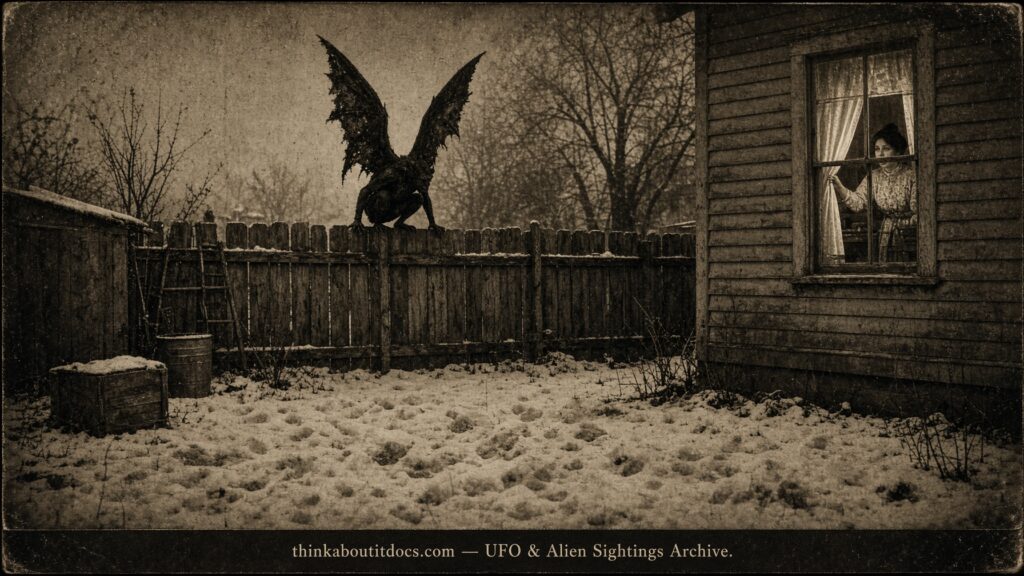
The January 21, 1909 Burlington, New Jersey sighting — Mrs. Michael Ryan reported the creature crouched on her back fence at dawn, as documented the next day by the Trenton Evening Times.
THINK ABOUTIT ENTITY ENCOUNTER REPORT
The January 1909 Jersey Devil Cluster
Six Sightings in Six Days, Sourced Honestly
Over roughly a week in mid-to-late January 1909, something moving through New Jersey and Pennsylvania was seen by a police patrolman who fired his revolver at it, a mother who watched it crouch on her back fence, a fishing party, a social club full of terrified men, and several others across at least five separate towns. Contemporary newspapers ran the story on their front pages. Whatever it was — a genuine unknown animal, a series of unrelated misperceptions, mass hysteria feeding on regional folklore, or an opportunistic hoax that got out of hand — the “Jersey Devil” cluster of January 1909 remains one of the most geographically concentrated, multiply-witnessed entity encounters documented anywhere in the pre-war record.
Case Name: The Jersey Devil, January 1909 Cluster
Location: Woodbury, Bristol (PA), Burlington, Moorestown, and Camden, New Jersey / Pennsylvania
Date Range: January 16–21, 1909
Sighting Time: Varies by incident — see Detailed Report for each incident’s specific time
Day/Night: Predominantly night, with one early-morning (dawn) incident
Urban or Rural: Mixed — small-town streets, a bridge, a cemetery/gravel pit area, a social club, and a residential backyard
No. of Entity(s): 1 (presumed the same creature across incidents, though this is not established — see Researcher’s Notes)
Entity Type: Winged/hoofed cryptid, popularly known as the “Jersey Devil”
Entity Description: Descriptions vary by incident: a phosphorescent-eyed white shape (Woodbury); a winged creature that flew (Bristol); a toothless “Jabberwock” with coal-like eyes (Burlington, Jan. 18); a roughly three-foot figure with long black hair, monkey-like arms, a dog-like face, split hooves, and a foot-long tail (Moorestown); an unspecified “grisly” figure (Camden); and a winged, small-legged, crouching shape (Burlington, Jan. 21)
Hynek Classification: N/A — entity encounter cluster, no associated craft
Duration: Undocumented per incident
No. of Object(s): 0 (no craft in any incident)
Description/Shape/Size/Color of Object(s): N/A
Distance to Object(s): N/A
Height & Speed: N/A
Number of Witnesses: At least 7 named or role-identified individuals across 6 incidents (Thack Cozzens; Patrolman James Sackville; an unnamed Burlington policeman; John Smith and George Snyder; Mr. Rouh and members of the Black Hawk Social Club; Mrs. Michael Ryan)
Special Features/Characteristics: A police patrolman fired his revolver at the creature twice and missed; footprints found near the Jan. 21 Burlington sighting; three taps reportedly heard on shutters after that same sighting
Case Status: Insufficient Data
Source: Jersey Devil literature and secondary UFO websites (Woodbury incident, weakest sourcing); Clark, Jerome, Unexplained!, 1993 (Bristol); New York Folklore Quarterly, 1974 (Burlington, Jan. 18); McCloy, James F., and Ray Miller Jr., The Jersey Devil, 1976 (Moorestown, Camden); Trenton Evening Times, January 22, 1909 (Burlington, Jan. 21 — the cluster’s only same-week primary source)
Summary/Description: Over roughly a week in January 1909, a creature was reported across five towns in New Jersey and Pennsylvania — chased by a police patrolman who fired his revolver at it, seen crouched on a woman’s back fence, and encountered by a fishing party and a social club, among other incidents. Sourcing quality varies sharply across the six incidents, from a same-week newspaper report to an unattributed quote circulated only through later Jersey Devil literature.
Related Cases: Part of the broader “Jersey Devil” folkloric tradition, with roots in colonial-era New Jersey Pine Barrens legend predating this 1909 cluster by over a century
DETAILED REPORT
January 16, Woodbury, New Jersey. Thack Cozzens, leaving the Woodbury Hotel, reported: “I heard a hissing and something white flew across the street. I saw two spots of phosphorus — the eyes of the beast. There was a white cloud, like escaping steam from an engine. It moved as fast as an auto.” This account’s sourcing is weaker than the others in the cluster — it comes down through Jersey Devil literature and secondary UFO websites, with no original newspaper citation identified.
January 16 or 17, Bristol, Pennsylvania. Patrolman James Sackville, alerted by his dogs while walking his beat near a bridge, reportedly saw movement in the shadows below. He drew his revolver and pursued a winged creature that let out a cry and sprang away, then flew directly over him — he fired twice and missed both times as it vanished into the dark. This account is documented in Jerome Clark’s Unexplained!, a major and generally reliable Fortean/UFO reference work.
January 18, Burlington, New Jersey. A policeman reportedly encountered a toothless creature with eyes “like blazing coals,” described in the period as a “Jabberwock” — a folkloric label rather than a specific physical description. This account is documented in the academic New York Folklore Quarterly.
January 19, Moorestown, New Jersey. John Smith reportedly chased the creature near Mount Carmel Cemetery until it vanished into a gravel pit; separately, George Snyder was reportedly startled by a “hideous-looking creature” while fishing nearby. Both men’s descriptions are said to have agreed: roughly three feet tall, covered in long black hair, monkey-like arms and hands, a dog-like face, split hooves, and a foot-long tail. This description is preserved in James McCloy and Ray Miller Jr.’s 1976 book The Jersey Devil, though the original quote is presented without a primary newspaper citation.
January 20 or 21, Camden, New Jersey. During a meeting of the Black Hawk Social Club on Ferry Avenue, a Mr. Rouh was startled by an “uncanny sound” at a back window and reported seeing a grisly figure staring in. Club members fled in fear; Rouh grabbed a club in self-defense, and the creature reportedly flew off “emitting blood-curdling sounds.” Also documented in McCloy and Miller.
January 21, Burlington, New Jersey. The cluster’s most rigorously sourced single incident. The Trenton Evening Times reported directly, the following day, that Mrs. Michael Ryan of Penn Street saw the creature on her back fence at 6:00 AM — broad-shouldered, winged, small-legged, crouching as if to spring. She retreated inside; three taps followed on the shutters shortly after. A search the next morning found unusual footprints leading to a fence but no other physical evidence. This is the only entry in the cluster with a same-week primary newspaper citation rather than a later secondary compilation.
RESEARCHER’S NOTES
The Jersey Devil Cluster — Sourcing Quality Varies Sharply Within a Single Week
- Only one incident has a contemporaneous primary source: the January 21 Mrs. Ryan sighting, reported by the Trenton Evening Times the next day. The other five incidents in this cluster are documented through later compilations — Jerome Clark’s Unexplained! (1993), an academic folklore journal (1974), and McCloy and Miller’s The Jersey Devil (1976) — all credible sources in their own right, but none contemporaneous with the events they describe. This matters for how much evidentiary weight the cluster as a whole can bear.
- The Woodbury (Cozzens) account is the weakest single entry: no original newspaper citation has been identified for it at all, only Jersey Devil literature and secondary websites repeating the same quote.
- Regional context matters: the “Jersey Devil” as a named folkloric figure predates 1909 by well over a century, with roots in colonial-era Pine Barrens legend. A concentrated week of sightings in January 1909, occurring against that pre-existing cultural backdrop, could represent anything from a genuine unusual animal encounter (a large bird, an escaped exotic animal, a known species misidentified in poor light) to community-reinforced pattern-matching, where each new report primed witnesses and reporters alike to interpret ambiguous stimuli through an already-familiar folkloric lens.
- The physical descriptions are not fully consistent across incidents: a phosphorescent-eyed white shape (Woodbury), a winged creature that flew (Bristol), a toothless “Jabberwock” with coal-eyes (Burlington, Jan. 18), a three-foot hoofed, tailed, monkey-armed figure (Moorestown), an unspecified “grisly” figure (Camden), and a winged, small-legged, crouching shape (Burlington, Jan. 21). These are not obviously the same creature described six different ways — they could equally represent several different, unrelated causes being folded into a single regional narrative under one folkloric name.
- This is presented as a documented historical cluster, not a solved case: per this site’s broader standing practice on weird and unexplained material, the Jersey Devil cluster belongs in the record honestly, with its sourcing strengths and weaknesses stated plainly rather than smoothed into a single confident narrative.
Six incidents in six days, across five towns, with sourcing ranging from a same-week newspaper report to an unattributed quote passed down through UFO websites. The Jersey Devil cluster of January 1909 is genuinely remarkable as a piece of regional history and folklore, whatever caused it. It’s presented here as exactly that — a documented wave of reports, honestly sourced where sourcing exists, and left open where it doesn’t.
“She said it is broad across the shoulders, has wings, and small legs, and when seen, was crouching as if about to spring at her window… there were three distinct taps on the shutters.”
— Trenton Evening Times, January 22, 1909, on Mrs. Michael Ryan’s January 21 sighting in Burlington, New Jersey