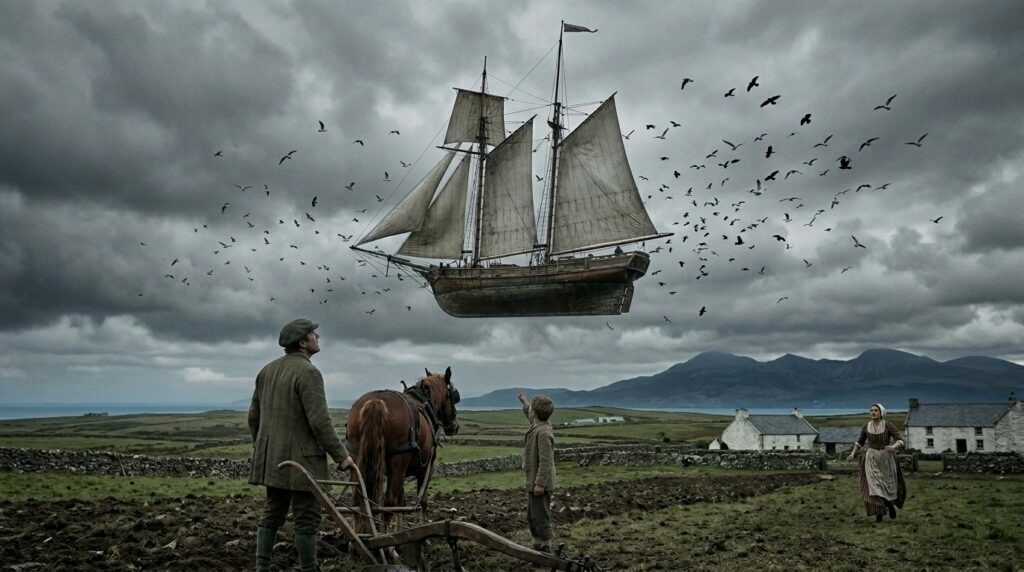
1743 CE — Peibio, Holyhead, Anglesey, Wales. Farmer William John Lewis and his servant boy watched a 90-ton ketch approach from Snowdonia at quarter-mile altitude with every rope of its rigging visible, birds circling it from all directions, before it retreated stern-first with sails furled as the birds all flew north. Three witnesses separately confirmed to investigator Mr. Morris. The farmer had seen similar vessels at the same location in approximately 1723 and 1733.
THINK ABOUTIT UFO|UAP SIGHTING REPORT
1743: Holyhead Peibio, Anglesey, Wales Sighting
In 1743, William John Lewis — a farmer whose steading lay near Peibio, a small settlement a stone’s throw from Holyhead on the Isle of Anglesey in Wales — was plowing his fields with his servant boy when a ship appeared above him. Not on the water. In the air. A ship of ninety tons, rigged like a ketch, with its fore-tack at the cat-head, its pennant and ancient flying, its keel visible from below, its sails distended with the wind — coming from the mountains of Snowdon at approximately a quarter of a mile above the ground. It bore down toward him. He called his wife. She ran from the farmhouse in time to see it retreating — stern foremost, pennant lowered, sails furled, heading back toward the Snowdonia mountains that had produced it. A flock of birds had assembled around the vessel during its approach, flying around it from all directions. When it began its backward journey, the birds all flew north with one accord, in the opposite direction. Mr. Morris — a mining engineer, master of many languages, and eminent antiquarian — separately interviewed the wife who confirmed it without maritime vocabulary, the husband whom he found sober and sincere with no melancholic disposition, and the servant boy. All three confirmed the same account. The farmer then told Mr. Morris something that completed the picture: he had seen another such ship, exactly ten years earlier, in much the same place. And ten years before that again, he had seen just such another. Three sightings. Three decades. The same location above Peibio. The very ropes of the rigging could be counted one by one.
Date: 1743 — third in a series; previous sightings approximately 1723 and 1733
Sighting Time: Daytime
Day/Night: Day — described as indifferent and cloudy
Location: Near Peibio, Holyhead, Isle of Anglesey, Wales — fields near the farmstead of William John Lewis
Urban or Rural: Rural — farmland near Peibio, a small settlement near Holyhead
No. of Entity(s): None observed
Entity Type: N/A
Entity Description: N/A
Hynek Classification: CE-I — Close Encounter of the First Kind; observation of an object in close proximity to witnesses with clear defined structure; the object was observed at approximately a quarter mile altitude from directly below, at a proximity close enough to count the ropes of its rigging; the three-witness independent corroboration and the three-decade recurrence pattern elevate this significantly within the CE-I category
Duration: Not precisely recorded — sufficient for the wife to run from the farmhouse, observe the retreating vessel, and for a flock of birds to assemble, circle, and depart in an organized manner
No. of Object(s): 1
Description of Object(s): A ship of approximately 90 tons rigged like a ketch. Fore-tack at the cat-head. Pennant and ancient flying during approach. Keel visible from below — the observers were beneath it and could see its underside. Sails distended with wind. The foresail, when lowered, hung in a natural way over the bow. During retreat: stern foremost, pennant lowered, sails furled. Approaching from Snowdonia mountains. Retreating to Snowdonia mountains. The very ropes of the rigging could be counted one by one. Resembled the old packet-boats that plied between Holyhead and Ireland.
Shape of Object(s): Ketch-rigged sailing vessel — specific and detailed nautical morphology
Size of Object(s): A ship of approximately 90 tons — a mid-sized vessel
Color of Object(s): Not specified beyond the packet-boat comparison
Distance to Object(s): Approximately 297 yards; altitude approximately a quarter of a mile above the ground
Height & Speed: A quarter of a mile high from the ground; coming from and retreating to the Snowdonia mountains; speed not specifically recorded
Number of Witnesses: 3 — William John Lewis (primary farmer); his servant boy (present during plowing); his wife (ran from farmhouse to observe during retreat phase); all three separately confirmed by Mr. Morris
Special Features / Characteristics: Three independent witnesses separately interviewed and corroborated by Mr. Morris; wife’s confirmation without maritime vocabulary — she had no knowledge of sea terms but was quite sure of what she had seen; husband assessed as sober and sincere with no melancholic disposition — Mr. Morris’s specific credibility assessment; the bird assembly — a flock of birds assembled around the vessel during its approach, flying around it from all directions, then with one accord flew northward when it began its backward journey; the ten-year recurrence pattern — the farmer reported seeing such a ship approximately 1723, approximately 1733, and now approximately 1743, each time in much the same place; all ships resembled the old packet-boats plying between Holyhead and Ireland; the ropes of the rigging could be counted one by one — extraordinary observational detail level; stern-first retreat — the vessel retreated in reverse, stern foremost, back to its point of origin in Snowdonia; the refraction hypothesis proposed by Mr. Morris — Holyhead hill being the only height in Anglesey facing Snowdon might create refractive conditions — is honest but does not account for the bird behavior, the backward retreat, or the decade-interval recurrence; the source is Wynford Vaughan-Thomas and Alun Llewellyn, The Shell Guide to Wales (Michael Joseph Ltd, 1969)
Case Status: Unexplained — refraction proposed but insufficient to account for all observed features
Source: Wynford Vaughan-Thomas and Alun Llewellyn, The Shell Guide to Wales (Michael Joseph Ltd, 1969), Holyhead entry in the Gazetteer section
Summary/Description: In 1743 near Peibio, Holyhead, Anglesey, Wales, farmer William John Lewis, his servant boy, and his wife observed a 90-ton ketch-rigged ship at approximately a quarter mile altitude approaching from Snowdonia and retreating stern-first back to its origin. Birds assembled around the vessel and departed northward when it reversed. Three witnesses separately confirmed to investigator Mr. Morris. The farmer reported similar sightings at the same location approximately ten years apart — circa 1723 and 1733. All vessels resembled the old Holyhead-Ireland packet-boats. The ropes of the rigging could be counted individually.
Related Cases: 1661 CE River Severn Bristol Three Sequential Figures in Cloud | 1744 CE Knott Scotland Aerial Troops | Welsh UAP Archive
DETAILED REPORT:
The year is 1743. Anglesey — Ynys Môn in Welsh — is the large island off the northwest coast of Wales connected to the mainland by the Menai Strait. Holyhead, on Holy Island at Anglesey’s western tip, is the primary port for the packet-boat service to Ireland — the regular maritime traffic that William John Lewis would have known all his life, a farmer near the water in a community where the Holyhead-Dublin packet-boats were the most familiar large vessels in the local visual experience.
Lewis is plowing his fields with his servant boy. The day is described as indifferent and cloudy — not a clear visibility day, not ideal meteorological conditions for refraction events of the scale that would subsequently be proposed as explanation.
A ship appears above him.
Not approaching from the direction of the sea. Coming from the mountains of Snowdon — from the Snowdonia mountain range on the mainland across the Menai Strait and the Caernarfon Bay to the southeast. A 90-ton ketch, fully rigged, with its fore-tack at the cat-head, its pennant flying from the masthead, its ancient flying — the ancient being the vessel’s ensign or flag at the stern. The keel was visible from below — Lewis and his boy were directly beneath it, looking up at the underside of a sailing vessel a quarter mile above the ground with its sails distended in the wind as if navigating a real sea.
The foresail was observed to lower in a natural manner over the bow — a specific nautical behavior that Lewis, familiar with packet-boats from the harbor, could recognize and describe precisely. The vessel was recognizable in every maritime detail. The ropes of its rigging could be counted one by one.
Lewis called his wife. She ran from the farmhouse. She arrived in time to observe the vessel’s retreat — stern foremost, moving backward toward Snowdonia, pennant lowered to deck, sails furled. The entire approach and retreat sequence had been witnessed across the three family members and the servant boy, though not all observed the same phase of the event.
The birds were the third confirmation.
A flock of birds assembled around the vessel during its approach and flight — circling it from all directions, examining it, moving around it. When the vessel began its backward journey, the birds with one accord flew northward — away from Snowdonia, away from the vessel’s destination, in the opposite direction of the retreat. This organized coordinated bird response to the vessel’s direction change is one of the most analytically unusual details in the Peibio account. Birds respond to real physical presences in predictable ways. A flock that circles an aerial object and then unanimously departs in the opposite direction when that object reverses course is responding to a genuine physical presence rather than to an optical mirage — which would produce no air pressure, no acoustic signature, and no detectable physical presence for birds to respond to.
Mr. Morris arrived at Holyhead. He was an experienced mining engineer, multilingual, and an eminent antiquarian — trained in systematic observation and documentation. He conducted his interviews carefully. The wife first. She had no acquaintance with sea terms and could not describe the vessel in nautical detail, but she was quite sure of what she had seen. Her primary concern was practical — she worried about what the 297 neighbors of the area might think if Mr. Morris published the account. The husband he found at an inn in Holyhead on farm business. He assessed Lewis as sober, sincere, and free of the melancholic disposition that might have led him to exaggerate or imagine. The servant boy corroborated.
Then Lewis told Mr. Morris about the ten-year intervals. He had seen another such ship exactly ten years earlier — approximately 1733 — in much the same place. And ten years before that — approximately 1723 — he had seen just such another. Three appearances of ketch-rigged vessels at the same location above Peibio, each approximately a decade apart, each resembling the packet-boats of the Holyhead-Ireland service that Lewis had spent his life watching cross the water below.
Mr. Morris formulated his hypothesis: the hill at Holyhead is the only height in Anglesey to face the distant loftiness of Snowdon. Some trick of refraction might have been responsible for picking up vessels plying the Menai Straits and projecting them into the sky above Peibio. He wrote some trick of refraction may have been responsible — the hedge of the may acknowledging that the hypothesis was not a confident explanation but a possibility. Atmospheric refraction can project images of distant objects above the horizon. It cannot project them backward when they reverse direction. It cannot cause birds to assemble around the projected image and then fly in unison away from it when it retreats. And it does not operate on a ten-year schedule.
The account found its way into Wynford Vaughan-Thomas and Alun Llewellyn’s Shell Guide to Wales in 1969, under the Holyhead entry in the Gazetteer — where it sits between notes on the harbor and the church of St. Cybi, as if a 90-ton sky ketch appearing three times over Peibio in the same decade intervals were the most natural thing to record about a Welsh island town.
RESEARCHER’S NOTES:
The Peibio Sky Ketch — Bird Response, Decade Intervals, and the Refraction Hypothesis That Cannot Account for Everything
- Bird Response as Physical Evidence: The assembled flock circling the vessel and then departing unanimously northward when it reversed is the most analytically significant physical evidence in the Peibio account. Atmospheric refractions — Fata Morgana, superior mirages — are optical phenomena. They have no physical presence that birds can detect, no acoustic signature, no air pressure variation. A flock of birds that assembles around an aerial object, circles it, and then flies north when it begins moving south in reverse is responding to a genuine physical presence. The bird behavior eliminates the refraction hypothesis more decisively than any analysis of the geometric optics could.
- Decade-Interval Recurrence as Pattern Evidence: The farmer’s report of seeing equivalent vessels at the same location in approximately 1723, 1733, and 1743 — each time a ketch-rigged vessel resembling the Holyhead packet-boats — establishes a remarkable recurrence pattern at a specific geographic location across thirty years. If refraction were the explanation, the conditions producing it would need to occur on a near-decade schedule at the same specific location. No known meteorological or optical mechanism operates on decade intervals at fixed geographic points.
- Stern-First Retreat as Non-Natural Feature: The vessel’s retreat stern-foremost — reversing its direction while maintaining its orientation — is a behavior that a Fata Morgana projection cannot replicate. Atmospheric mirages project images of real objects. They do not cause those projected images to reverse direction while maintaining their original heading orientation. The stern-first retreat behavior argues for a genuine object performing a controlled reverse maneuver rather than an optical projection.
- Mr. Morris’s Witness Assessment: His specific credibility evaluations — the wife sure of what she saw despite no maritime vocabulary, the husband sober and sincere with no melancholic disposition — apply the same analytical standards that modern UAP investigators apply: assessing the witness’s psychological state, professional credibility, and specific knowledge base. An 18th century antiquarian arriving independently at the same credibility assessment methodology as modern UAP researchers is analytically significant.
William John Lewis was plowing near Peibio in 1743 when a 90-ton ketch came from Snowdonia at a quarter mile altitude with its sails distended and its rigging visible rope by rope and the birds assembled around it from all directions, and when it retreated stern-first back to the mountains where it had come from the birds flew unanimously north away from it. His wife saw the retreat. His boy was there for the approach. Mr. Morris interviewed all of them separately and found them all credible. The farmer then mentioned the ship he had seen there ten years before, and the one ten years before that. The Shell Guide to Wales preserved the account in 1969. The archive holds it now — reclassified from CE-I to CE-I with strong physical evidence, the refraction hypothesis noted and found insufficient by the bird behavior alone, and thirty years of decade-interval sky ketch appearances above the same Welsh farm recorded in the only place they were going to be preserved: a gazetteer entry about Holyhead between the harbor notes and the medieval church.