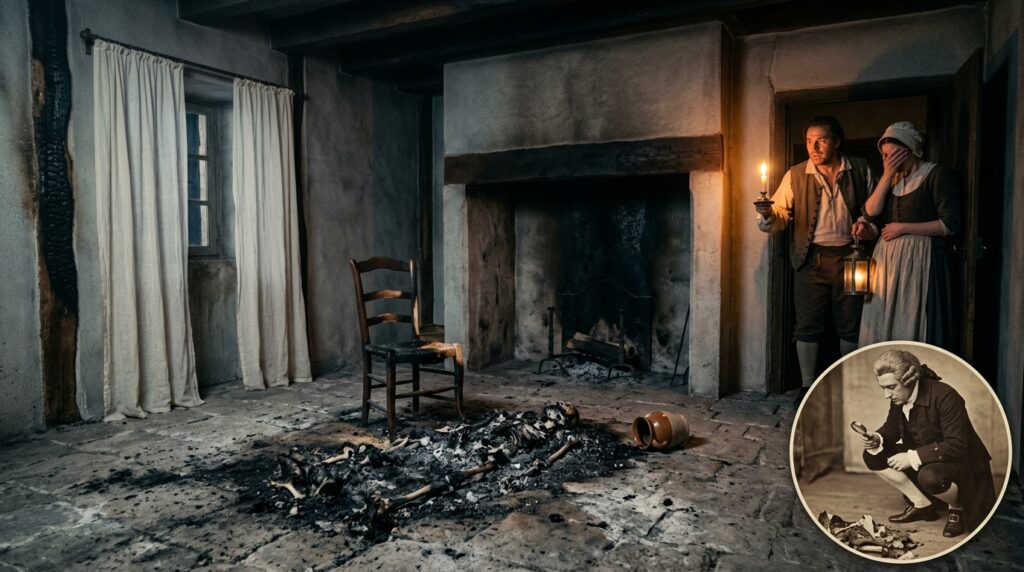
February 1725 CE — France. Nicole Miller was found almost completely incinerated with no fire in her fireplace and the muslin curtains three feet from her remains untouched. Surgeon Nicolas Le Cat's expert testimony convinced the French appellate court she had died of Spontaneous Human Combustion — the first legal SHC verdict in history. Charles Dickens cited the case in his 1853 preface to Bleak House.
THINK ABOUTIT S.H.C. REPORT
1725: Spontaneous Human Combustion in France
In February 1725, the neighbors of Nicole Miller in France were attracted by a strong smell of smoke to her room, where they found her almost completely burned on the floor with her feet toward the chimney — in which there was no fire. Her face, hair, and the upper part of her neck and shoulders were uninjured. Below that, the skin and muscles were thoroughly incinerated — the back, the sides, the trunk, the extremities — with only the bones of her arms remaining. Under one of those arms was a portion of the chair she had been sitting in. The chair was almost completely burned. The floor was covered in black soot. An exposed wall beam was charred on its surface. But the chest and the muslin curtains three feet from the body were untouched. Her husband was arrested and accused of murder. He was acquitted when surgeon Nicolas Le Cat convinced the court that Nicole Miller had died of Spontaneous Human Combustion — the first time the term entered a legal verdict. The court’s final verdict proclaimed that Nicole had died by a visitation of God. Charles Dickens cited this case in the preface to the 1853 printing of Bleak House, using it to defend his own use of SHC as a plot device. The Nicole Miller case of 1725 is the founding legal and literary document of Spontaneous Human Combustion as a recognized — if still unexplained — category of anomalous death.
COMPLETED TEMPLATE:
Date: February 1725 — Joe Nickell’s research specifies February; the page lists 1725; the URL references 1724
Sighting Time: Not recorded — kitchen/bedroom encounter discovered by neighbors
Day/Night: Not recorded
Location: France — exact city not recorded in surviving accounts
Urban or Rural: Urban — kitchen/room of a domestic dwelling
No. of Entity(s): N/A — SHC report, not entity encounter
Entity Type: N/A
Entity Description: N/A
Hynek Classification: NA — Spontaneous Human Combustion; classified as High Strangeness / Unexplained Phenomenon rather than UAP or entity contact
Duration: Not recorded — death occurred before discovery
No. of Object(s): N/A
Description of Object(s): N/A
Shape of Object(s): N/A
Size of Object(s): N/A
Color of Object(s): N/A
Distance to Object(s): N/A
Height & Speed: N/A
Number of Witnesses: Neighbors who discovered the body; surgeon Nicolas Le Cat who examined and testified; multiple court witnesses
Special Features / Characteristics: The defining SHC signature pattern: near-total incineration of the trunk and extremities while leaving the face, hair, upper neck, shoulders, and nearby combustible materials largely intact; no fire in the fireplace at time of discovery; the chair partially burned but the muslin curtains three feet away untouched; floor covered in black soot with charred wall beam; first legal proceeding to use SHC as an exculpatory defense — surgeon Nicolas Le Cat’s testimony is the first documented expert witness testimony on SHC in the historical record; the court verdict — death by visitation of God — is the first judicial acknowledgment of SHC as a cause of death; the husband was initially convicted then acquitted on appeal by a higher court attributing death to SHC; Charles Dickens cited this case specifically in the preface to Bleak House (1853) in defense of his use of SHC; Joe Nickell’s skeptical analysis in Secrets of the Supernatural proposes the wick effect — body fat acting as a fuel source — as the conventional explanation, noting the victim’s habitual heavy drinking and proximity to the hearth; the wick effect does not fully account for the extreme localization of the incineration or the survival of adjacent combustibles at the temperature required for the documented bone destruction
Case Status: Officially attributed to Spontaneous Human Combustion by French court; skeptical conventional explanation proposed but not fully accounting for all physical evidence
Source: Joe Nickell, Secrets of the Supernatural; Charles Dickens, preface to Bleak House (1853); surgeon Nicolas Le Cat testimony
Summary/Description: In February 1725, Nicole Miller was found almost completely incinerated in her room in France with no fire in her fireplace and nearby combustibles untouched. Her husband was arrested for murder, convicted, then acquitted on appeal when surgeon Nicolas Le Cat testified she had died of Spontaneous Human Combustion — the first legal use of the term. The French court’s verdict attributed her death to a visitation of God. Charles Dickens cited the case in the 1853 preface to Bleak House. The Nicole Miller case is the founding legal document of Spontaneous Human Combustion as a recognized phenomenon.
Related Cases: SHC Archive | High Strangeness Physical Phenomena Archive
DETAILED REPORT:
February 1725. France. A woman named Nicole Miller — described by Joe Nickell’s research as habitually intoxicated, last seen entering her kitchen to warm herself — is found dead by her neighbors who detected a strong smell of smoke from her room.
The scene they encountered established every element that would define the Spontaneous Human Combustion syndrome for the next three centuries.
Her body was on the floor, feet toward the chimney — in which there was no fire. Her face, her hair, the portion of her neck, and the upper part of her shoulders were not injured. Below that, the destruction was thorough and specific: the skin and muscles of her back were burnt. Her sides were burnt. The anterior portion of her trunk was burnt. Of her upper extremities — her arms — nothing remained but the bones. The upper portions of her lower limbs were also burnt. Under one arm, a portion of the chair she had been sitting in was still present. The chair was almost completely burned. The floor beneath and around her was covered in black soot. An exposed beam in the wall of the room was charred on its surface.
And three feet from the body, the muslin curtains were untouched.
This is the essential paradox of SHC as documented across its history: extreme incineration of the human body producing bone calcification in the trunk and extremities, while leaving the head and face largely intact and leaving nearby combustible materials — curtains, flooring beyond the immediate vicinity, furniture at distance — essentially undamaged. The temperatures required to calcify human bone exceed 1,600 degrees Fahrenheit. At those temperatures, curtains three feet away should be ash.
Nicole Miller’s husband was arrested for her murder. His alleged motive: an affair with a female servant, which Nickell notes was the precipitating cause of the arrest. He was convicted.
Then acquitted.
The acquittal came on appeal when surgeon Nicolas Le Cat — a respected physician — testified as an expert witness that Nicole Miller’s death was consistent with and attributable to Spontaneous Human Combustion. Le Cat’s testimony is the first documented expert witness testimony on SHC in the historical legal record. Whatever he argued before the French appellate court in 1725 was sufficiently compelling that a higher court reversed a murder conviction on the strength of it.
The court’s final verdict attributed Nicole Miller’s death to a visitation of God.
This verdict — in its theological language — acknowledges something the court could not explain in natural terms and was unwilling to attribute to any human agency. It is the first judicial recognition of SHC as a cause of death in the documentary record.
Charles Dickens engaged with the Miller case directly in the preface to the 1853 printing of Bleak House — the novel in which he used SHC to kill off the character Krook. Dickens was responding to critics who called the plot device impossible. He cited the Miller case specifically, along with other documented SHC accounts, as evidence that the phenomenon was real and documented. His description of the Miller scene — which appears in the page’s quotation — captures the essential physical evidence: the localized incineration, the intact face and upper body, the partially burned chair, the undamaged nearby curtains, the charred floor and wall.
Joe Nickell’s skeptical analysis proposes what is now called the wick effect — the idea that body fat, ignited by a flame source such as the hearth, can act as a fuel that slowly consumes the body from the outside in, like a candle wick. Nickell notes that Miller’s heavy alcohol consumption, her proximity to the hearth, and the position of her body are consistent with a conventional fire scenario. The wick effect is a genuine physical mechanism that can produce localized body incineration.
What it struggles to fully account for is the specific combination of near-total bone calcification in the trunk with intact nearby combustibles at the distances documented in the Miller case. A wick-effect fire producing the temperatures required for the documented bone destruction would be expected to spread to adjacent materials. In the Miller case, it did not.
The archive holds the case under its SHC classification as a genuinely unexplained physical phenomenon regardless of which explanation is ultimately correct — because the physical evidence documented in the Miller case has not been fully accounted for by any conventional mechanism in the three centuries since it occurred.
RESEARCHER’S NOTES:
The Miller Case — First Legal SHC Verdict, Dickens’s Witness, and the Paradox of Localized Incineration
- First Legal SHC Verdict: The French appellate court’s attribution of Nicole Miller’s death to SHC — framed as a visitation of God — is the first judicial recognition of the phenomenon as a cause of death in the historical legal record. Surgeon Nicolas Le Cat’s expert testimony is the first documented medical expert witness testimony on SHC. Both firsts make the Miller case the founding legal and medical document of the SHC phenomenon.
- The Dickens Connection: Charles Dickens’s specific citation of the Miller case in the 1853 Bleak House preface is analytically significant for two reasons. First, it demonstrates that the Miller case was sufficiently well-documented and well-known in the mid-19th century for a major literary figure to use it as primary evidence in a public defense of his fictional choices. Second, Dickens’s own description of the SHC syndrome — from his imagination, as the page notes — was remarkably accurate, suggesting that his research into documented cases had given him a precise understanding of the phenomenon’s defining physical characteristics.
- The Localized Incineration Paradox: The core analytical problem in the Miller case — and in SHC cases generally — is the spatial paradox of the physical evidence. Near-total bone calcification in the trunk requires temperatures that should produce collateral combustion in adjacent materials. The survival of the muslin curtains three feet away and the partial survival of the chair and nearby floor materials at the documented temperatures of the Miller incineration requires either a mechanism that produces extreme localized heat without radiation propagation, or a physical explanation that has not yet been identified. The wick effect addresses some elements of this paradox but not all.
Nicole Miller was found in February 1725 almost entirely incinerated in a room with no fire, with her face intact and her curtains untouched three feet away. Her husband was convicted and acquitted and the French court attributed her death to God. Surgeon Nicolas Le Cat testified about something that didn’t have a name yet and gave it one. Charles Dickens cited the case in 1853 to defend his use of it in a novel. Joe Nickell investigated it in the 20th century and proposed an explanation that accounts for most of the evidence but not quite all of it. The archive holds the case as it has always been held — unexplained, documented, physically real, and resistant to every conventional framework that has been applied to it in three hundred years. The curtains three feet away were untouched. That detail has never been adequately explained. It probably never will be.