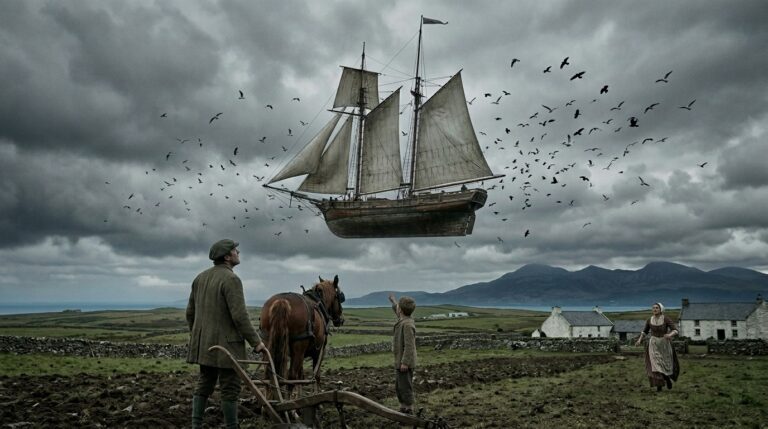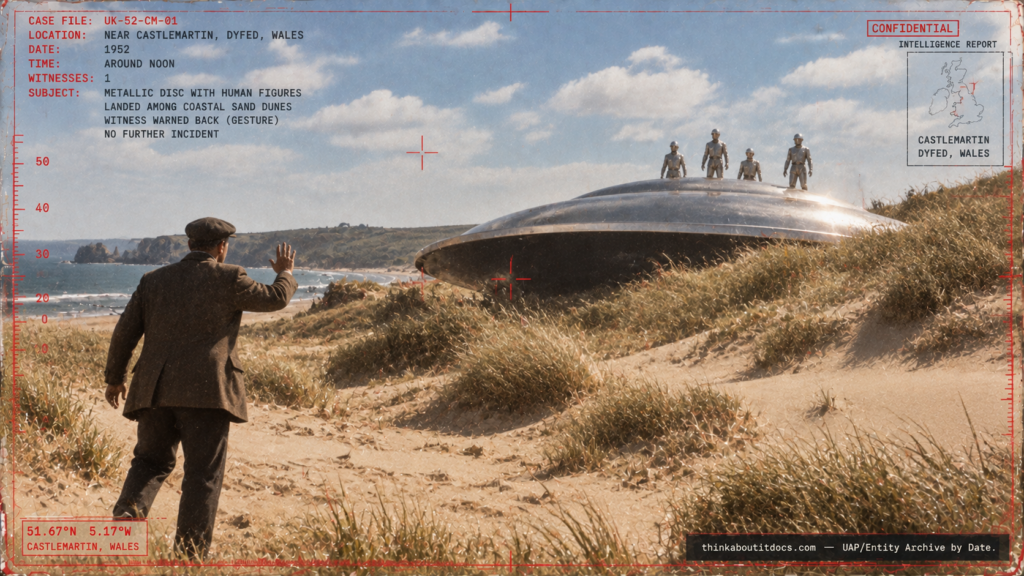
Near Castlemartin, Dyfed, Wales, 1952 — Nellie Thomas's encounter among the dunes.
THINK ABOUTIT UFO|UAP & ENTITY ENCOUNTER REPORT
1952: Dyfed, Wales — Nellie Thomas and the Sand Dune Disc
Walking off his lunch among the sand dunes near Castlemartin, Wales, Nellie Thomas noticed a shiny metal shape half-buried in the sand — and moving closer to investigate, found several men standing atop a disc-shaped craft, one of whom warned him back before he could get hurt by the very rays the craft was using to recharge itself in the sun.
What followed was a message rather than a threat: the men, human in every visible respect, told Thomas they had been visiting Earth for hundreds of years and were troubled by humanity’s self-destructive course — a warning delivered in the classic “Space Brothers” register that defined much of the era’s friendlier contactee literature, and preserved here through Janet and Colin Bord’s well-regarded survey of British folklore and anomalous phenomena.
Date: 1952 (exact date not recorded)
Sighting Time: Around noon
Day/Night: Day
Location: Near Castlemartin, Dyfed (Pembrokeshire), Wales
Urban or Rural: Rural
No. of Entity(‘s): Several (exact number not recorded)
Entity Type: Humanoid, claimed extraterrestrial origin
Entity Description: Described as looking very similar to humans; no further physical detail recorded
Hynek Classification: CE-III (Close Encounter of the Third Kind) — close observation with animate beings associated with the object
Duration: Not recorded
No. of Object(s): 1
Size of Object(s): Not recorded
Distance to Object(s): Close enough for the witness to be personally warned back by the craft’s occupants; exact distance not recorded
Shape of Object(s): Disc-shaped
Color of Object(s): Shiny metallic
Number of Witnesses: 1 (Nellie Thomas)
Special Features/Characteristics: The craft was partially concealed among sand dunes and appeared to be recharging itself using the sun’s rays. The apparent leader warned Thomas not to approach closer without protective clothing, citing strong rays the craft was emitting. The occupants stated they had been visiting Earth for hundreds of years and expressed concern that humanity was on a self-destructive path. They told Thomas the name of their home planet, which he could not later recall.
Case Status: Insufficient Data — a single witness account preserved through a secondary folklore/anomalous-phenomena compilation, with no independent corroboration, physical evidence, or second witness on record; the account also follows a widely recognized “Space Brothers” contactee narrative template common to the era
Source: Janet & Colin Bord, “Modern Mysteries of Britain”
Summary/Description: Sometime in 1952, around noon, Nellie Thomas was taking an after-lunch stroll among the sand dunes near Castlemartin, Dyfed, Wales, when he came across a shiny metallic object partially concealed among the dunes. Approaching to investigate, he found several men standing atop the now-visible disc-shaped craft. One, apparently the leader, warned Thomas not to come any closer, explaining that the craft was recharging itself using the sun’s rays and that he risked injury from those rays without protective clothing. The men, who looked very human, told Thomas they had been visiting Earth for hundreds of years and were concerned that humanity was on a self-destructive path. They gave him the name of their home planet, but he was unable to recall it afterward.
Related Cases: Not Applicable
Detailed Report
The Dyfed case reaches this archive through Janet and Colin Bord’s “Modern Mysteries of Britain,” a respected survey of British folklore and anomalous phenomena rather than a dedicated UFO investigation, which places the account’s documentary chain closer to a compiled secondary source than a field-investigated case file. No date more precise than “1952” survives, and the witness — identified only as Nellie Thomas — is not otherwise described.
The encounter’s content sits squarely within what ufology literature commonly calls the “Space Brothers” or “contactee” template: human-looking visitors, a benevolent rather than threatening posture, a warning delivered for the witness’s own safety, and a message expressing concern about humanity’s trajectory. This pattern recurs across numerous 1950s contact narratives, and recognizing it doesn’t resolve whether this particular account is accurate — but it does mean the case shares its basic shape with many contemporaneous reports rather than standing as a unique anomaly.
The detail of the craft “recharging” using solar rays, and the specific warning about injury from those rays absent protective clothing, is a more mechanically specific claim than many contactee messages of the period, which tend toward purely verbal warnings without an accompanying physical hazard. No name for the visitors’ home planet was retained by the witness, closing off what would otherwise have been a distinctly checkable detail.
RESEARCHER’S NOTES
Dyfed, Wales — 1952 and the “Space Brothers” Template
- A recognizable contactee pattern: Human-looking visitors, a benevolent warning, and concern for Earth’s future are recurring elements of the era’s friendlier contact narratives — this archive notes the pattern as context, not as a verdict on the account’s truth.
- A specific, if ultimately unverifiable, physical hazard claim: The solar-recharging rays and injury warning are more mechanically detailed than a purely verbal message, though nothing about the claim can be independently tested.
- A forgotten, and therefore unverifiable, key detail: The name of the visitors’ home planet — potentially the single most checkable fact in the entire account — was not retained by the witness, closing off that avenue entirely.
- Secondary compilation source, not a field investigation: The Bords’ book is a respected general survey of British anomalous phenomena, but it is not the same as a dedicated UFO investigator’s case file with named research contacts.
What’s left of that after-lunch walk near Castlemartin is one man’s account of a warning he took seriously enough to remember for years — and a planet’s name he never could.
“They also told the witness that they were concerned that the earth was on a self-destructive path.”
— Nellie Thomas’s account, as recorded by Janet & Colin Bord