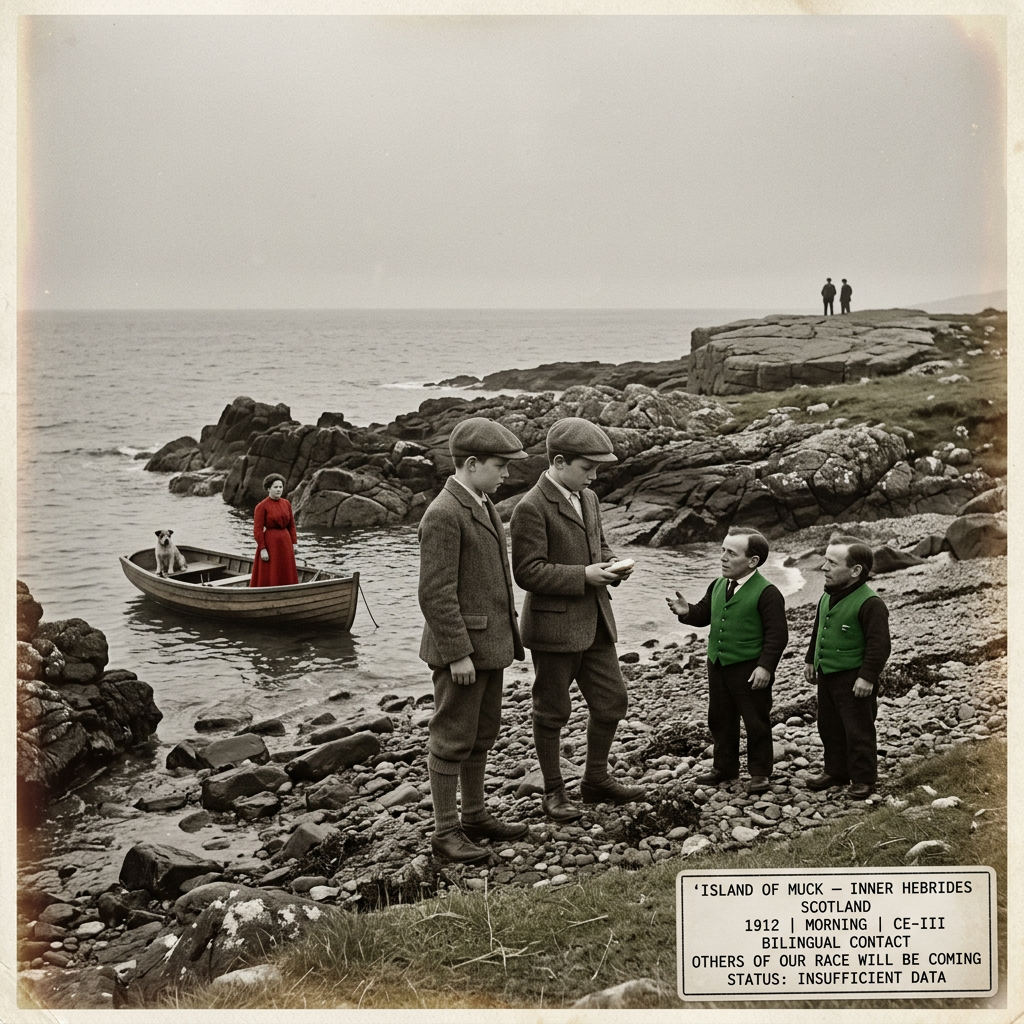
Island of Muck, Inner Hebrides, Scotland, 1912 — two boys looking for driftwood encountered two small men in green vests who spoke English and Gaelic, offered them bread from a tiny boat carrying a woman in red and a tiny dog, and told them before leaving: others of our race will be coming. The boys were found afterward sitting on the rocks staring at the sea. Source: Janet & Colin Bord, Modern Mysteries of Britain. Case status: Insufficient Data.
THINK ABOUTIT UFO | UAP | ENTITY | ENCOUNTER REPORT
1912: ISLAND OF MUCK, SCOTLAND — OTHERS OF OUR RACE WILL BE COMING
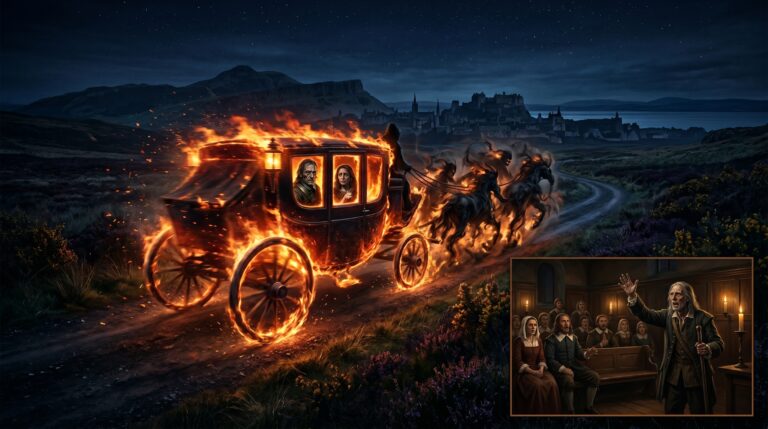
On a morning in 1912 on the Island of Muck — one of the smallest and most isolated of the Scottish Inner Hebrides, population a few dozen — two young boys were looking for driftwood along the beach when two small men in green vests appeared out of nowhere and asked them what they were doing. The men spoke both English and Gaelic. Beside a rocky cove the boys saw a tiny boat with a tiny woman in red standing in it and a tiny dog. The woman invited them aboard. The boys refused. She gave them small pieces of bread, which they ate. Before leaving, the little men told the boys: others of our race will be coming. The two boys were found sitting on the rocks staring at the sea in a state of shock. Janet and Colin Bord documented it from Scottish oral tradition. The archive holds it here — not as folklore, but as the pre-war archive’s most extraordinary direct statement of identity and intent by a non-human intelligence.
Date: 1912 — exact date not recorded
Sighting Time: Morning
Day/Night: Day
Location: Island of Muck, Highland Region, Scotland — beach and rocky cove
Urban or Rural: Rural — remote Scottish island beach, Inner Hebrides
No. of Entity(‘s): 4 — two small men on the beach; one small woman in a tiny boat; one tiny dog in the boat
Entity Type: Small humanoid — described as little people; spoke English and Gaelic; offered food; announced future contact by their race
Entity Description: Two small men — size not precisely recorded but consistently described as small relative to the child witnesses; wearing green vests; appeared suddenly out of nowhere on the beach; spoke to the boys in both English and Gaelic, demonstrating bilingual capability in the local language pair; manner described as social and interactive rather than threatening. One small woman — standing in the tiny boat alongside the cove; wearing red clothing; invited the boys aboard the boat; gave them small pieces of bread when they refused to board. One tiny dog — in the boat with the woman; no further description. Before departing, one or both of the men delivered a specific statement to the boys: others of our race will be coming.
Hynek Classification: CE-III (Close Encounter III) — close observation of and direct verbal interaction with animate non-human beings; physical gift of food accepted by witnesses; specific statement of identity and future intent delivered; no associated craft beyond the tiny boat
Duration: Extended — long enough for conversation in two languages, refusal of boarding invitation, acceptance of food, and delivery of the parting statement; exact duration not recorded
No. of Object(s): 1 — a tiny boat alongside the rocky cove; not a conventional watercraft — described as tiny in the same proportion as its occupants
Description of the Object(s): Tiny boat — proportionally sized to its occupants; alongside the rocky cove; the woman in red stood in it; the tiny dog was also in it; no propulsion, rigging, or structural description beyond its tiny proportions
Shape of Object(s): Boat
Size of Object(s): Tiny — proportional to the small entities
Color of Object(s): Not recorded
Distance to Object(s): The two men were on the beach directly interacting with the boys; the boat and its occupants were alongside the cove within clear view and conversation distance
Height & Speed: Ground and water level; departure method not recorded
Number of Witnesses: 2 — two young boys, unnamed; found by others sitting on the rocks staring at the sea in a state of shock after the encounter
Special Features/Characteristics: Bilingual communication — the entities spoke both English and Gaelic, the two languages in use on the island at the time; this demonstrates either prior knowledge of the local linguistic environment or real-time language capability; food offering and acceptance — the small woman gave the boys pieces of bread which they ate; physical food exchange between non-human entities and human witnesses is documented across the archive but remains analytically unusual; the parting statement — others of our race will be coming — is the most specific and extraordinary statement of identity and future intent in the pre-war archive; it implies a species-level identity, knowledge of future events or plans, and a deliberate communication of that knowledge to human witnesses; post-encounter shock state — the boys were found by others sitting on the rocks staring at the sea, unable or unwilling to move, in a state documented in the archive as post-CE-III shock response
Case Status: Insufficient Data — account transmitted through Scottish oral tradition via Janet and Colin Bord; no primary written record; no named witnesses; the bilingual detail, food exchange, and specific parting statement are internally consistent details that argue against casual fabrication
Source: Janet & Colin Bord, Modern Mysteries of Britain
Summary/Description: In 1912 on the beach of the Island of Muck, Inner Hebrides, Scotland, two young boys encountered two small men in green vests who spoke both English and Gaelic. Alongside the cove was a tiny boat containing a small woman in red and a tiny dog. The woman invited the boys aboard; they refused. She gave them bread which they ate. Before departing the men told the boys: others of our race will be coming. The boys were found sitting on the rocks in a state of shock. Documented by Janet and Colin Bord. Case status: Insufficient Data.
Related Cases: 1914: Alastaro, Finland — Grandmother’s Prior Knowledge | 1918: Fontainebleau, Quebec — Green Suited Entities | 1912 UFO|UAP Archive Page | Scottish Sightings Archive | Small Entity Cases Archive
Detailed Report
Others of Our Race Will Be Coming — Island of Muck, Inner Hebrides, Scotland, 1912 Source: Janet & Colin Bord, Modern Mysteries of Britain
The Island of Muck is the smallest of the Small Isles in the Inner Hebrides, lying between the Isle of Skye and the Scottish mainland. In 1912 its population was a few dozen — farmers, fishermen, and their families, living in one of the most geographically isolated communities in the British Isles. Two languages were in daily use on the island: English and Gaelic.
Two young boys were looking for driftwood along the beach one morning when two small men wearing green vests suddenly appeared. The men asked the boys what they were doing. They spoke in both English and Gaelic.
The boys saw, alongside a rocky cove, a tiny boat. Standing in the boat was a tiny woman wearing red. A tiny dog was also in the boat. The woman invited the boys to come aboard. The boys refused. She then gave them small pieces of bread, which they ate.
Before leaving, the little men told the boys that others of their race would be coming.
The two boys were subsequently found by others sitting on the rocks, staring at the sea, in a state of shock.
RESEARCHER’S NOTES
Others of Our Race Will Be Coming — Island of Muck 1912 and the Parting Statement as Archive Evidence
- The Parting Statement — Most Significant Entity Communication in the Pre-War Record: Others of our race will be coming is not a greeting, a warning, or a dismissal. It is a statement of species identity and future intent delivered deliberately as a parting communication to two human witnesses. The entity or entities who said it: identified themselves as belonging to a race distinct from humanity; acknowledged that they were not the only members of that race who would interact with humans; and chose to communicate this information to two children on a remote Scottish island beach in 1912. The archive holds no comparable statement in the pre-war record. The Alastaro Finland grandmother’s knowledge that the beings visit now and then is a human observer’s description of a recurring pattern. The Island of Muck statement is an entity’s direct announcement of planned ongoing contact. These are analytically different categories. The archive treats the Muck statement as the most operationally significant pre-war entity communication in any national record.
- Bilingual Fluency in English and Gaelic — Language as Operational Intelligence: The entities spoke both English and Gaelic — the exact language pair in use on the Island of Muck in 1912. This is not a generic language capability. It is precise local linguistic adaptation. An entity or species capable of operating in a specific regional dialect pair demonstrates either advance knowledge of the target population’s linguistic environment, real-time language processing capability, or a history of contact with the local population sufficient to acquire both languages. The Island of Muck in 1912 had a population of a few dozen. Its Gaelic was a specific regional variety. The entities’ fluency in both languages on a remote island that few outsiders visited implies a depth of familiarity with the local human community that is deeply inconsistent with a one-time random encounter.
- Food Exchange as Physical and Relational Marker: The small woman gave the boys pieces of bread which they ate. This physical exchange is not incidental. Across folklore traditions worldwide the acceptance of food from non-human beings carries specific significance — it marks a relationship, an obligation, a boundary crossed. Whether the entities understood this in cultural terms or not, the physical fact of the exchange is that two human children ate food offered by non-human entities on the Island of Muck in 1912. The food’s nature — bread, ordinary and familiar — rather than something alien or strange, suggests either that the entities had specifically prepared human-appropriate food, or that what was described as bread was the closest familiar category the children could apply to what they received. The archive holds both possibilities.
- Post-Encounter Shock as CE-III Physical Marker: The boys were found sitting on the rocks staring at the sea in a state of shock. Not frightened and running. Not telling adults what had happened. Sitting. Staring. Unable to process or respond normally. This specific post-encounter dissociative state — quiet shock rather than active distress — is documented across multiple CE-III cases in the archive and appears to be a physiological response to proximity with non-human intelligence rather than a reaction to fear. The children were not harmed. They were not threatened. The encounter had been conversational and the entities had given them food. The shock state therefore does not reflect traumatic fear — it reflects cognitive overwhelm, the physiological response to an experience that the human nervous system cannot immediately integrate.
Others of our race will be coming. Two boys on a Scottish island beach were told this in 1912 in their own languages by small men in green vests who had a boat and a woman in red and a dog and a piece of bread for each of them. The boys were found staring at the sea afterward, not moving, not speaking. What they had been told was not frightening. It was simply too large for a morning on a beach. The archive holds the statement here — not as comfort, and not as threat, but as the record of something that was said and has not yet been fully accounted for.