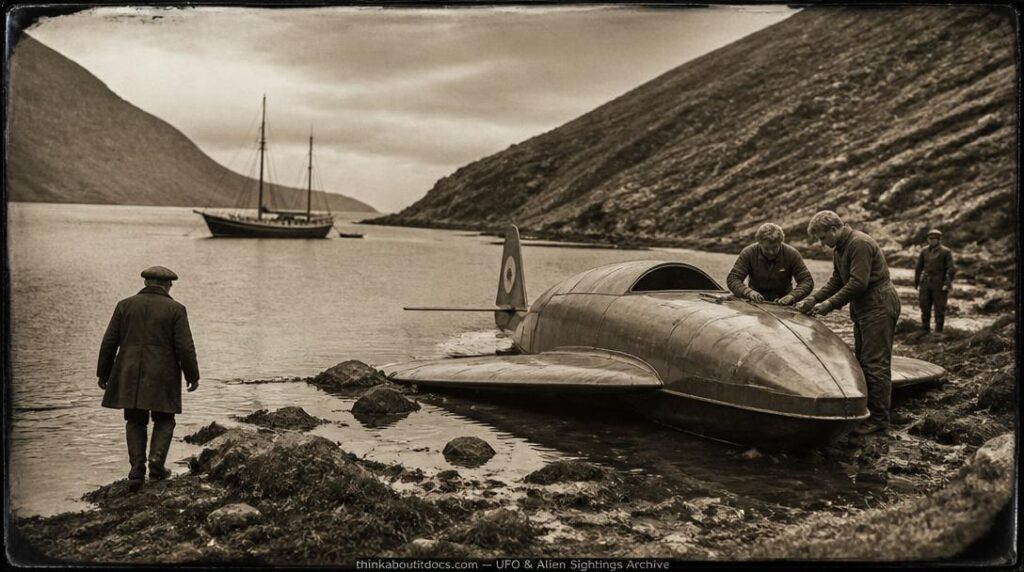
Late February 1913, Killary Harbor, Ireland — Mr. Collins found a ditched aeroplane-like craft with three occupants, two tall and blond, one of whom answered his German in French and firmly told him to leave.
THINK ABOUTIT UFO | UAP | ENTITY | ENCOUNTER REPORT
1913: KILLARY HARBOR, IRELAND — LEAVE THE AREA
In late February 1913, a man named Mr. Collins was aboard his yacht in Killary Harbor on the wild Atlantic coast of Connemara when a strange aeroplane-like object came in from the sea and ditched into the water near the shore. Collins approached. Three occupants were apparently working on the object at the shoreline. Two of them were tall, heavy-set, blond-haired, and light-complexioned. He assumed from their appearance they were German and addressed them in German. One of the men replied in French, claiming he could not understand German. Then — in no uncertain terms — he told Collins to leave the area. Collins quickly left and did not see the craft depart. This is not a lights-in-the-sky case. It is a craft in the water, crew working on it, a linguistic exchange, and a direct order to withdraw — five months before the world went to war, in an Atlantic harbor on the western edge of Europe where no aeroplane of 1913 had any business coming down.
Date: Late February 1913 — exact date not recorded
Sighting Time: Unknown — not recorded in available source
Day/Night: Unknown — not recorded in available source
Location: Killary Harbor, Connemara, County Galway, Ireland — shore of the harbor near where the craft ditched
Urban or Rural: Rural — remote Atlantic harbor, Connemara coastline
No. of Entity(‘s): 3 — three occupants observed working on the craft at the shoreline
Entity Type: Human in appearance — two described in detail as tall, heavy-set, blond-haired, and light-complexioned; third not individually described; communicated in French when addressed in German; dismissed witness with direct authority
Entity Description: Three occupants. Two described directly: tall, heavy-set build, blond hair, light complexion — consistent with northern European physical type. The third occupant is not individually described. All three were working on the craft at the shoreline when Collins approached — engaged in what appeared to be repair or maintenance activity. One of the two described men responded to Collins’s German with French — claiming not to understand German — and then told him in no uncertain terms to leave the area. The directness and authority of the dismissal, combined with the language switching and the refusal to explain their presence, is the most analytically significant behavioral element.
Hynek Classification: CE-III (Close Encounter III) — close observation of animate beings associated with a landed or water-ditched craft; direct verbal exchange between witness and occupants; witness ordered to leave the area
Duration: Brief — Collins approached, initiated contact, was dismissed, and left quickly; the craft had apparently ditched and the crew were working on it before his arrival; Collins did not observe the craft’s departure
No. of Object(s): 1
Description of the Object(s): A strange aeroplane-like object — not a conventional aircraft of the period, described as strange specifically to distinguish it from known aircraft; it approached from the sea and ditched into the water near the shore, suggesting either a controlled water landing, a forced landing from mechanical difficulty, or a deliberate water entry. The object was apparently at the shoreline rather than submerged when Collins approached and the crew were working on it. No further structural description recorded in available source.
Shape of Object(s): Aeroplane-like — elongated, implying a fuselage-style form; but specifically described as strange, distinguishing it from any 1913 aircraft type Collins recognized
Size of Object(s): Sufficient to carry three occupants and require maintenance or repair work by all three simultaneously
Color of Object(s): Insufficient Data — not recorded in available source
Distance to Object(s): Collins approached close enough to address the occupants verbally and receive a verbal reply; direct conversational proximity
Height & Speed: Came from the sea at flying altitude, then ditched into the water near shore; at shoreline level when Collins arrived
Number of Witnesses: 1 — Mr. Collins, aboard his yacht in Killary Harbor; no other witnesses recorded in available source
Special Features/Characteristics: Approach from the sea — the craft came from the sea suggesting a transoceanic or coastal flight origin inconsistent with any 1913 Irish or British aviation; ditch landing near shore — a forced or controlled water entry suggesting either mechanical difficulty or a deliberate protocol for concealed approach; all three occupants engaged in external maintenance — suggesting a repair requirement after the ditch or a standard post-landing technical procedure; language switching — the occupant’s response in French rather than German when addressed in German is analytically significant; it does not confirm the occupants were French, it confirms they chose French as their response language, possibly as a deflection or as the closest available human language they could use; the direct dismissal order — leave the area, in no uncertain terms — is an active security protocol, not a social rebuff; a genuine German flight crew of 1913 would not order a lone Irish yachtsman to leave the area of a crash landing; they would seek his assistance or at minimum explain their presence; the dismissal suggests the occupants had reason to prevent observation of the craft and their work on it; Collins complied and did not observe the departure — the craft left without his knowledge of how or when
Case Status: Insufficient Data — single named witness (surname only); secondary source via Nigel Watson; no primary document; the specific behavioral details — French language response to German, direct dismissal, all-crew external maintenance — are consistent with a genuine anomalous encounter and inconsistent with any known 1913 aviation scenario
Source: Nigel Watson
Summary/Description: In late February 1913, Mr. Collins aboard his yacht in Killary Harbor, Connemara, Ireland observed a strange aeroplane-like object approach from the sea and ditch into the water near shore. Three tall blond occupants were working on the craft. Collins addressed them in German assuming German origin. One responded in French claiming not to understand German and told Collins in no uncertain terms to leave the area. Collins left. He did not observe the craft’s departure. Documented by researcher Nigel Watson.
Related Cases: 1913: Beningbrough Yorkshire — River Barge Cigar With Visible Pilot | 1912: Island of Muck Scotland — Others of Our Race | 1913 UFO|UAP Archive Page | Ireland Sightings Archive | Craft Ditch and Water Entry Cases Archive
Detailed Report
Leave the Area — Killary Harbor, Connemara, Ireland, Late February 1913 Source: Nigel Watson
Killary Harbor is Ireland’s only true fjord — a long, narrow, deep Atlantic inlet cutting between the mountains of Connemara and County Mayo on the wild western coast. In late February 1913 it was one of the most remote stretches of water in the British Isles, rarely visited except by local fishing vessels and the occasional private yacht.
Mr. Collins was aboard his yacht in the harbor when he saw a strange aeroplane-like object approaching from the sea. It suddenly ditched into the water near the shore.
Collins approached. At the shoreline the craft was apparently accessible and three occupants were working on it. Two of them were tall and heavy-set, with blond hair and light complexions. Thinking they might be German — their physical appearance and the political climate of 1913 both suggested that possibility — Collins addressed them in German and asked if they needed help.
One of the men responded in French. He said he could not understand German. Then, in no uncertain terms, he told Collins to leave the area.
Collins quickly left. He did not see the craft depart.
RESEARCHER’S NOTES
Leave the Area — Killary Harbor 1913 and the Anomalous Craft Ditch in the Pre-War Atlantic Record
- The Ditch as Operational Signature: The craft approached from the sea and ditched into the water. In 1913 the word ditch specifically implies an unintended or forced water landing — it was not flying overhead and then landing normally, it came from the sea and went into the water near shore. Three possibilities exist: a forced landing due to mechanical difficulty requiring immediate repairs — consistent with all three crew being engaged in external maintenance work on arrival; a deliberate concealed approach using the water as cover and the shore as a work platform; or a craft that routinely operated in both air and water — a transmedium vehicle — and the ditch was a normal operational transition. The archive does not assert which of these is correct. It notes that all three are inconsistent with any known 1913 aircraft technology. No aeroplane of 1913 could approach from the Atlantic, ditch into a harbor, and be worked on by its crew at the shoreline.
- The Language Exchange — Deflection Rather Than Communication: The occupant’s choice to respond in French rather than German when addressed in German is the behavioral element that most argues against this being a human aviation crew. A German crew that had just crash-landed in an Irish harbor would not switch languages — they would respond in German or possibly in English, the local language, to seek help. Switching to French as a claimed language barrier and then immediately issuing a firm dismissal order is not a distressed crew seeking assistance. It is a crew managing an unwanted witness. The French response is a deflection: it establishes a communication barrier, prevents the witness from assuming shared language identity, and terminates the potentially helpful exchange. The dismissal follows immediately. The sequence — false language barrier, direct dismissal — is the behavior of people who want Collins gone and are prepared to use whatever deflection works.
- The Direct Dismissal Order and Its Implications: Leave the area, in no uncertain terms. This is not a request. It is not an explanation. It is a direct authoritative order delivered to a man on his own yacht in a public harbor by people who had no legal authority over him and no conventional right to issue such an order. Collins complied. That compliance is itself analytically significant — it suggests either that the manner of the dismissal carried a quality of authority that overrode Collins’s normal social confidence, or that something about the crew or the craft made Collins feel that compliance was the appropriate response. A lone yachtsman encountering distressed aviators asks questions and offers help. A lone yachtsman encountering something he cannot categorize and being told to leave by someone who makes him feel he should — that produces the described response: Collins quickly left.
- Killary Harbor Geographic Context — The Edge of Europe: Killary Harbor in 1913 sits at the western edge of the European continent — the last significant sheltered anchorage before the open Atlantic. Whatever came from the sea and ditched there in late February 1913 had crossed the Atlantic or approached from an oceanic direction. There were no commercial or military aviation facilities within operating range. The nearest British military aviation installations were hundreds of miles away and possessed nothing capable of a transoceanic crossing. The Irish aviation infrastructure in 1913 consisted of experimental enthusiasts. The Connemara coast in February was not a destination for any known 1913 aircraft. What came from the sea that day came from somewhere the record cannot account for.
Collins left Killary Harbor having been told to by someone who had arrived in something that should not have been there. He did not wait to see it leave. He did not file a report. He told someone eventually, and the account reached Nigel Watson, and the archive holds it here — at the western edge of Europe, in a deep Atlantic harbor, five months before the war began, where three tall blond men were working on a strange aeroplane that had come from the sea and did not want company.
“Thinking they were or German origin he asked if they needed any help in German. One of the men responded in French, claiming he could not understand, and then in no uncertain terms told the witness to leave the area.”
— Account of the late February 1913 Killary Harbor, Ireland encounter, as documented by researcher Nigel Watson









