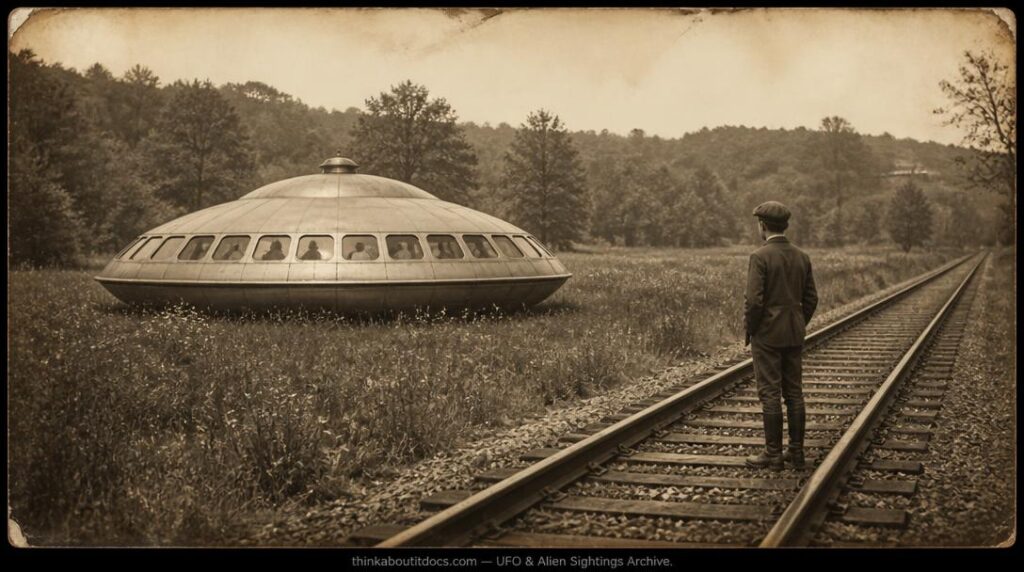
October 1917, near Youngstown, Pennsylvania — John Boback watched a car-sized saucer-shaped object with occupants visible through its domed windows before it departed slowly.
THINK ABOUTIT UFO|UAP & ENTITY ENCOUNTER REPORT
The 1917 Youngstown, Pennsylvania Saucer Sighting
John Boback’s Account
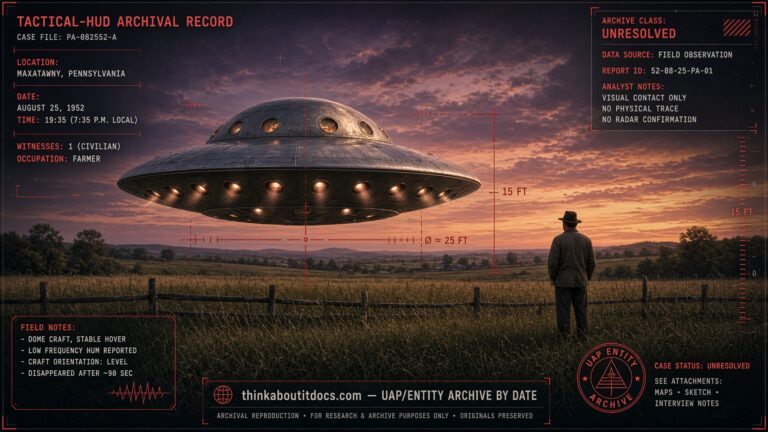
At half past noon in October 1917, seventeen-year-old John Boback was walking the railroad tracks between Youngstown and Mt. Braddock, Pennsylvania when he spotted something sitting in a field thirty yards off — a saucer-shaped object about the size of a car, with a platform, rows of lights, and a domed top with elongated windows. Figures moved behind the glass. He watched it for a minute or two before it lifted off with a high-pitched whine, climbing away slowly, like a plane rather than a rocket.
Date: October 1917
Sighting Time: 12:30 PM
Day/Night: Day
Location: Near Youngstown, Pennsylvania (between Youngstown and Mt. Braddock)
Urban or Rural: Rural (railroad right-of-way, open field)
No. of Entity(s): Undocumented count; figures visible through the craft’s windows
Entity Type: Craft occupants, visible but not described
Entity Description: Undocumented — figures were seen through the elongated windows, but no physical description survives
Hynek Classification: CE-II
Duration: Approximately 1 to 2 minutes
No. of Object(s): 1
Description of the Object(s): A saucer-shaped object with a platform and rows of lights, and a domed top fitted with elongated windows
Shape of Object(s): Saucer-shaped with a domed top
Size of Object(s): Approximately the size of an average car
Color of Object(s): Undocumented beyond the presence of rows of lights
Distance to Object(s): 30 yards
Height & Speed: Sitting on the ground at first sighting; on departure, rose gradually with a high-pitched sound, climbing “like a slow plane” rather than an abrupt or explosive ascent
Number of Witnesses: 1 (John Boback, age 17)
Special Features/Characteristics: High-pitched sound accompanied takeoff; occupants visible through elongated dome windows throughout the observation
Case Status: Insufficient Data
Source: Hartle, Orvil, A Carbon Experiment
Summary/Description: John Boback, 17, walking railroad tracks near Youngstown, Pennsylvania, saw a saucer-shaped object with a platform and rows of lights sitting in a field 30 yards away, with figures visible through its domed, windowed top. He watched it for one to two minutes before it departed with a high-pitched sound, climbing gradually.
Related Cases: Undocumented
DETAILED REPORT
The case is documented in Orvil Hartle’s book A Carbon Experiment, which compiled a range of early-20th-century American UFO reports. John Boback, seventeen years old at the time, was walking along the railroad right-of-way between Youngstown and Mt. Braddock, Pennsylvania, at half past noon in October 1917 when he noticed an object sitting in an adjacent field, roughly thirty yards from the tracks.
Boback’s description of the object is specific: saucer-shaped, with what he described as a platform and rows of lights along its structure, roughly the size of an average automobile. Its top formed a dome fitted with elongated windows, through which he could see figures moving — though the account does not preserve any further physical description of those figures, only that they were present and visible.
He watched the object for one to two minutes without approaching closer or attempting to interact with it. At the end of that period, it departed, producing a high-pitched sound as it lifted off. Notably, Boback’s account describes the ascent as gradual — “rising gradually like a slow plane” — rather than a sudden or explosive departure, a detail that distinguishes this case from several others in the archive’s pre-war record where witnesses describe near-instantaneous acceleration.
RESEARCHER’S NOTES
Youngstown — A Restrained, Specific Account With a Single Source
- The account is notably restrained for its category: a car-sized object, occupants visible but undescribed, a brief observation window, and a gradual rather than dramatic departure. Nothing about the account reaches for maximal strangeness — Boback doesn’t claim communication, doesn’t describe the occupants in detail he wasn’t in a position to see clearly, and gives a takeoff description (slow, plane-like) that is less sensational than many comparable cases.
- Sourcing rests on a single secondary compilation: Hartle’s A Carbon Experiment is the only source identified for this case in this pass. No contemporary 1917 newspaper account has been located, and the book’s own original interview date with Boback (if any) is not established from the material reviewed here.
- The “size of an average car” comparison is a useful, concrete anchor — unlike many pre-war reports that give estimates in vague or wildly varying terms, this comparison gives a reasonably specific sense of scale that a 1917 rural Pennsylvania witness would have had readily available as a reference point, given the automobile’s rapidly increasing presence in American life by that date.
- A single teenage witness with no named corroboration limits this case’s evidentiary weight regardless of how measured and specific the account itself reads.
The Youngstown case is a modest, specific, single-witness account — a landed saucer-shaped object, briefly observed, its occupants seen but not described, its departure notably unhurried. It doesn’t reach for spectacle, which in a field full of dramatic pre-war reports is itself worth noting, whatever it ultimately means about the account’s reliability.
“He watched the object for one or two minutes until it took off with a high-pitched sound, rising gradually like a slow plane.”
— Account of John Boback’s October 1917 sighting near Youngstown, Pennsylvania, as documented by Orvil Hartle, A Carbon Experiment