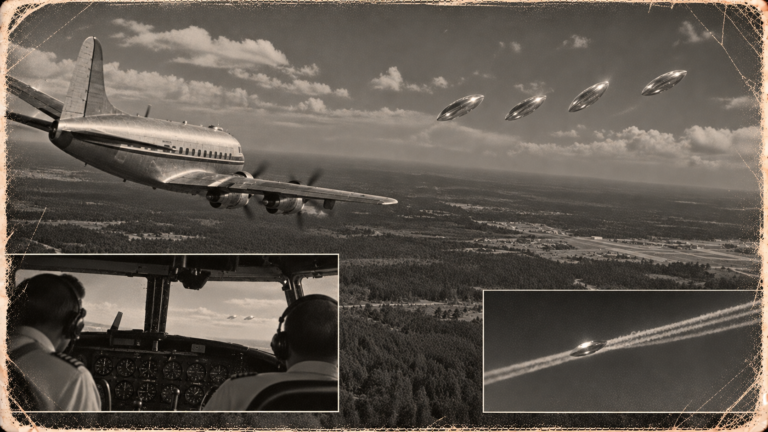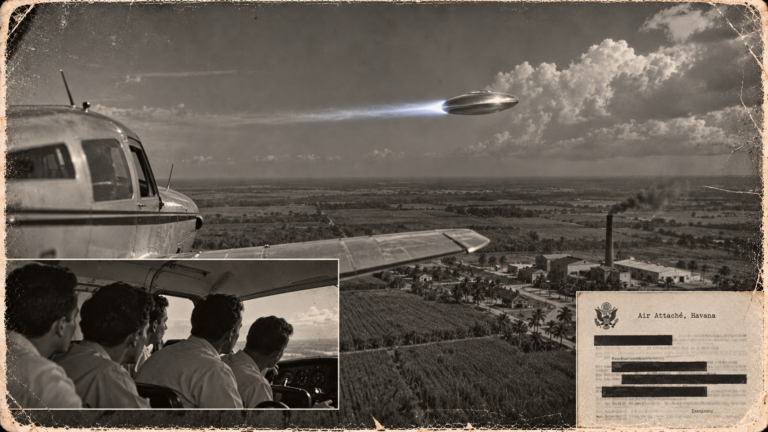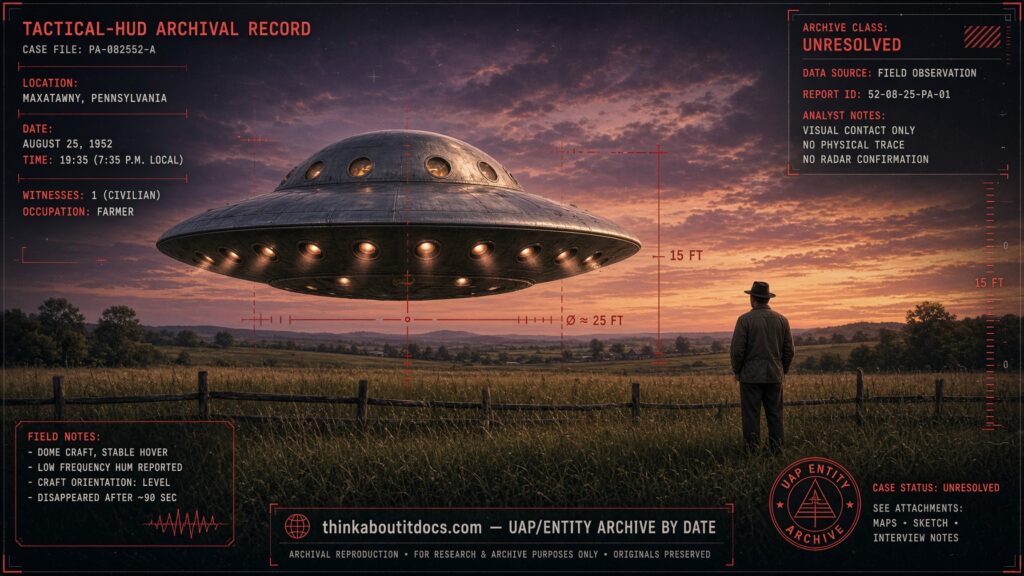
Near Maxatawny, Pennsylvania, August 25, 1952 — the craft Herbert Long says he encountered again over the following months.
THINK ABOUTIT
UFO|UAP & ENTITY ENCOUNTER REPORT
1952: Maxatawny, Pennsylvania — Herbert Long’s Jupiter Contact Case
On an August evening in 1952, Herbert Long watched a shiny, dome-shaped craft settle 15 feet above a field near Maxatawny, Pennsylvania — a ring of jet pipes circling its rim, light and motion flickering behind its portholes — before it climbed and shot away at tremendous speed. That alone would have been a routine entry in this archive’s record of the great 1952 flap. What follows it is not: over the next six to eight months, Long says he returned to the same field again and again, made four or five further contacts, and was eventually invited aboard by beings he described as “men like us but more advanced” — vegetarian, peaceful, and piloting what they called “observation discs” from Jupiter.
It’s a story that fits neatly into a genre that was just taking shape in 1952: the friendly “Space Brothers” contact narrative that would soon define the careers of figures like George Adamski. Long’s account, preserved through NICAP researcher Richard Hall, offers real physical specifics — a 25-foot diameter, a precise distance, a described departure — layered underneath a much larger and far less verifiable claim of an extended, personal relationship with visitors from within our own solar system.
Date: August 25, 1952 (initial sighting; Long reported additional contacts over the following six to eight months)
Sighting Time: 7:35 p.m.
Day/Night: Not explicitly recorded; 7:35 p.m. in late August would fall around dusk
Location: Near Maxatawny, Pennsylvania (Berks County)
Urban or Rural: Rural
No. of Entity(‘s): Multiple (exact number not recorded); occupants encountered only in later contacts, not the initial sighting
Entity Type: Humanoid, claimed by Long to be from Jupiter — a “Space Brothers”-style contactee narrative
Entity Description: Described only as “men like us but more advanced,” said to eat no meat and to be peacefully oriented toward humanity; no further physical description recorded
Hynek Classification: CE-III (Close Encounter of the Third Kind) — close observation with animate beings associated with the object
Duration: The initial sighting lasted about 7 minutes; Long reported 4 to 5 further contacts spread across the following 6 to 8 months
No. of Object(s): 1
Size of Object(s): 25 feet in diameter
Distance to Object(s): Approximately 30 feet, hovering 15 feet above the field
Shape of Object(s): Dome-shaped, surrounded by a ring of jet pipes, with portholes along its body
Color of Object(s): Shiny/metallic
Number of Witnesses: 1 (Herbert Long)
Special Features/Characteristics: Light and movement were visible through the craft’s portholes during the initial sighting. After hovering for about 7 minutes, the object rose 15 feet and departed at tremendous velocity. Long says he returned to the site repeatedly over the following 6 to 8 months, reporting 4 or 5 additional contacts, and was eventually invited aboard the craft. The occupants identified their vehicles as “observation discs” from Jupiter, described themselves as advanced but human-like, said they ate no meat, and expressed a desire for friendship with humanity.
Case Status: Insufficient Data — a single witness account that escalates over time from a physically described sighting into an extended, undocumented series of personal contacts and an eventual boarding claim; no second witness, physical evidence, or independent corroboration exists for any stage beyond the initial sighting
Source: Richard Hall (NICAP)
Summary/Description: On the evening of August 25, 1952, Herbert Long saw a 25-foot, shiny, dome-shaped object surrounded by a ring of jet pipes hovering 15 feet above a field near Maxatawny, Pennsylvania, about 30 feet from where he stood. Light and movement were visible through its portholes. After roughly 7 minutes, the object rose and departed at tremendous speed. Long says he subsequently returned to the site repeatedly over the following 6 to 8 months, reporting 4 or 5 further contacts and eventually being invited inside the craft, whose occupants he described as human-like but more advanced, non-meat-eating, and piloting “observation discs” from Jupiter with peaceful intentions toward humanity.
Related Cases: Not Applicable
Detailed Report
The Maxatawny case splits cleanly into two very different evidentiary layers, and it’s worth keeping them separate rather than treating the whole account as a single block. The first layer — the August 25, 1952 sighting itself — is a fairly conventional, physically detailed CE-III report: a specific size, a specific distance, a described hovering and departure pattern, and light and movement visible through portholes. This layer resembles many other single-witness 1952 disc reports in this archive.
The second layer is categorically different: Long’s claim of returning to the site repeatedly over six to eight months, accumulating four or five further contacts, and eventually being invited aboard the craft to meet its occupants. None of these subsequent contacts carry the same physical specificity as the original sighting — no dates, no times, no described locations beyond “the site,” and no second witness at any point across nearly a year of claimed encounters. This is the layer that places Maxatawny squarely within the “contactee” tradition that was just beginning to take shape in 1952 and would soon be exemplified by figures like George Adamski — friendly, human-looking “Space Brothers” from within the solar system, professing peaceful intentions and often some dietary or philosophical marker (here, not eating meat) that distinguishes them from ordinary humans.
The claimed planetary origin — Jupiter — is itself worth noting without further comment: Jupiter is a gas giant with no solid surface, a detail that later, more scientifically grounded ufology would treat as a significant strike against a literal reading of such claims, though this archive does not resolve that question here. What can be said plainly is that the case’s evidentiary weight rests almost entirely on the initial sighting; everything after it is testimony without corroboration.
RESEARCHER’S NOTES
Maxatawny, Pennsylvania — 1952 and the Escalating Contactee Pattern
- Two distinct evidentiary layers: The initial sighting carries real physical specificity (size, distance, described behavior); the subsequent months of claimed contacts carry none. This archive treats them as separate tiers of confidence rather than one uniform account.
- A recognizable genre template: Friendly, human-like beings from a nearby planet, professing peaceful intent and a distinguishing lifestyle marker (here, abstaining from meat), is a pattern that recurs across early-1950s contactee cases — recognizing the pattern doesn’t resolve whether any individual case within it is genuine, but it does provide useful context.
- Jupiter as claimed origin: A gas giant with no solid surface is an unusual point of origin for a physically described, human-crewed craft; this archive notes the tension without adjudicating it, since it was consistent with how such claims were often made in this era regardless of the astronomical particulars.
- No corroboration for the escalation: Four or five additional contacts over six to eight months, ending in an invitation aboard, would ordinarily be exactly the kind of claim most amenable to some form of corroboration (a second witness on even one occasion, a specific date) — and none exists in the surviving source.
What began as one man’s specific, detailed sighting of a dome-shaped craft over a Pennsylvania field became, over the better part of a year, an unwitnessed friendship with visitors from Jupiter — and the record holds both halves of that story exactly as Herbert Long told them, without pretending the second half carries the same weight as the first.
“They are observation discs from Jupiter, piloted by men like us but more advanced, who eat no meat, and want to be friends to humans.”
— Herbert Long’s account, as recorded by Richard Hall, NICAP