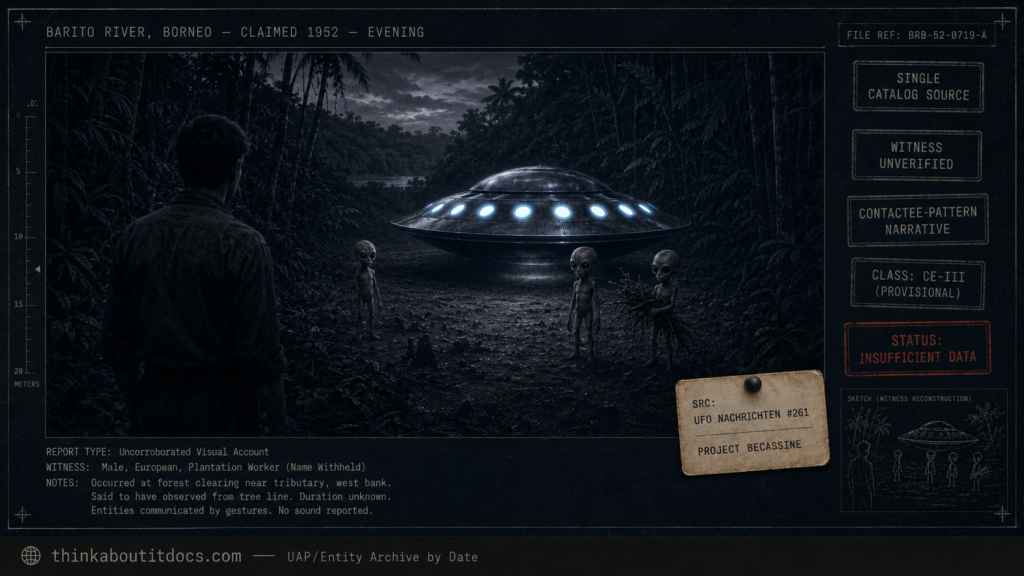
The 1952 Barito River, Borneo "Homan" contact — a single uncorroborated humanoid-catalog entry with an unverifiable witness and a contactee-style narrative, logged as Insufficient Data. (thinkaboutitdocs.com — UAP/Entity Archive by Date)
THINK ABOUTIT UFO|UAP|ENTITY SIGHTINGS REPORT
1952: Barito River Area, Borneo, Indonesia
It has the shape of a perfect close-encounter story — a lone flyer stumbles on a clearing in the Borneo jungle, finds a shining disc hovering inches off the ground, and meets three small big-headed beings who calmly tell him, in a local dialect, that they come from a planet called “Homan” in the star system “Wolf,” gather a few branches and soil samples, and vanish in a burst of light. It is also a story that exists nowhere but a humanoid catalog. There is no 1952 report behind it, no investigator, no Indonesian newspaper, no second witness — only a single entry that has been copied from one database to the next. The neat foreign-planet conversation and the tidy sample-collecting are the hallmarks of the contactee template, not of a documented sighting. The archive keeps the entry as part of the catalog record, but tells the truth about it: an uncorroborated fragment from one source, with an unverifiable witness and a narrative that reads as constructed.
Date: Given as July 23, 1952 (date unverified; see Researcher’s Notes)
Sighting Time: Evening (as stated)
Day/Night: Evening
Location: Barito River area, Borneo (Kalimantan), Indonesia
Urban or Rural: Rural (jungle clearing)
No. of Entity(‘s): 3
Entity Type: Small humanoids — contactee-style “sample collectors”
Entity Description: About 1 meter tall, with large heads, large eyes, long arms, small mouths, and pointed chins (as described in the single catalog source)
Hynek Classification: CE-III (animate beings associated with the object) — provisional, as the account rests on a single uncorroborated catalog entry
Duration: Not recorded
No. of Object(s): 1
Description of the Object(s): A disc-shaped object with a central dome encircled by luminous portholes, hovering very close to the ground without touching it; it departed in a bright flash of light
Shape of Object(s): Disc with central dome
Size of Object(s): Not recorded
Color of Object(s): Metallic / reflective
Distance to Object(s): The entities stood about 10 meters from the object; the witness was nearby
Height & Speed: Not recorded (object hovered, then departed in a flash)
Number of Witnesses: 1 (named in the source as Theo L. Smeets, 28; not independently verifiable)
Special Features/Characteristics: Reported verbal communication in an Indonesian dialect; beings named a home planet (“Homan”) and star system (“Wolf”); collection of plant and soil samples; departure in a bright burst of light — all classic contactee-narrative elements
Case Status: Insufficient Data
Source: Single catalog chain — UFO Nachrichten #261, via Denys Breysse, Project Becassine (humanoid-report compilation); no contemporaneous or independent source located
Summary/Description: By a single catalog account, a man identified as Theo L. Smeets, 28, came upon a clearing in the Barito River area of Borneo one evening in 1952 and found a shiny domed disc with luminous portholes hovering just above the ground. Three meter-tall humanoids with large heads and eyes reportedly spoke to him in a local dialect, said they came from a planet “Homan” in the “Wolf” system, gathered branches and soil, and left in a flash of light. The account is uncorroborated, the witness unverifiable, and the narrative follows the contactee pattern; it is logged as Insufficient Data.
Related Cases: 1947: 7 ft Aliens Spotted in Brazil (Bauru / Higgins, three beings, samples) | 1959: Six Aliens in the Alor Islands, Indonesia | the broader 1950s contactee “sample-collector” landing reports
DETAILED REPORT
The account, as it appears in the one source that carries it, runs as follows. One evening in 1952, a 28-year-old man named in the catalog as Theo L. Smeets, described as a local tour pilot, was exploring jungle in the Barito River area of Borneo when he entered a clearing and found a shiny, disc-shaped object hovering just above the ground. It had a central dome ringed with luminous portholes and did not quite touch the earth. About ten meters from it stood three humanoids, roughly a meter tall, with large heads, large eyes, long arms, small mouths, and pointed chins. They are said to have approached and spoken to him in an Indonesian dialect, telling him they came from a planet called “Homan” in a star system called “Wolf.” They then gathered some tree branches and soil samples, walked back into the craft, and departed in a brilliant flash of light.
Read as a narrative it is vivid and self-contained; read as a record it nearly dissolves. The crucial point is that this story has no documentary existence outside a single humanoid-catalog entry. It is traceable to the German bulletin UFO Nachrichten and to Denys Breysse’s “Project Becassine,” a latter-day compilation of occupant reports, and from there it has been copied — frequently word for word — onto websites that reproduce such catalogs. No contemporaneous 1952 report has been located, no investigator is named, no Indonesian newspaper or official record is cited, and there is no second witness. A chronological archive can note that the entry exists; it cannot treat the event as established.
The internal details deepen the doubt. The witness as described is hard to credit: a Dutch-surnamed “local tour pilot” wandering on foot through interior Borneo jungle in 1952 fits neither the geography nor the period well, in the early, unsettled years of Indonesian independence when organized jungle tourism did not exist. More tellingly, the encounter follows the contactee template almost beat for beat — beings who emerge, converse politely, announce a specific named home world and star system, collect botanical and soil specimens, and exit in a flash. Genuine close-encounter reports of the era are usually far less articulate and far less tidy; named planets delivered in conversation belong to the Adamski-era contactee literature, where the message is the point. The “Wolf” star name is itself suggestive, echoing the real catalog of Wolf-numbered stars in a way that reads as borrowed rather than reported.
The archive’s previous entry reproduced the catalog text directly, including a “shiny” entry in the color field (a finish, not a color) and a location that wavered between “Barito” and “Basito”; Barito, a real major river of Kalimantan, is the correct form and is used here. None of these are the substance of the problem, which is simply that the case is a single uncorroborated catalog fragment dressed as an event. It may preserve the echo of some real local story, or it may be wholly constructed; on what can actually be examined, neither can be shown.
RESEARCHER’S NOTES
The Borneo “Homan” Contact — Indonesia 1952 and the One-Source Problem
- Classification, held but provisional: CE-III describes the type of claim — animate beings associated with a craft at close range — and so it stands as the report-type label. But with a single unverifiable witness and no investigation, the class marks a category rather than a confirmed encounter, and it sits beside an Insufficient Data status. The contactee character of the narrative is worth flagging within the classification note: when beings deliver a spoken message naming their origin, the account leans toward the contactee tradition even where, as here, it is filed as a humanoid close encounter.
- Source-chain assessment: The case has exactly one root — UFO Nachrichten #261, via Breysse’s Project Becassine — and every other appearance is a copy of it. Project Becassine is a useful index of occupant reports, but an index entry is only as good as the report beneath it, and beneath this one there is no locatable primary material: no contemporaneous account, no named investigator, no Indonesian-language source. This is the archive’s central caution made concrete: a catalog citation is a pointer, not corroboration, and a story that exists only as a recopied catalog line has not earned the status of a documented event.
- Why the narrative reads as constructed: The strongest analytical signal is the shape of the story itself. Polite beings who announce a named planet and star system, collect plant and soil samples, and leave in a flash of light reproduce the mid-century contactee formula, in which the encounter exists to deliver information about benevolent visitors. The named witness compounds the implausibility: a Dutch-surnamed “local tour pilot” exploring 1952 Borneo jungle on foot is not a profile that survives scrutiny in that time and place. None of this proves fabrication, but it places the account firmly in the category of stories that look authored rather than observed.
- Evidentiary weight and why Insufficient Data: There is no physical evidence, no second witness, no contemporaneous documentation, and no verifiable witness identity — but neither is there positive proof of deliberate hoax. That is the precise meaning of Insufficient Data: not a documented anomaly to call “Unexplained,” and not a demonstrated fabrication or misidentification to call “Explained.” The honest course is to keep the entry, correct its location and field errors, name its single source plainly, flag its contactee character, and decline to present a one-line catalog story as a confirmed Borneo landing.
The Barito River case is a clean illustration of how an occupant catalog can lend a fragile story a borrowed solidity. One database line, copied forward enough times, starts to look like a documented 1952 encounter — complete with a named witness, a named planet, and a tidy exit in a flash of light. Stripped back to its evidence, it is a single uncorroborated entry whose witness cannot be confirmed and whose narrative follows the contactee script. The archive keeps it, fixes the Barito spelling and the stray field errors, names Project Becassine as its lone source, and files it where it belongs: Insufficient Data, an uncorroborated catalog report, told straight rather than presented as a landing the record cannot support.