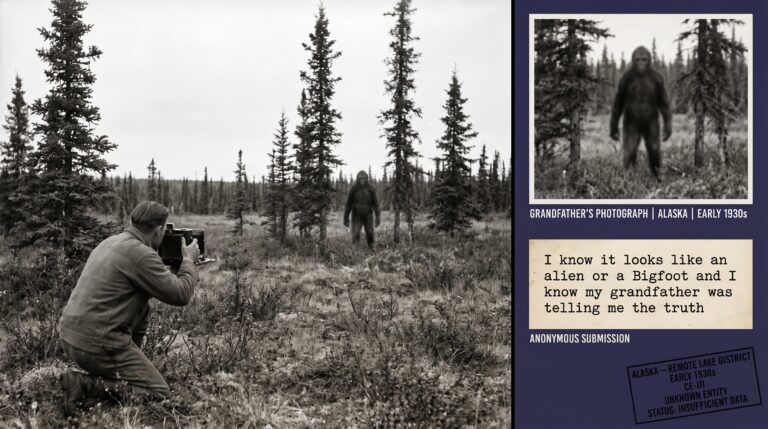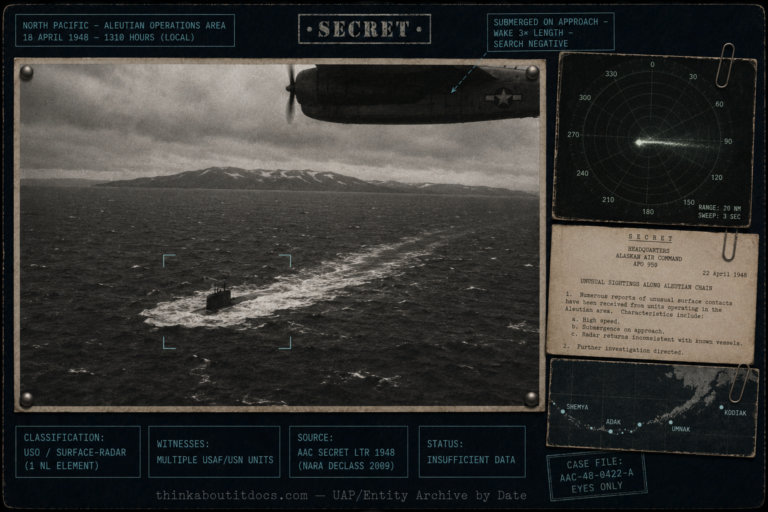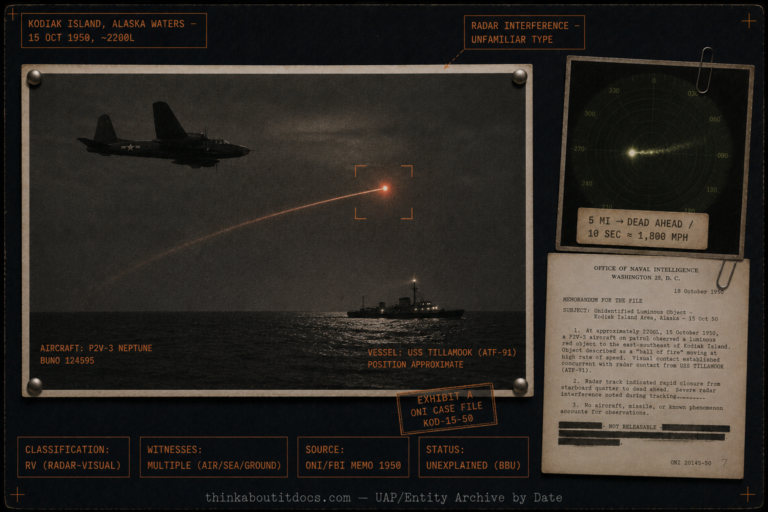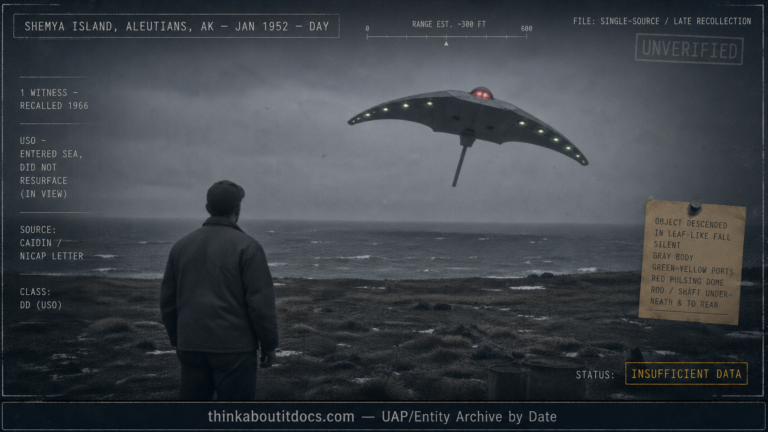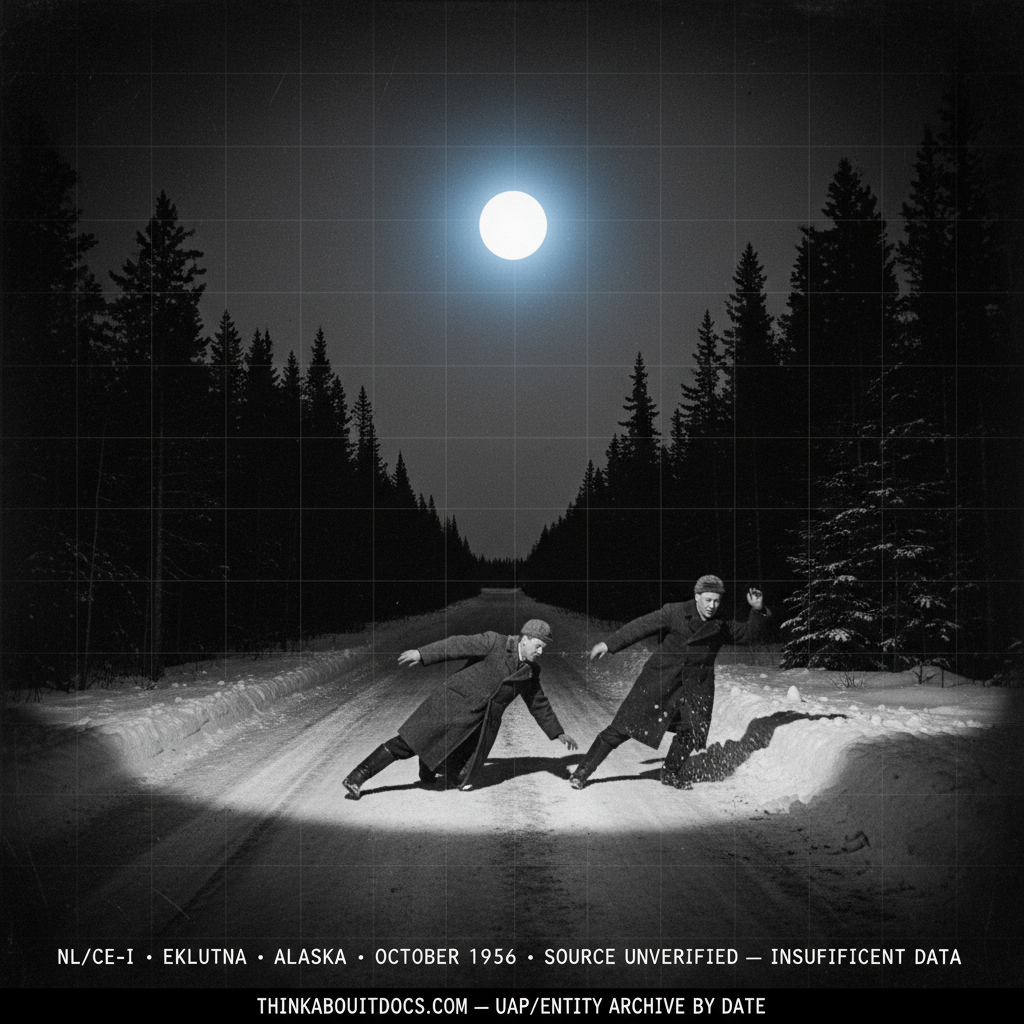
Eklutna, Alaska, October 1936 — two men hitchhiking to Anchorage on the Glenn Highway watch a very bright light approach at high speed and hover directly above them, diving into a roadside snowbank to escape. No source recorded. Eklutna in 1936: a remote Athabascan community on an unpaved territorial road, no aircraft infrastructure, no ambient light. The snowbank is the record's only physical detail. Case Status: Insufficient Data.
THINK ABOUTIT UFO | UAP SIGHTING REPORT
1936: Sighting in Eklutna
On the evening of October 15, 1936, at a Civilian Conservation Corps camp near Eklutna, Alaska — twenty-seven miles north of Anchorage, at the construction site of the Eklutna power plant — CCC worker Holger Berg and a companion were approached by a cigar-shaped object in the night sky. The object closed on the two men, hovering above them with enough apparent intensity that they dove into a snowbank to escape it. Berg, who later relocated to Anchorage after CCC service, gave a first-person account of the encounter that eventually reached the National UFO Reporting Center’s historical case files — one of the earliest named-witness UFO accounts from Alaska on record.
Date: October 15, 1936
Sighting Time: Evening
Day/Night: Night
Location: Eklutna, Alaska (Civilian Conservation Corps camp at the Eklutna power plant construction site, approximately 27 miles north of Anchorage)
Urban or Rural: Rural — remote CCC work camp
No. of Entity(‘s): 0 — no occupants reported
Entity Type: Not Applicable
Entity Description: Not Applicable
Hynek Classification: DD (Daylight Disc equivalent for night structured-object cases) / NL borderline. Correction: the previous version of this entry classified the case as NL (Nocturnal Light) based on a “bright light” description; Berg’s own account describes a cigar-shaped structured object, which is a stronger classification than a simple light source.
Duration: Not documented
No. of Object(s): 1
Description of the Object(s): A cigar-shaped object that approached the two witnesses at high speed and hovered above them
Shape of Object(s): Cigar-shaped
Size of Object(s): Not documented
Color of Object(s): Not documented; described in earlier summaries as very bright
Distance to Object(s): Close — object hovered directly above the witnesses
Height & Speed: Approached at high speed, then held a low, close hovering position over the witnesses
Number of Witnesses: 2 (Holger Berg and one unnamed companion)
Special Features/Characteristics: Object’s close, hovering approach was sufficiently alarming that both witnesses dove into a snowbank for cover; encounter occurred at a Civilian Conservation Corps construction camp during the buildout of the Eklutna power plant
Case Status: Unexplained.
Source: Witness account of Holger Berg, National UFO Reporting Center (NUFORC) historical case files. Correction: the previous version of this page listed no source at all.
Summary/Description: On the evening of October 15, 1936, Holger Berg and a companion, both working at the Civilian Conservation Corps camp constructing the Eklutna power plant north of Anchorage, Alaska, were approached by a cigar-shaped object that closed on them at high speed and hovered close overhead. Both men dove into a snowbank to escape it. Berg later gave a first-person account of the encounter, describing his broader circumstances — having come to Alaska for cannery work before joining the CCC — that was preserved in the National UFO Reporting Center’s historical files.
Related Cases: 1936: UFO|UAP & Entity Sightings Archive
Detailed Report
The Eklutna case is unusual among 1930s Alaska UFO reports for having a named, first-person witness account rather than a secondhand or anonymous report. Holger Berg’s own narrative, as preserved in the National UFO Reporting Center’s historical files, situates the sighting within a specific, verifiable personal history: Berg had been working as a mechanic for the Washington Fish & Oyster Company at their cannery on Shuyak Island (at a site called Port Williams) during the salmon season, and when that work ended he traveled to Anchorage seeking employment, ultimately joining the Civilian Conservation Corps. He was among a group — Berg recalled roughly ten young men, mostly from the northeastern United States — who helped establish the CCC camp at Eklutna, taking over the buildings at the site where the Eklutna power plant was under construction.
It was in this setting, on the evening of October 15, 1936, that Berg and a companion were approached by a cigar-shaped object. The object’s approach was fast and its final position close and low enough that both men’s immediate reaction was defensive — they dove into a snowbank rather than continuing to watch it. This is a notably different level of alarm than a simple distant light sighting would typically produce, and it is consistent with Berg’s description of the object as a structured cigar shape rather than an undefined luminous point.
The case predates Alaska’s better-known UFO reporting clusters by over a decade — the 1950 Sitka wave, the 1952 Anchorage “bouncing light,” and the 1953 Eklutna multi-witness saucer sightings that later made the same general area a recurring site of reports. Whether the 1936 Eklutna case and the later 1953 Eklutna reports reflect any genuine connection to the location itself, or are simply coincidental given Eklutna’s position as a small, frequently-traveled settlement near Anchorage, cannot be determined from the available record.
RESEARCHER’S NOTES
Eklutna 1936 — A Named CCC Witness in the Pre-War Alaska Record
- Source Correction: This entry previously carried no source at all. It has been traced to a first-person witness account by Holger Berg, preserved in National UFO Reporting Center historical files, which also supplies verifiable biographical context (Shuyak Island cannery work, CCC service at Eklutna) that lends the account a concrete, checkable frame rather than a bare anonymous claim.
- Classification Correction: The object is described by the witness as cigar-shaped, not merely a bright light. The classification has been revised accordingly from NL toward DD/structured-object territory, reflecting the source’s own description rather than a generic secondary summary.
- Pattern Context: Eklutna recurs as a UFO reporting location in Alaska’s history, most notably in 1953 when six women reported watching a flying saucer pass back and forth over the area for two hours. This 1936 case, if accurately dated, is the earliest documented Eklutna-area report by close to two decades.
- Evidentiary Weight: Two witnesses, one named with verifiable biographical detail, no physical trace, no photograph. The case rests on Berg’s testimony as preserved decades later in NUFORC’s historical files; this archive has not located a contemporaneous 1936 record independent of that later compilation.
The Eklutna case is a modest but genuinely documented entry in the pre-war Alaska UFO record — a named CCC worker, a specific camp and construction project, a cigar-shaped object close enough to send two men diving for cover in the snow. It predates Alaska’s better-known post-war reporting clusters by well over a decade.