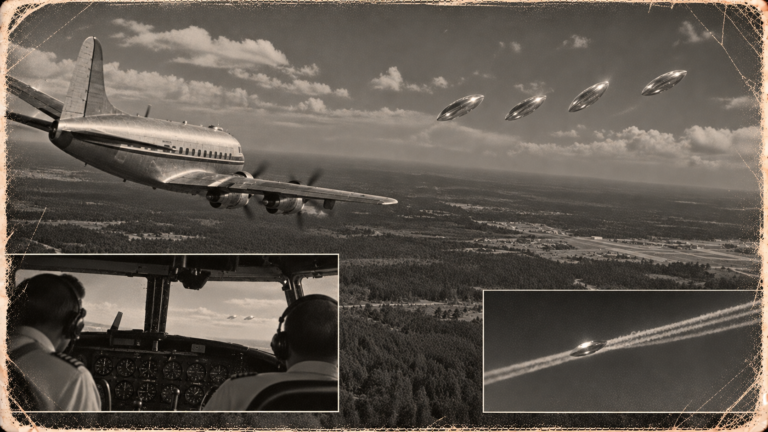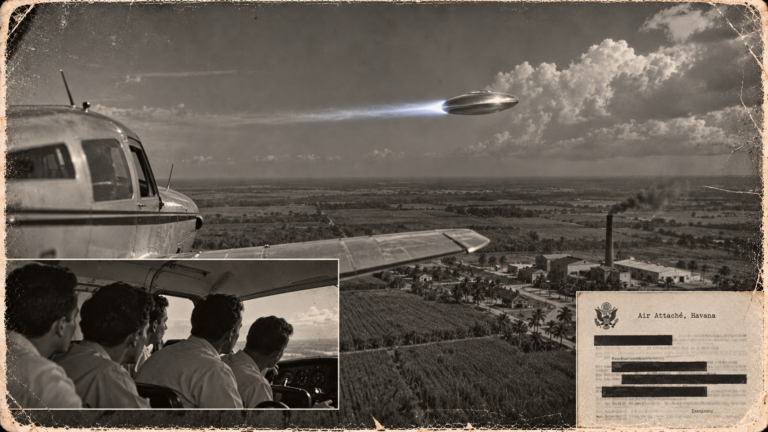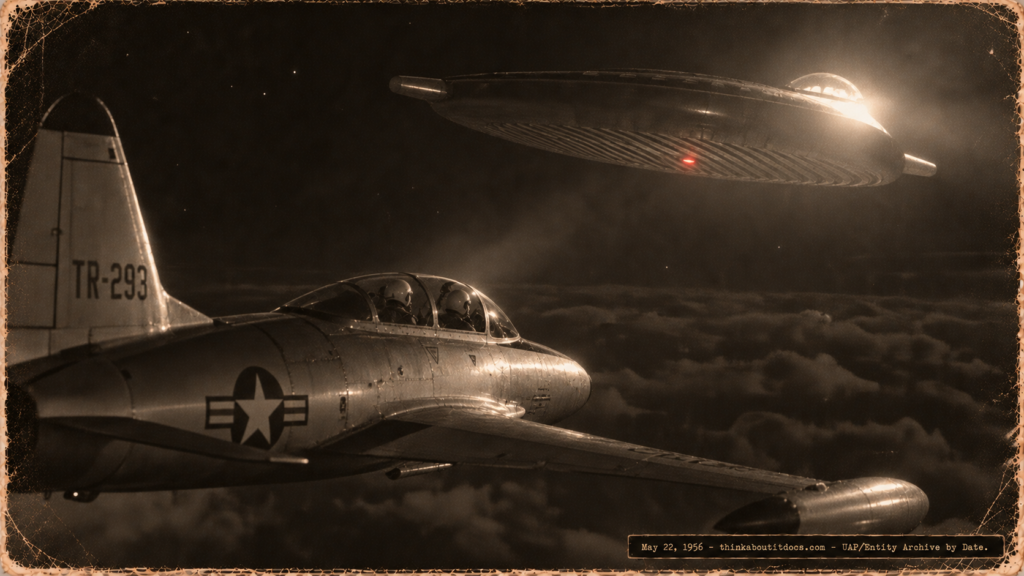
Northwest of Monroe, Louisiana, May 22, 1956: a ribbed elliptical object with no wings passed 225 feet from the cockpit and flashed a blinding white light through the canopy.
THINK ABOUTIT UFO|UAP ENCOUNTER REPORT
1956: Monroe, Louisiana: The Object That Came Back for a Second Pass
On the night of May 22, 1956, USAF officer Earl D. Holwadel was flying a T-33 jet at 18,000 feet over Louisiana, about 58 miles northwest of Monroe, when he spotted a bright light to the east. He saw it again ten minutes later and banked right to investigate. The object suddenly reversed and came straight at them. His back-seater braced as it flashed across the T-33’s nose at an estimated 225 feet — close enough to see it clearly. It was elliptical, about 30 to 40 feet long, with a ribbed steel-colored underside, stubby protrusions on the sides instead of wings, and a single small steady red light at its center. As it passed, the dome-shaped structure at its forward end fired an intensely bright white light through their canopy.
Then it came back. It returned at high speed on a westward course, and the crew watched it maneuver with what they described as fantastic agility while never changing its own flight attitude. The Monroe encounter is one of the most detailed military pilot sightings of the 1950s and one of the few in the American record where an object made two close passes at an interceptor. It is documented in the McDonald list, the NARCAP database and the Hynek-CUFOS files.
Date: May 22, 1956
Sighting Time: 11:05 p.m. (CST); close encounter at approximately 11:15–11:20 p.m.
Day/Night: Night
Location: Airspace approximately 58 miles northwest of Monroe, Louisiana
Urban or Rural: Airborne (over rural north Louisiana)
No. of Entity(‘s): Not Applicable
Entity Type: Not Applicable
Entity Description: Not Applicable
Hynek Classification: CE-I (Close Encounter of the First Kind — 225-foot pass)
Duration: First sighting at 11:05 p.m.; second sighting at 11:15 p.m.; close pass and return pass totaling several minutes
No. of Object(s): 1
Description of the Object(s): An elliptical object about 30 to 40 feet long, shorter than a C-47 but wider, with a steel-colored bottom covered in ribs extending 2 to 4 feet down in a wave-like pattern, stubby protrusions (no wings) of about 3 to 4 feet long extending roughly 25 feet on each side, a single small steady red running light at its center, and a dome or cockpit window at the forward end
Shape/Size/Color of Object(s): Elliptical, about 30 to 40 feet long; steel-colored underside; single red center light; dome forward; no wings
Distance to Object(s): About 225 feet at closest approach, passing ahead under the T-33’s nose
Height & Speed: At the T-33’s altitude of 18,000 feet. Initial speed appeared very fast. The object made a high-speed approach, passed, then returned at high speed. The crew described fantastic maneuverability at all times without any change in the object’s own flight attitude.
Number of Witnesses: 2: USAF officer Earl D. Holwadel (pilot) and an unnamed officer in the back seat
Special Features/Characteristics: The object reversed from a receding course and came head-on at the jet. It made two passes. As it crossed the nose, the forward dome or window emitted an intensely bright white light that lit up the T-33’s canopy. The object showed no jet wash. It maneuvered with “fantastic” agility while maintaining constant flight attitude.
Case Status: Unexplained (Project Blue Book unknown)
Source: NARCAP; James E. McDonald list; Hynek-CUFOS files (BBU)
Summary/Description: A USAF T-33 crew flying at 18,000 feet over Louisiana had an elliptical, ribbed object reverse course and pass 225 feet in front of them, flashing a blinding light through the canopy, then return for a second pass. No jet wash was felt. Blue Book listed the case as unknown.
Related Cases: 1956: May UFO|UAP & Entity Sightings Archive
Detailed Report
USAF officer Earl D. Holwadel was flying a Lockheed T-33 jet trainer at 18,000 feet, heading 50 degrees northeast over Louisiana at 11:05 p.m. on May 22, 1956, approximately 58 miles northwest of Monroe. An unnamed officer rode in the back seat. Holwadel spotted a bright light to the east, then lost it, then saw it again to the southeast at 11:15 p.m. He banked right to try to close with it, but it was at great distance to the southeast.
The object suddenly reversed. It came straight at them at high speed on a heading of 330 degrees — northwest, directly toward the T-33. As it crossed in front of the nose at roughly 225 feet, the crew could see it clearly. It was elliptical and about 30 to 40 feet in length, shorter than a Douglas C-47 but wider. Its underside was steel-colored with ribs extending 2 to 4 feet down in a wave-like pattern. There were no wings, only stubby protrusions about 3 to 4 feet wide extending roughly 25 feet out on each side. A single small steady red running light sat at the center of the object. At its forward end was a structure Holwadel described as a greenhouse-shaped dome or cockpit window. As the object crossed their path, that forward dome emitted an intensely bright white light that flooded the cockpit canopy. There was no jet wash.
The object moved away to the west, and Holwadel reported he thought that was the end of it. But it came back. It returned at high speed on a westward course, demonstrating what both crew members described as fantastic maneuverability — never at any point changing its own flight attitude as it moved. After the second pass the crew filed their report through the normal intelligence channels. The McDonald list, NARCAP and the Hynek-CUFOS files all carry the case, and Project Blue Book listed it as unknown.
RESEARCHER’S NOTES
One of the Most Detailed Pilot CE-I Records of the Decade
- Object description quality: The Holwadel report is unusual for the level of structural detail: the ribbed wave-pattern underside, the specific size comparison to a C-47, the distinction between the stubby protrusions and actual wings, the steady red center light, and the forward dome that emitted the white flash. That level of description at night suggests either exceptional visibility conditions or a very close pass, and the 225-foot estimate makes the latter plausible.
- No jet wash: A conventional jet aircraft at 225 feet would produce significant disturbing airflow. The absence of any jet wash is noted explicitly in the report and is consistent with the other physical anomalies in the case.
- Two passes: The return pass is the most unusual element. Aircraft — including conventional fast jets — do not typically reverse course and re-approach a target they have just passed. The crew’s description of “fantastic maneuverability” without any change in flight attitude during those reversals does not fit any conventional aircraft of 1956.
- Back-seater unnamed: Every secondary summary of this case names Holwadel but not the back-seat officer. The original NARCAP or Hynek-CUFOS file would identify both.
- Conventional possibilities: At night over rural Louisiana in 1956, a conventional aircraft at 225 feet would be the obvious candidate, but there were no wings, no jet wash, no exhaust, and the object reversed and returned. A balloon cannot reverse course and make two fast passes. A meteor cannot maintain station and return. The case has no plausible conventional explanation in any of the databases that carry it.
The Monroe, Louisiana T-33 encounter is best understood as what it is on the record: a credentialed USAF pilot’s close-range observation of a structured craft exhibiting propulsion and maneuverability that no 1956 aircraft could replicate. Its appearance in three separate research databases — NARCAP, McDonald and Hynek-CUFOS — speaks to the consistency and credibility of the underlying report. The case remains unexplained.
“The object passed in front of the T-33 at about 225 feet.”
USAF officer Earl D. Holwadel, T-33, northwest of Monroe, Louisiana, May 22, 1956 (NARCAP; McDonald list)