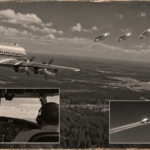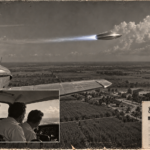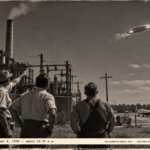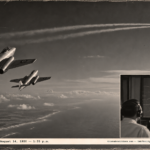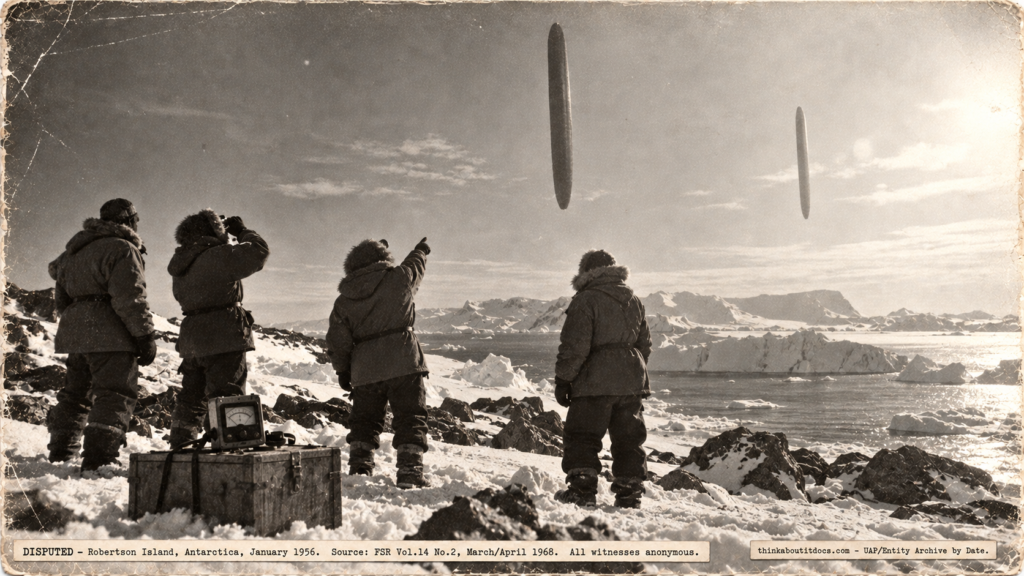
Robertson Island, Antarctica, January 8–9, 1956: two enormous vertical cigars reportedly observed for nearly two days — never verified, all witnesses anonymous, no photographs released.
THINK ABOUTIT UFO|UAP SIGHTINGS REPORT
***DISPUTED***
1956: Robertson Island, Antarctica: Two Vertical Cigars Over the Ice — A Disputed Account
In January 1956, a Chilean field party of four men camped at Robertson Island, near the tip of the Antarctic Peninsula, reportedly watched two enormous cigar-shaped craft hang motionless over the ice with their long axes pointing straight up. Over two days, the objects descended and performed rapid maneuvers, a Geiger counter read forty times background radiation, theodolite measurements put the objects at roughly 8 kilometers altitude and 150 meters long, and polarized-light experiments appeared to affect their behavior. The men took color and black-and-white photographs.
None of this has ever been confirmed. The account was first published twelve years after it allegedly occurred, in Flying Saucer Review in 1968, by a named author but with four anonymous witnesses. No photographs, no theodolite data, no Geiger readings and no Chilean expedition records matching this party have ever been made public. It is cited frequently in UFO literature and stands as one of the most detailed Antarctic sighting claims of the 1950s. It is presented here as a disputed case: the details are reported as the source describes them, with a full accounting of what can and cannot be verified.
Date: January 8–9, 1956 (continuing until clouds obscured the view at approximately 11:00 p.m. on January 9)
Sighting Time: Before 7:00 a.m. on January 8 (first sighting); objects reportedly remained visible for most of two days
Day/Night: Day and night (Antarctic summer; continuous daylight with brief darker periods)
Location: Robertson Island, near the Antarctic Peninsula (roughly 65°S, 60°W)
Urban or Rural: Extremely remote Antarctic field camp
No. of Entity(‘s): Not Applicable
Entity Type: Not Applicable
Entity Description: Not Applicable
Hynek Classification: NL/DD (Nocturnal Light / Daylight Object — extended visual observation; no intercept or close approach)
Duration: Approximately 40 hours (January 8 before 7:00 a.m. until cloud cover moved in at about 11:00 p.m. on January 9)
No. of Object(s): 2
Description of the Object(s): Two cigar-shaped objects, hanging motionless with their long axes vertical. Through binoculars they appeared smooth, polished and metallic. Theodolite measurements (if accurate) placed them at about 8 km altitude and approximately 150 m long by 25 m across. They changed colors through a spectrum and performed rapid maneuvers when they went horizontal.
Shape/Size/Color of Object(s): Cigar-shaped; reported at roughly 150 m long and 25 m across; metallic and polished; color-shifting
Distance to Object(s): Reported at about 8 km altitude
Height & Speed: Approximately 8 km altitude when stationary. When one went horizontal it made rapid silent stops, turns and accelerations. Speed not quantified.
Number of Witnesses: 4 (Chilean field party; all unnamed in the source)
Special Features/Characteristics: Geiger counter reportedly read 40 times normal background radiation during the observation. Polarized light aimed at one object reportedly caused it to descend and then rise back. Color photographs and black-and-white photographs reportedly taken. Details said to have been reported to U.S. Air Technical Intelligence Center (ATIC). All of these elements remain unverified.
Case Status: DISPUTED — Unverified (single secondary source published 12 years after the event; all four witnesses anonymous; no photographs, instrument data or expedition records have been located)
Source: Flying Saucer Review, Vol. 14, No. 2 (March/April 1968), p. 20; NICAP 1956 UFO Chronology
Summary/Description: A Chilean field party of four at Robertson Island, Antarctica, reported watching two large vertical cigar-shaped craft for most of two days, with elevated radiation readings, theodolite measurements, photographs and apparent craft response to a polarized-light experiment. The account first appeared in print in 1968, twelve years after the alleged event; all supporting data remain unpublished and unconfirmed.
Related Cases: 1956: January UFO|UAP & Entity Sightings Archive
Detailed Report
Robertson Island lies at roughly 65 degrees south, just off the northern coast of the Antarctic Peninsula, in the stretch of ice-clogged water known as the Weddell Sea approach. In January 1956 — Antarctic summer, with near-continuous daylight — a Chilean field party of four men was camped there. Their work and institutional affiliation are not given in the source.
Before 7:00 a.m. on January 8, one of the men noticed two objects hanging in the sky with their long axes vertical, like enormous pencils pointing straight up. Through 7×50 binoculars the objects looked smooth, polished and metallic. A Geiger counter that was part of the party’s equipment read approximately forty times the normal background radiation level.
At 9:00 a.m., one of the objects turned to the horizontal position, flashed through a spectrum of colors and then made a series of rapid silent movements — stops, turns and accelerations — for about five minutes, after which it returned to vertical. The second object then repeated this performance for about three minutes.
The party took both color and black-and-white photographs throughout. They also directed a beam of polarized light at one of the objects; it reportedly descended closer and then rose back to its original altitude. At some point the following day they used a theodolite to measure the objects’ position, arriving at an altitude of approximately 8 kilometers and dimensions of roughly 150 meters long by 25 meters across. The objects remained visible until clouds moved in at approximately 11:00 p.m. on January 9, at which point the radiation reading also fell back to normal. The party reported that the details had been passed to the U.S. Air Technical Intelligence Center.
The account first appeared in Flying Saucer Review in March/April 1968, written by a named author but with all four members of the field party left anonymous.
RESEARCHER’S NOTES
Why This Case Is Widely Cited — and Why It Cannot Be Confirmed
- The twelve-year gap: The event is said to have occurred in January 1956; the first published account appeared in March/April 1968. No contemporary report, no expedition log, no news item, no press account and no scientific publication from 1956 or any subsequent year until 1968 has been found to support it. A radiation anomaly at this level and a multi-hour sighting by a scientific party would normally generate some kind of contemporary record — a field log entry, a radio transmission, a report to a base. None has been located.
- All witnesses anonymous: The single greatest obstacle to verification is that all four members of the Chilean party are unnamed in the source and have never come forward publicly. Chilean Antarctic operations in January 1956 are a matter of historical record. A named party would be traceable. The anonymity makes independent verification impossible by design, whatever the author’s reasons.
- Photographs never produced: Color and black-and-white photographs of two enormous metallic craft at 8 km altitude over Antarctica in January 1956, held since then by or on behalf of the field party, would be extraordinary evidence. They have never appeared in any publication, archive or court. No reason for their continued suppression is given in the source.
- ATIC reporting not confirmed: The claim that details were passed to the U.S. Air Technical Intelligence Center has not been confirmed in any declassified ATIC, Blue Book or USAF document. ATIC was aggressive about collecting such reports in 1956; a Chilean party reporting 150-meter cigar-shaped craft and elevated radiation would have generated significant documentation if the report had actually been received.
- What the account would mean if true: If the theodolite measurements, the radiation readings, the polarized-light response and the photographs are all accurate, this would be among the most instrumentally documented UAP observations in history — two craft the size of large naval vessels observed at close enough range for color photography over nearly two days, by a scientific party with calibrated instruments. The absence of any corroborating record after nearly seventy years is extraordinary either way.
- Place in the archive: Robertson Island belongs in this archive because it is widely cited in the literature, because denying it a clear-eyed page would leave readers finding it only in uncritical sources, and because the standard for inclusion on this site is “documented in the record” — not “verified.” The DISPUTED header is not a dismissal; it is the honest label for a case that cannot currently be confirmed or refuted.
The Robertson Island account is one of the most frequently cited Antarctic UFO claims of the 1950s and one of the least verifiable. Until a member of the field party is identified, the photographs surface, the expedition records are found, or an ATIC file matching the account is declassified, it remains exactly what it has always been: a remarkably detailed story from an unidentifiable source, published twelve years too late to check.
At 8 km altitude and 150 m long — measured by theodolite. The photographs have never been published.
Summary of the Robertson Island account, Flying Saucer Review, March/April 1968, p. 20