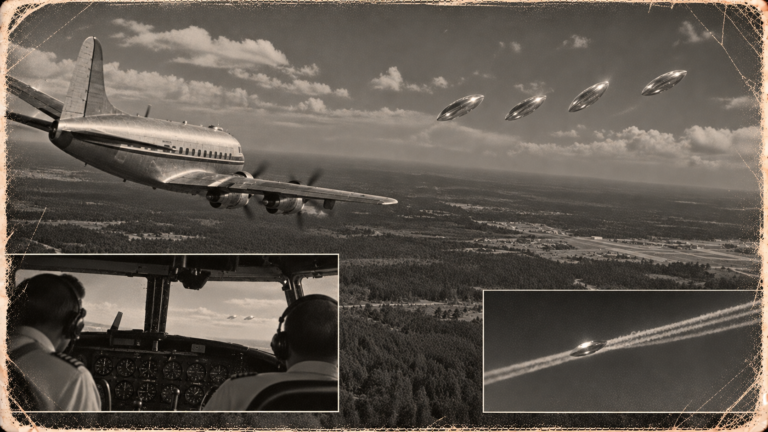
Near the Azores, August 1956: Eastern Airlines Flight 49's crew watched an orange-white pulsating light accompany their DC-4 for 20-30 minutes before it came within 40 feet.
THINK ABOUTIT UFO|UAP SIGHTINGS REPORT
1956: Near the Azores — Eastern Airlines Flight 49: The Light That Came Within 40 Feet
At 0145Z on August 17, 1956, the aircraft commander of Eastern Airlines Flight 49 — a DC-4 flying from Ponta Delgada in the Azores to LaGuardia, New York — transmitted a CIRVIS report to Olmsted AFB in Pennsylvania. A bright light, round and orange-white, had been pacing the aircraft. It had come from the right side, bearing 270 degrees from the aircraft’s heading, and it had been there for 20 to 25 minutes, diving, climbing and circling. At some point it had passed within 40 feet of the aircraft, approaching from above and below. The crew had taken evasive action. At 6,000 feet over the North Atlantic, the object was also in sight of the tower operator at LaGuardia — nearly 900 miles away in New York, where the flight was destined, and where the object was apparently still visible as the DC-4 approached.
Project Blue Book’s conclusion was astronomical body — most probably a star or planet. The ATIC file shows Blue Book queried the Air Force Weather Service for balloon tracks in the area, got a negative reply, then queried General Mills Inc. of Minneapolis, the primary USAF high-altitude balloon contractor. General Mills replied that the last Florida balloon had flown on August 8 and that no General Mills or Texas operations balloons were in that area on August 16-17. With balloon ruled out and the winds at all levels blowing from 270 degrees — the same direction the object maintained throughout — Blue Book landed on astronomical. The crew described the object as diving, climbing and circling for 20-25 minutes. Stars do not dive, climb and circle. The file is what it is.
Date: August 16–17, 1956 (departure date August 16; GMT time of sighting 17/0145Z; local Azores time approximately 12:45 a.m. August 17)
Sighting Time: 0145Z (August 17) — first CIRVIS flash sent; object had been in sight since approximately 2050E local, observation 20–25 minutes total
Day/Night: Night
Location: Over the North Atlantic near the Azores; observer position confirmed at 31°50’N, 73°55’W; aircraft enroute Ponta Delgada (POU) to LaGuardia (LGA)
Urban or Rural: Airborne over open ocean
No. of Entity(‘s): Not Applicable
Entity Type: Not Applicable
Entity Description: Not Applicable
Hynek Classification: NL (Nocturnal Light) — extended observation of a pulsating brilliant light at night, with close approach and evasive action; no confirmed physical effects on the aircraft
Duration: 20–25 minutes
No. of Object(s): 1
Description of the Object(s): Round, orange and white bobbing light. Size: dime at arm’s length. Motion: brilliant light moving across sky; observed at 270 degrees relative to the aircraft’s course; performed diving, climbing and circling movements over 20–25 minutes. Came within 40 feet of the aircraft approaching from above and below.
Shape/Size/Color of Object(s): Round; dime at arm’s length; orange and white; no sound
Distance to Object(s): Passed within 40 feet of the aircraft at closest approach, coming in from above and below
Height & Speed: Aircraft altitude: 6,000 feet (per detailed CIRVIS report; CIRVIS flash message gave 4,000 feet — likely the initial report figure). Object maintained 270° relative bearing throughout; no separate altitude or speed figure given for the object itself.
Number of Witnesses: At minimum: the aircraft commander (Eastern Airlines Flight 49 captain; name redacted in file; New Hyde Park, New York; approximately 38 years old); additional crew not individually named in available documents. Second independent witness: tower operator at LaGuardia Airport, who had the object in sight at 2125E (local) as the flight approached New York.
Special Features/Characteristics: Object performed diving, climbing and circling motions over 20–25 minutes. Evasive action taken by the aircraft (“evasive action by aircraft” — confirmed in CIRVIS follow-up). Object came within 40 feet, approaching from above and below. LaGuardia tower also acquired the object visually. Winds at all altitudes from surface to 50,000 feet were from 270 degrees throughout — the same direction the object maintained — making free-balloon explanation untenable (confirmed negative by General Mills Inc. balloon contractor query).
Case Status: Blue Book conclusion: Astronomical (most probable explanation stated as astronomical body / star or planet). Balloon ruled out by USAF Weather Service query and General Mills Inc. confirmation. The crew’s description of diving, climbing and circling motion is not consistent with an astronomical object.
Source: Project 10073 Record Card; CIRVIS Report from FSC Olmsted AFB, 17 Aug 56, 1702Z (RC 091); Detailed Sighting Report RJEDLS 75H; ATIC balloon query to General Mills Inc. and 1110th Air Support Group; General Mills reply 29 Aug 56; NARCAP; FUFOR Index; Project Blue Book files
Summary/Description: Eastern Airlines Flight 49 (DC-4, POU-LGA) crew observed a round orange-white bobbing light at 270° bearing for 20–25 minutes. It came within 40 feet, performing diving, climbing and circling maneuvers; crew took evasive action. LaGuardia tower also had visual contact. Balloon ruled out. Blue Book concluded astronomical body.
Related Cases: 1956: August UFO|UAP & Entity Sightings Archive; 1956: Monroe, Louisiana T-33 near-collision, May 22, 1956
Detailed Report
Eastern Airlines Flight 49 was operating a scheduled service from Ponta Delgada in the Azores to LaGuardia Airport in New York on the night of August 16-17, 1956. The aircraft was a Douglas DC-4 with four radial engines. At approximately 2050 local Azores time — 0145Z on August 17 — the aircraft commander observed a round, orange and white bobbing light off the right side of the aircraft, bearing 270 degrees from the flight’s southward heading. It was the size of a dime at arm’s length.
The light remained with the aircraft, performing what the crew described as diving, climbing and circling motions over the next 20 to 25 minutes. At some point during this period it came within 40 feet of the DC-4, approaching from above and then from below. The aircraft commander took evasive action. The object made no sound.
A CIRVIS (Communications Instructions for Reporting Vital Intelligence Sightings) message was transmitted from FSC Olmsted AFB in Pennsylvania at 1702Z, relaying the aircraft commander’s report. The message went simultaneously to Commander ADC at Ent AFB in Colorado, the Chief of Staff USAF in Washington, and Commander Air Technical Intelligence Center at Wright-Patterson AFB in Ohio. The report also noted that the object had been in sight by the tower operator at LaGuardia Airport at 2125 local — a second independent visual contact from the ground nearly 900 miles from the sighting location, suggesting the object was either large, very bright, or both.
ATIC’s follow-up investigation ran balloon queries through two channels. The Air Force Weather Service was queried about balloon tracks in the area of 31°50’N, 73°55’W at 0145Z August 17; the response was negative. ATIC then queried General Mills Inc. of Minneapolis, the primary USAF contractor for high-altitude research balloon operations. General Mills’ Balloon Department responded on August 29: the last Florida balloon had flown on August 8, and no General Mills or Texas operations balloons were in or near the area on August 16-17. Balloon was eliminated.
Winds at all altitudes at the time and place of the sighting were from 270 degrees — from 5 knots at 5,000 feet to 40 knots at 30,000 feet, all from due west. This means any free-floating balloon would have been moving eastward, away from the aircraft’s course, which was southward. An object maintaining a steady 270-degree bearing from a southbound aircraft while winds blow from that direction is not drifting with the wind. The wind data corroborates the balloon elimination.
Blue Book’s Project 10073 Record Card checked “Was Astronomical — Star/Planet” as the conclusion, adding the comment that the “most probable explanation is astro body.” The record card also noted that the description “appears characteristic of balloon” — but the balloon query had returned negative, and the winds made it impossible regardless. The astronomical conclusion was the fallback.
RESEARCHER’S NOTES
Why “Astronomical Body” Doesn’t Work, and What the File Actually Shows
- Stars don’t dive, climb and circle: The crew’s formal questionnaire response (section D of the detailed sighting report) states the object was “diving, climbing and circling.” These are three-dimensional active maneuvers. No astronomical body performs them. Blue Book’s astronomical conclusion ignores the motion description entirely and relies instead on the object’s color and general appearance as a bright light. The conclusion is internally inconsistent with the crew’s own report.
- The balloon elimination chain: ATIC’s investigation was actually thorough on this point — they queried both the Weather Service and the primary civilian balloon contractor. General Mills’ reply is in the file and is unambiguous: no balloon operations in that area on that date. The wind data independently confirms it. Blue Book cannot have both “appears characteristic of balloon” and “no balloons in area” as simultaneously operative — the file’s own evidence eliminates the balloon hypothesis.
- The LaGuardia tower contact: The CIRVIS message states the object was “in sight by TWR operator LGA at 2125E.” LaGuardia is approximately 870 miles from the observer position at 31°50’N, 73°55’W. An object simultaneously visible from an aircraft near the Azores and from a tower in New York City would need to be either at enormous altitude, of extraordinary brightness, or both. This detail has not been adequately addressed in any available commentary on the case and is perhaps the most anomalous element in the file.
- Altitude discrepancy resolved: The CIRVIS flash message says “flying at 4000”; the detailed questionnaire says “DC4 Flight 49 6000 ft 195 degrees 185K LGA.” The 6,000-foot figure from the formal questionnaire is the more reliable of the two — the flash was a rapid initial report under stress, the questionnaire was completed deliberately afterward. Both figures have appeared in secondary sources; the correct altitude is 6,000 feet.
- 40 feet: The DC-4’s fuselage width is approximately 11 feet. Its wingspan is 117 feet. An object 40 feet from the fuselage is inside the aircraft’s own airspace — between the engines on one side and the wingtip. At this distance, any conventionally powered object would have been audible, felt as wake turbulence, and seen as something with structure by the crew. The crew reported no sound and described only a bobbing light. What passed within 40 feet of a Douglas DC-4 at 6,000 feet over the North Atlantic on August 17, 1956 was not identified.
Object passed within 40 ft of acft coming in from above and below. Acft was flying at 4000. Evasive action by aircraft.
CIRVIS Report, FSC Olmsted AFB, 17 Aug 56 1702Z — A/C Commander, Eastern Airlines Flight 49, enroute POU-LGA — Project Blue Book files