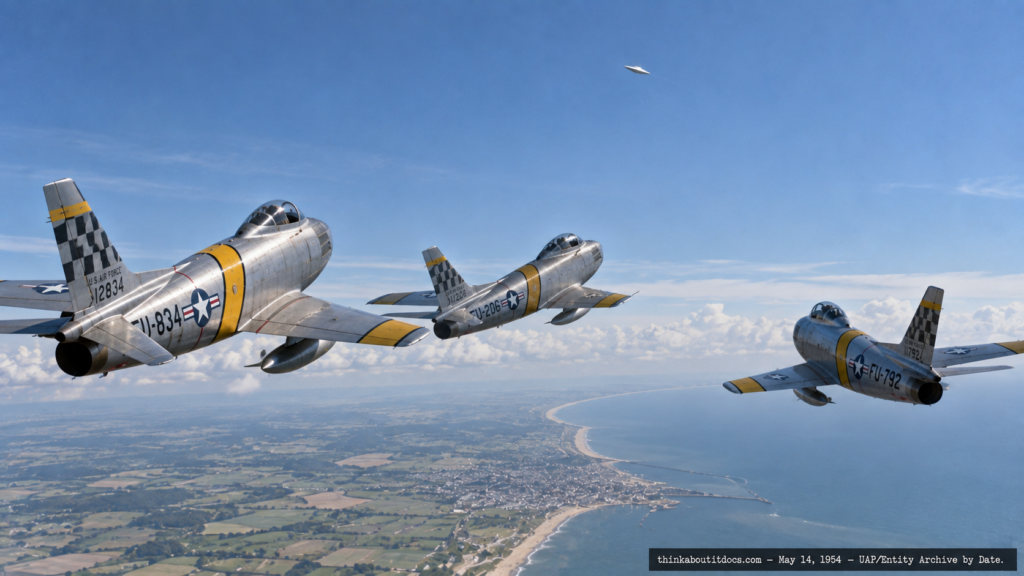
The unidentified object that outclimbed three F-86 jets and RAF Bawdsey's ground radar near Great Yarmouth, England, May 14, 1954.
THINK ABOUTIT UFO|UAP SIGHTINGS REPORT
1954: The Great Yarmouth Intercept — RAF Bawdsey Radar
Ground radar at RAF Bawdsey vectored three USAF F-86 jets toward an unidentified target near Great Yarmouth — and when the pilots got close enough to see it, they found a silvery, thirty-foot round object holding altitude twenty thousand feet above their own. It turned once, unhurried, and simply climbed out of the fight entirely, vanishing above the reach of the very radar that had found it.
Date: May 14, 1954 BBU
Sighting Time: 3:40 p.m.
Day/Night: Day
Location: Approximately 10 miles NNW of Great Yarmouth, England
Urban or Rural: Air
No. of Entity(‘s): 0
Entity Type: Not Applicable
Entity Description: Not Applicable
Hynek Classification: RV (Radar-Visual)
Duration: Not precisely specified; the intercept and departure occurred over a period of several minutes
No. of Object(s): 1
Description of the Object(s): A round object, silver or gray in color, showing a thin silhouette while turning, seen from below
Shape/Size/Color of Object(s): Round, approximately 30 ft in diameter; silver or gray
Distance to Object(s): Initially detected at 8 miles range by GCI radar; closed to visual range as the fighters approached
Height & Speed: Object held at 50,000-60,000 ft, well above the fighters’ own 40,000 ft altitude; moving at approximately 240 knots IAS before making a 180° turn and departing at high speed beyond conventional aircraft capability, climbing above ground radar range
Number of Witnesses: 3 (USAF pilots Capt. Kenneth J. Scott Jr., 2nd Lt. Harry Joseph Ickes, and 2nd Lt. David B. Clardy, 91st Fighter Squadron)
Special Features/Characteristics: The intercept was initiated by ground-controlled interception (GCI) radar at RAF Bawdsey (Type 7 radar), which vectored the three F-86 fighters directly to the target’s position; the object was seen from below at extreme altitude, well above the pursuing jets, and its silhouette thinned as it turned; the fighters were unable to close the altitude gap before the object made a 180° turn and departed at a speed and altitude beyond both the aircraft’s performance and the reach of the ground radar that had found it
Case Status: Officially logged by Project Blue Book (BBU); a three-pilot military intercept with ground radar vectoring and direct visual confirmation, ending in an escape beyond available radar and aircraft capability
Source: Jan Aldrich
Summary/Description: At 3:40 p.m. on May 14, 1954, three USAF F-86 jets flown by Capt. Kenneth J. Scott Jr., 2nd Lt. Harry Joseph Ickes, and 2nd Lt. David B. Clardy of the 91st Fighter Squadron, flying at 40,000 ft, were vectored by GCI radar at RAF Bawdsey toward an unidentified object 8 miles distant, roughly 10 miles northwest of Great Yarmouth, England. The pilots visually confirmed a round, silver or gray object approximately 30 ft in diameter, holding at 50,000-60,000 ft — well above their own altitude. The fighters were unable to close the gap. The object made a 180° turn and departed at high speed beyond the F-86s’ performance capability, climbing out of range of the ground radar that had initially detected it.
Related Cases: None known
Detailed Report
At 3:40 in the afternoon on May 14, 1954, three USAF F-86 jets were flying at 40,000 feet near Great Yarmouth, England, when ground-controlled interception radar at RAF Bawdsey picked up an unidentified target and vectored the fighters toward it. The pilots — Capt. Kenneth J. Scott Jr., 2nd Lt. Harry Joseph Ickes, and 2nd Lt. David B. Clardy of the 91st Fighter Squadron — closed on the reported position, roughly ten miles northwest of the town, following the radar’s guidance to a target eight miles out.
What they found, once close enough to make visual contact, was well beyond their own operating altitude: a round object, silver or gray in color, roughly thirty feet across, holding steady at 50,000 to 60,000 feet — ten to twenty thousand feet above the F-86s themselves. Seen from below, its silhouette thinned visibly as it turned, giving the pilots a clear enough view to describe its basic shape and coloring despite the extreme altitude difference.
There was no way for the fighters to close that gap. The object simply held its position, then executed a 180-degree turn and departed at a speed that exceeded anything the F-86s — themselves capable aircraft for their era — could hope to match. It climbed higher still as it left, rising beyond not just the pilots’ reach but the range of the very ground radar system that had detected and vectored them to it in the first place.
RESEARCHER’S NOTES
Great Yarmouth — 1954 and an Intercept That Never Had a Chance
- Radar-initiated, not pilot-initiated: This case began with a ground radar detection and controlled vectoring, not a chance visual spotting — meaning an instrument recorded something unusual before any human eye confirmed it, a stronger evidentiary sequence than a purely visual account.
- Three named, credentialed witnesses: All three pilots are identified by name and rank, giving this case a level of accountable, verifiable witness identity that anonymous or secondhand accounts in this archive lack.
- An altitude advantage the fighters never overcame: The object’s 50,000-60,000 ft cruising altitude, compared to the F-86s’ 40,000 ft, meant the pursuit was effectively over before it began — the pilots could confirm the object’s presence and basic appearance but never had a realistic chance of closing distance.
- Departure beyond both aircraft and radar capability: The object’s final climb didn’t just outpace the F-86s — it exceeded the detection range of the ground radar system that had found it in the first place, a double demonstration of performance beyond available 1954 technology, whether military or (implicitly) civilian.
- A clean, uncomplicated account: Unlike many entries in this archive with entities, injuries, or elaborate narrative elements, this case is a straightforward radar-visual military intercept with no additional embellishment — its evidentiary weight rests entirely on the credentialed witnesses and radar corroboration rather than any dramatic secondary detail.
This is a clean, well-documented military intercept case: ground radar detection, three named pilots’ visual confirmation, and a departure exceeding both aircraft and radar capability. It remains unresolved, with no indication in the surviving record of what conclusion, if any, was reached about the object’s nature.
“Fighters unable to close on object which made 180° turn and disappeared at high speed beyond conventional aircraft capability, climbing high above ground radar range.”
— Jan Aldrich, on the May 14, 1954 Great Yarmouth intercept









