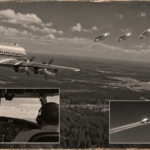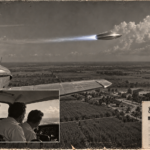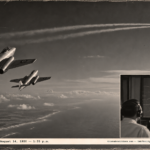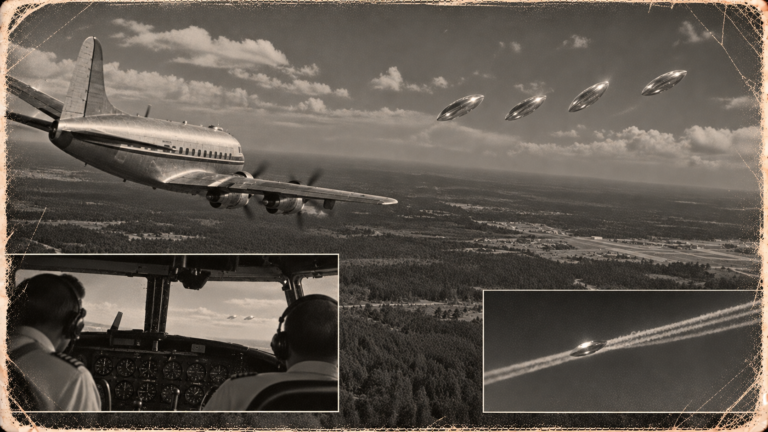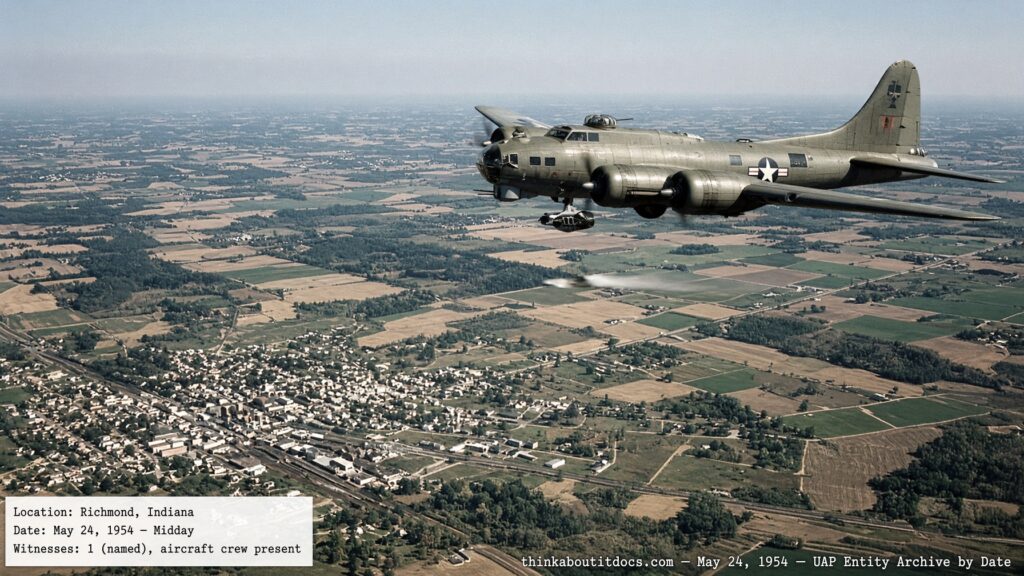
Major Leo Brubaker's B-17 mapping mission over Richmond, Indiana, during which he photographed an unidentified fast-moving object, May 24, 1954.
THINK ABOUTIT UFO|UAP SIGHTINGS REPORT
1954: The Brubaker Photographs — Richmond, Indiana
Major Leo Brubaker was flying a routine photographic mapping mission over Richmond, Indiana when something crossed beneath his B-17, moving at nearly twice his own aircraft’s speed. He had exactly the right equipment already running: an F11 mapping camera, pointed down, recording the ground below for forty-five uninterrupted seconds — long enough to capture on film an object most witnesses only ever get to describe from memory.
Date: May 24, 1954 BBU
Sighting Time: 12:25 p.m. (EST)
Day/Night: Day
Location: Richmond, Indiana (airspace)
Urban or Rural: Air
No. of Entity(‘s): 0
Entity Type: Not Applicable
Entity Description: Not Applicable
Hynek Classification: DD (Daylight Disc)
Duration: 45 seconds
No. of Object(s): 1
Description of the Object(s): Photographed with an F11 mapping camera; specific shape and surface detail as captured on film not further described in the surviving case summary
Shape/Size/Color of Object(s): Not specified beyond what the photographs themselves show
Distance to Object(s): Below the B-17’s flight path, close enough for sustained photographic tracking over the full 45-second observation
Height & Speed: Brubaker’s aircraft flew at 18,500 ft and 220 knots; the object’s speed was estimated at 440 knots — roughly twice the B-17’s own speed — covering approximately six miles over the ground during the observation
Number of Witnesses: 1 direct named witness (Major Leo Brubaker); additional B-17 crew presumably present given the nature of the mission, though not individually named
Special Features/Characteristics: The object was captured on film using the aircraft’s own F11 mapping camera, already active and pointed toward the ground for the photographic survey mission underway — meaning the photographic record exists as a byproduct of routine equipment already in use, not a hastily improvised attempt to document the sighting; the object’s calculated speed (440 knots) was precisely double the B-17’s own airspeed (220 knots), covering six miles of ground track during the 45-second observation
Case Status: Officially logged by Project Blue Book (BBU); a rare case with contemporaneous photographic documentation captured by standard aircraft mapping equipment rather than a witness’s personal camera
Source: UFOE, III; Project Blue Book files; James McDonald; Michael Swords; Dan Wilson
Summary/Description: At 12:25 p.m. EST on May 24, 1954, while flying a photographic mapping mission over Richmond, Indiana in a B-17 at 18,500 ft and 220 knots, Major Leo Brubaker of the USAF observed and photographed an object below his aircraft for 45 seconds using the plane’s F11 mapping camera. The object’s speed was estimated at 440 knots — twice that of Brubaker’s own aircraft — and it covered approximately six miles of ground track during the period of observation.
Related Cases: None known
Detailed Report
Major Leo Brubaker of the U.S. Air Force was flying a photographic mapping mission over Richmond, Indiana on May 24, 1954 — routine, methodical work, the kind that depends on precise, stable aerial photography rather than dramatic maneuvering. His B-17 held a steady course at 18,500 feet, cruising at 220 knots, its F11 mapping camera doing exactly what it was built to do: recording the terrain below in careful, systematic passes.
At 12:25 in the afternoon, something appeared below the aircraft that had nothing to do with the ground survey the camera was meant to capture. Brubaker observed the object directly and, crucially, had the equipment already running and pointed in roughly the right direction to photograph it — not a hastily grabbed personal camera, but the aircraft’s own precision mapping instrument, already active for the mission at hand.
Over the course of 45 seconds, Brubaker tracked the object as it moved, calculating its speed at approximately 440 knots — almost exactly double his own aircraft’s 220-knot airspeed. In that time, the object covered roughly six miles of ground track, outpacing the B-17 by a wide and clearly measurable margin.
RESEARCHER’S NOTES
Richmond — 1954 and Photography as a Byproduct of Ordinary Equipment
- A photograph that wasn’t improvised: Most UFO photographs in this era come from witnesses grabbing whatever camera happened to be at hand, often too late to capture much. Here, the photographic record exists because precision mapping equipment was already active and operating — a meaningfully different, arguably more reliable, chain of custody for the resulting images.
- A precisely calculated relative speed: The object’s 440-knot estimate being exactly double Brubaker’s own 220-knot airspeed is either a striking coincidence of measurement or reflects genuinely careful tracking against a known reference speed (his own aircraft) — either way, it’s a specific, calculable figure rather than a vague impression.
- Multiple independent research citations: This case’s sourcing spans UFOE, official Blue Book files, and cross-referencing by researchers including James McDonald, Michael Swords, and Dan Wilson — a broader base of independent research attention than many single-source entries in this archive receive.
- Limited surviving description of the photographs themselves: Despite the existence of photographic evidence, this archive’s surviving case summary does not describe what the images actually show in visual detail — a gap worth acknowledging rather than filling in with assumption.
- A named, ranked military witness: Brubaker’s rank and the official nature of his mission lend this case institutional credibility consistent with several other military-sourced entries in this archive’s record.
This case’s principal strength is the existence of contemporaneous photographic documentation captured by precision equipment already in active use — a stronger form of physical evidence than most testimony-only accounts in this archive can offer. Without direct access to the photographs’ content as described in the surviving record, this archive cannot characterize what they show beyond the case’s own summary details.
“The object traveled a distance of six miles over the ground at a speed twice that of the aircraft. The photos were taken with an F11 mapping camera.”
— Case summary, on Major Leo Brubaker’s account, May 24, 1954