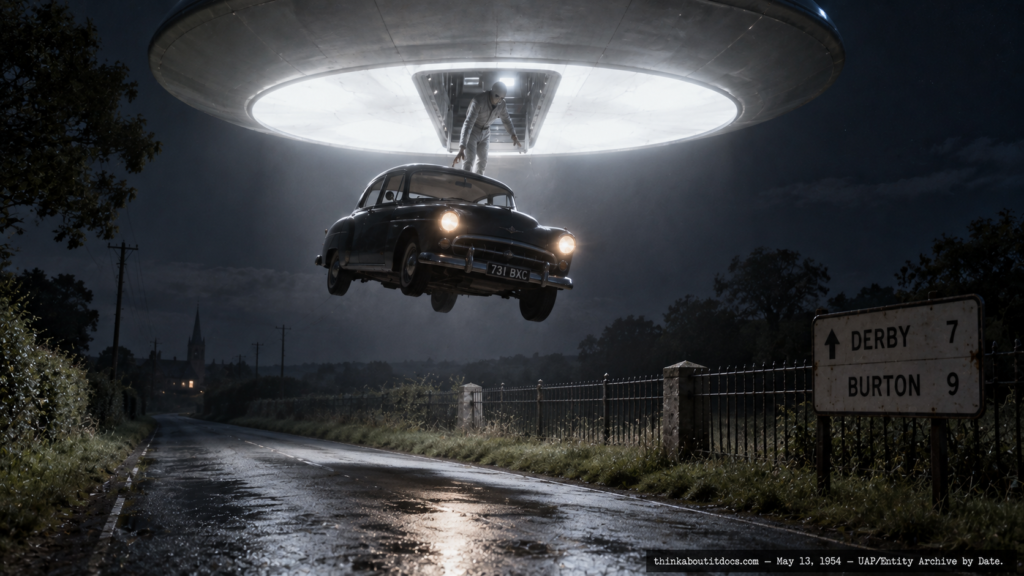
The Derby-to-Burton road where Commander H.R. Penrose's car was lifted beneath a hovering craft, May 13, 1954.
THINK ABOUTIT
UFO|UAP & ENTITY ENCOUNTER REPORT
1954: The Penrose Abduction — Derby to Burton, England
Commander H.R. Penrose was simply driving home from Derby to Burton when a bright light appeared ahead of him on the road — and then his account leaves the register of an ordinary sighting entirely. A crash. His car lifted bodily from the ground. A man in a one-piece suit hauling him effortlessly up into a hovering craft, a room full of instrument panels and quiet questions about his naval career and his radar work, and a green fluid injected into his arm before everything simply stopped. He woke up in his wrecked car, on top of a set of iron railings it had somehow knocked flat, with a concussion and no memory of how he’d gotten there.
Date: May 13, 1954
Sighting Time: 23:30 (11:30 p.m.)
Day/Night: Night
Location: The road between Derby and Burton, Derbyshire, England
Urban or Rural: Rural roadway
No. of Entity(‘s): Multiple (at least the man who lifted him aboard, plus additional men and women operating controls inside)
Entity Type: Humanoid
Entity Description: Wore matching one-piece suits; the individual who lifted Penrose aboard did so with unusual, effortless physical strength; no further physical description of the entities themselves survives in the account
Hynek Classification: CE-IV (Close Encounter, Fourth Kind — abduction, with vehicle interference and physical injury)
Duration: Not precisely specified; encompassed the roadway incident, the abduction and questioning, and Penrose’s eventual discovery unconscious in his wrecked vehicle
No. of Object(s): 1
Description of the Object(s): A large, round object emitting a bright light, hovering above the road, with an entrance on its underside
Shape/Size/Color of Object(s): Round; large; emitted a bright light; further shape and color detail not specified
Distance to Object(s): Penrose was lifted directly from his car into the object hovering above
Height & Speed: Not specified; the object was described as hovering above the crash site
Number of Witnesses: 1 direct (Commander H.R. Penrose); a railway signalman independently reported seeing a car with an extremely bright light above it pass his signal box the same night
Special Features/Characteristics: Penrose’s car was apparently lifted from the road along with him following an impact he experienced as a crash; he was carried through an entrance on the underside of the hovering object into an interior room containing operated controls; he was questioned, apparently telepathically, specifically about his naval experience and his work with radar; a woman injected a green fluid into his arm, after which his memory ends; he was later found unconscious and concussed in his car, which had come to rest atop a set of iron railings it had knocked down; an independent railway signalman corroborated seeing an extremely bright light above a passing car that night; hypnotic regression was planned to recover further detail
Case Status: Unresolved — a detailed single-witness abduction account with independent partial corroboration (the signalman’s sighting) and a documented physical injury (concussion) consistent with the described vehicle incident
Source: Margaret & Geoffrey Westwood, Flying Saucer Review, Vol. 23 #4
Summary/Description: At 11:30 p.m. on May 13, 1954, Commander H.R. Penrose was driving from Derby to Burton, Derbyshire, when a bright light appeared ahead, heading toward him. As it reached his position, he experienced what felt like a crash, was thrown against the windshield, and then felt his car lifted from the ground into the air beneath a large, bright, hovering round object. A man in a one-piece suit lifted him effortlessly through an entrance on the object’s underside into an interior room with operated controls, staffed by men and women in similar suits. He was questioned, apparently telepathically, about his naval experience and radar work, then a woman injected a green fluid into his arm — after which he recalled nothing further. He was found unconscious with a concussion in his car, which had come to rest atop a set of iron railings it had knocked down, and was hospitalized. After recovering, he located a railway signalman who independently confirmed seeing a car with an extremely bright light above it pass his signal box that same night. Hypnotic regression was planned to recover additional memory.
Related Cases: None known
Detailed Report
Commander H.R. Penrose was driving home along the road between Derby and Burton, Derbyshire, at half past eleven on the night of May 13, 1954, when a bright light appeared ahead, moving toward him. What happened as it reached his position defies an easy description as a simple sighting: Penrose experienced it as a crash, violent enough to throw him forward against his windshield.
What followed was stranger still. Rather than simply coming to a stop, the car itself seemed to lift from the road, carrying Penrose with it, rising through the air beneath a bright light positioned above him. The vehicle — and Penrose — were being drawn up toward a large, round, luminous object hovering overhead.
A man in a one-piece suit met him at an entrance on the object’s underside and lifted Penrose up and inside with what struck him as impossible, effortless strength. Once aboard, he found himself in a room fitted with controls, staffed by additional men and women dressed similarly. They questioned him — telepathically, by his own impression — with a notably specific line of inquiry: his experience in the Navy, and particularly his work with radar. Then a woman administered an injection of green fluid into his arm. Penrose’s memory of the encounter ends there.
He was discovered afterward in his car, unconscious and suffering from concussion, the vehicle resting atop a set of iron railings it had evidently struck and knocked down. He was taken to hospital for treatment.
Once recovered, Penrose returned to the site to see what he could learn. He found a railway signalman who, independently and without prompting from Penrose’s own account, confirmed having seen a car pass his signal box that night with an extremely bright light positioned above it — a detail that corroborated at least the visible, external portion of Penrose’s story, even though it couldn’t speak to anything that happened once he was allegedly aboard the object. Hypnotic regression was planned as a next step to try to recover further memory of the missing time.
RESEARCHER’S NOTES
Derby/Burton — 1954 and a Documented Injury Alongside an Independent Witness
- A genuine physical injury consistent with the account: Penrose’s concussion and the state of his wrecked car are independently verifiable facts — something happened to that vehicle and to Penrose physically that night, regardless of what explanation one assigns to the rest of the narrative.
- Independent partial corroboration is a real strength: The signalman’s account of an extremely bright light above a passing car, offered without prompting and matching the general timeframe and location, is a genuinely valuable piece of external support — though it corroborates only the light’s presence, not anything Penrose describes happening afterward.
- A specific, professionally-targeted line of questioning: Being asked specifically about naval service and radar experience, rather than generic questions about humanity or Earth, is an unusually pointed detail — it reads as a targeted interview rather than a generic contactee message.
- Hypnotic regression as a planned, not completed, step: The source material describes hypnosis as intended but doesn’t confirm it was carried out or what, if anything, it revealed — this archive notes that gap rather than assuming a result that isn’t documented.
- A credentialed witness with military background: As with several other entries in this archive, Penrose’s naval rank and background lend the account institutional credibility, though it remains, for the aboard-the-craft portion, an uncorroborated single-witness narrative.
This case combines documented physical injury, an independent signalman’s partial corroboration, and a specific, professionally-targeted line of questioning — a stronger evidentiary combination than many single-witness abduction accounts in this archive. What happened once Penrose was allegedly aboard the object remains entirely his own account, with no independent verification of that portion of the story.
“They questioned him (telepathically, he thinks) about his naval experiences and his work with radar.”
— Margaret & Geoffrey Westwood, Flying Saucer Review, Vol. 23 #4