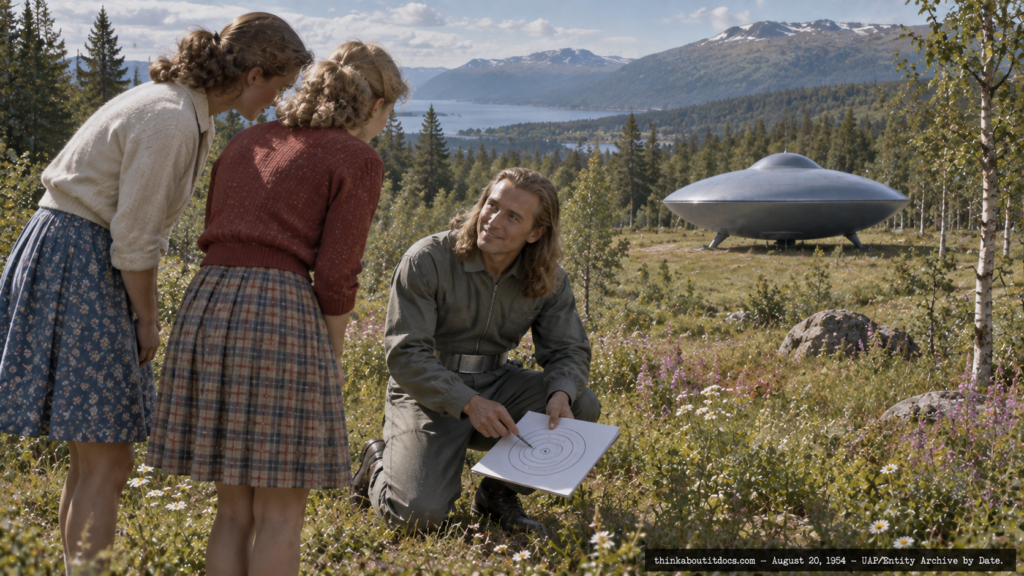
The Ceydalen, Norway wildflower field where Edith Jacobsen and Asta Solvang met a friendly stranger, August 20, 1954.
THINK ABOUTIT
UFO|UAP & ENTITY ENCOUNTER REPORT
1954: The Ceydalen, Norway Encounter — Edith Jacobsen
Edith Jacobsen and her sister Asta Solvang were picking wildflowers near Mosjoen, Norway when a smiling stranger approached with his hand out — not for a handshake, but to brush their palms gently with his own before speaking in an unplaceable, sing-song language neither woman, fluent in five others, could parse. He sketched the solar system in the dirt with something like a pencil, pointed to a planet they couldn’t quite make out through their own astonishment, then led them to a small clearing where a gray-blue lens-shaped craft sat waiting.
Date: August 20, 1954
Sighting Time: Afternoon
Day/Night: Day
Location: Ceydalen, near Mosjoen, Norway
Urban or Rural: Rural
No. of Entity(‘s): 1
Entity Type: Humanoid, claiming or implying extraterrestrial origin
Entity Description: Wore a greenish, one-piece coverall extending to the neck with no visible buttons or seams, and a very wide belt; long, light brown hair; light-colored, somewhat slanted eyes; noticeably bronzed skin; long, well-manicured, artist-like fingers
Hynek Classification: CE-V (Close Encounter, Fifth Kind — voluntary, bilateral contact)
Duration: An extended encounter of unspecified length, from initial approach through the craft’s departure
No. of Object(s): 1
Description of the Object(s): Lenticular, resembling two bowls placed together with a small dome on top, with a hatch at its base
Shape/Size/Color of Object(s): Lenticular, 4-5 m in diameter and approximately 1.30 m in height; metallic gray-blue
Distance to Object(s): The women were led to the craft but motioned to keep their distance as it rested in the clearing
Height & Speed: Rose vertically with a rotating motion to approximately 45 m, paused momentarily, then accelerated its rotation and climbed away on a diagonal trajectory until out of sight
Number of Witnesses: 2 (Edith Jacobsen, 24, and her sister Asta Solvang; their uncle, Halvlan Jacobsen, had been present earlier but had walked away before the encounter began)
Special Features/Characteristics: The entity’s initial greeting involved brushing the women’s palms with his own rather than a conventional handshake; he spoke in a “sing-song” language unrecognizable to both women despite their fluency in English, German, Russian, Spanish, and French; using a pencil-like tool, he drew a diagram on paper depicting a central point surrounded by circles representing the solar system’s planetary orbits, identifying Earth and the moon before pointing to another planet the women could not clearly make out due to their excitement; the craft emitted a slight whistling sound during liftoff; both women reported the encounter to police, who confirmed they were considered sound of mind and well known in the community
Case Status: Unresolved — a two-witness account with police-confirmed witness credibility in the local community
Source: Oddvar J. Larsen
Summary/Description: On August 20, 1954, 24-year-old Edith Jacobsen and her sister Asta Solvang were picking wildflowers near Ceydalen, close to Mosjoen, Norway, after their uncle had walked off separately. A smiling stranger approached, gesturing in greeting; he wore a seamless greenish coverall with a wide belt, had long light brown hair, slanted light-colored eyes, and bronzed skin. Rather than shaking hands, he brushed their palms with his own and spoke in an unrecognizable sing-song language, despite both women being fluent in five other languages. He drew a diagram of the solar system with a pencil-like tool, indicating Earth, the moon, and another unclear planet, then led them to a nearby clearing containing a gray-blue, lenticular craft roughly 4-5 m across. Motioning them to keep their distance, he entered through a base hatch and sealed it behind him; the craft rose with a rotating motion, paused at about 45 m, then accelerated and departed diagonally out of sight. The women reported the encounter to police, who confirmed both were considered sound of mind and well known locally.
Related Cases: None known
Detailed Report
Edith Jacobsen, 24, her sister Asta Solvang, and their uncle Halvlan Jacobsen had gone out into fields near Ceydalen, close to Mosjoen, Norway, on August 20, 1954, to gather wildflowers. After a while, their uncle wandered off on his own, leaving the two sisters alone. It was shortly afterward that they noticed a man approaching from a distance, smiling, making friendly hand gestures as he came. Startled but not frightened enough to flee, the women decided to wait and see who he was.
Up close, the stranger’s clothing was the first thing that struck them as unusual: a greenish, one-piece coverall reaching all the way to his neck, with no visible buttons or seams anywhere, cinched with an unusually wide belt. But it was his hair that really caught their attention — long, and a light brown color, paired with light-colored, somewhat slanted eyes and noticeably bronzed skin.
The women greeted him back, gesturing in return, and asked who he was. Still smiling, he extended his hand — not for a handshake, but to gently brush the palm of one woman’s hand with his own, before speaking in a language neither of them could identify, delivered in what they described as a sing-song manner. This was notable in itself: both women were fluent not just in English but in German and Russian, and reasonably capable in Spanish and French as well. Whatever he was speaking matched none of it. “His hands were beautiful,” one of them later said, “with long well-manicured fingers like that of an artist.”
The stranger radiated, by their account, a genuine warmth and kindness that left a strong impression on both of them. He then produced something resembling a pencil, along with a piece of paper, and began to draw: a central point surrounded by several circles, representing — as he indicated by pointing — the orbits of the planets in the solar system. He identified Earth and the moon clearly enough. When he pointed to another planet, the women found themselves too overwhelmed by the moment to register clearly which one he meant.
Just as smoothly as he’d produced them, he tucked the pencil and paper back into his coverall, apparently through some opening the women couldn’t quite locate. A little uneasy now despite his continued friendliness, they nonetheless followed when he motioned for them to come with him. He led them to a small nearby clearing, where a metallic, lens-shaped object rested — described afterward as looking like two bowls placed rim to rim, with a small dome on top, roughly four to five meters across and about a meter and a third tall, colored a gray-blue.
As they neared, he motioned firmly for them to stop and keep their distance. He then opened a hatch at the base of the craft, stepped inside, and sealed it behind him. A slight whistling sound followed, and the object began to rise, rotating slowly as it climbed. At around forty-five meters up, it paused briefly — then its rotation sped up dramatically, and it shot upward along a diagonal path before vanishing from sight entirely.
Shaken by what they’d experienced, both women reported the encounter to the police. According to the officials who took their statements, both Edith and Asta were well known in the local community and considered entirely sound of mind.
RESEARCHER’S NOTES
Ceydalen — 1954 and Two Credible Witnesses With a Consistent Story
- Police-confirmed local standing: Unlike many single-witness accounts in this archive, this case includes an explicit third-party assessment — police confirming both women were well known and considered sound of mind — a form of character corroboration this archive rarely has available.
- A specific test of the language barrier: The detail that both women were independently fluent in multiple European languages, and still couldn’t place what they heard, is a meaningful way of ruling out a simple misheard-foreign-language explanation, at least among the languages they knew.
- An unusual, deliberate greeting gesture: Brushing palms rather than shaking hands is a specific enough detail that it doesn’t read as generic contactee filler — it’s the kind of small, particular behavior that’s easy to remember precisely because it doesn’t match an expected script.
- A solar system diagram, only partly legible to the witnesses: The women’s honest admission that they couldn’t identify the planet he indicated — rather than claiming certainty about a dramatic revelation — reads as a more credible kind of imperfect recall than a suspiciously complete account would.
- Two witnesses, one uncle absent at the critical moment: The uncle’s departure just before the encounter is a detail worth noting plainly — it means the case’s only witnesses are the two sisters, without a third, differently-positioned observer to corroborate.
This case combines two mutually corroborating witnesses with independently confirmed community standing — a stronger baseline of ordinary credibility than many entries in this archive can claim. It remains, in the end, a close-range single-encounter account with no physical trace and no third witness, evaluated on the strength of the two women’s consistency and reputation alone.
“His hands were beautiful, with long well-manicured fingers like that of an artist.”
— Edith Jacobsen and Asta Solvang, Ceydalen, Norway, August 20, 1954