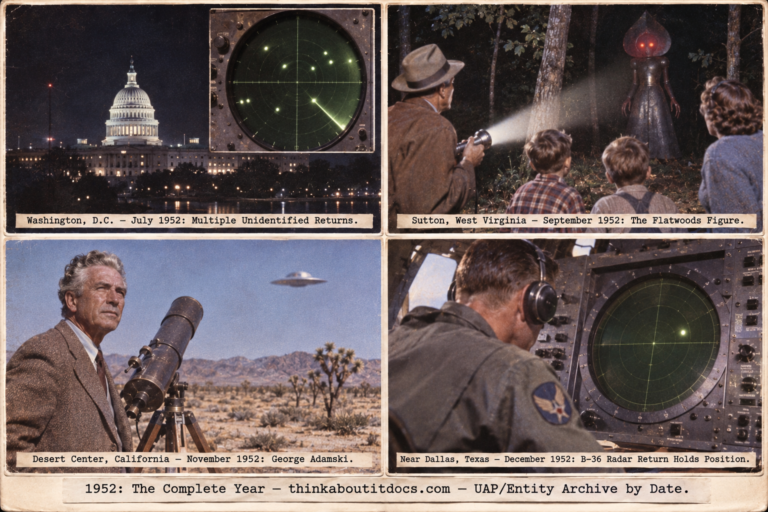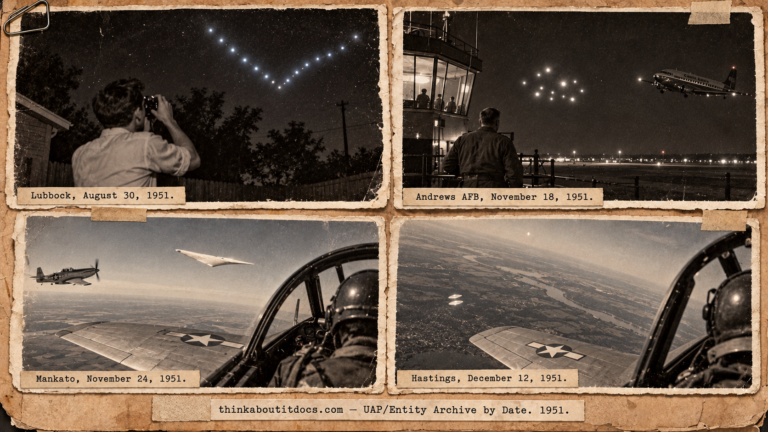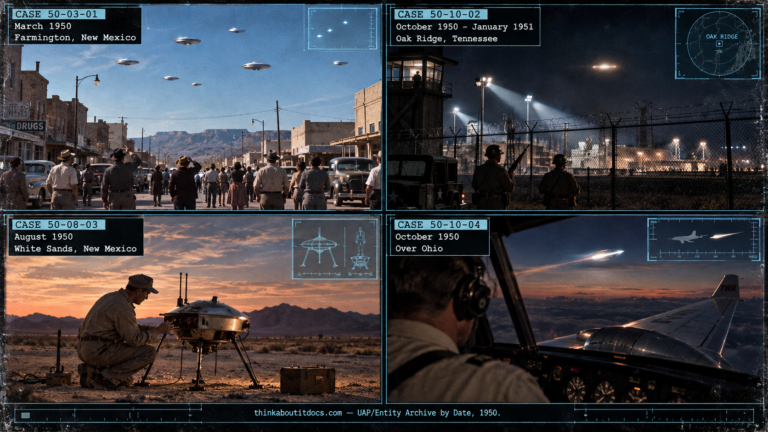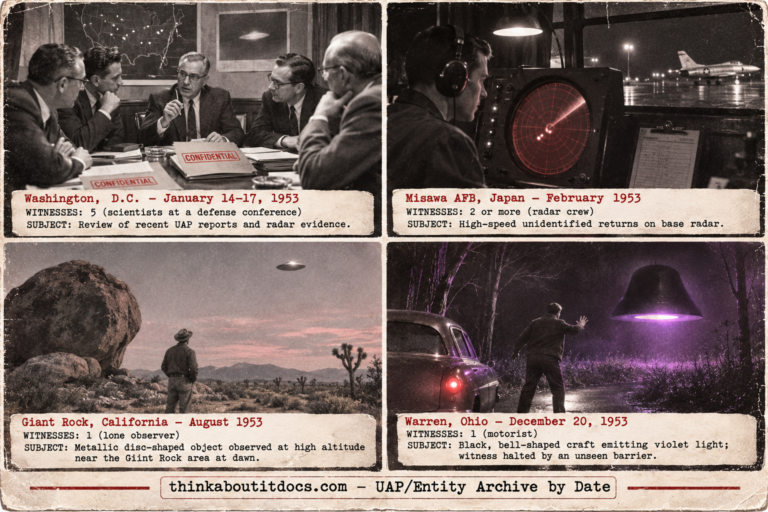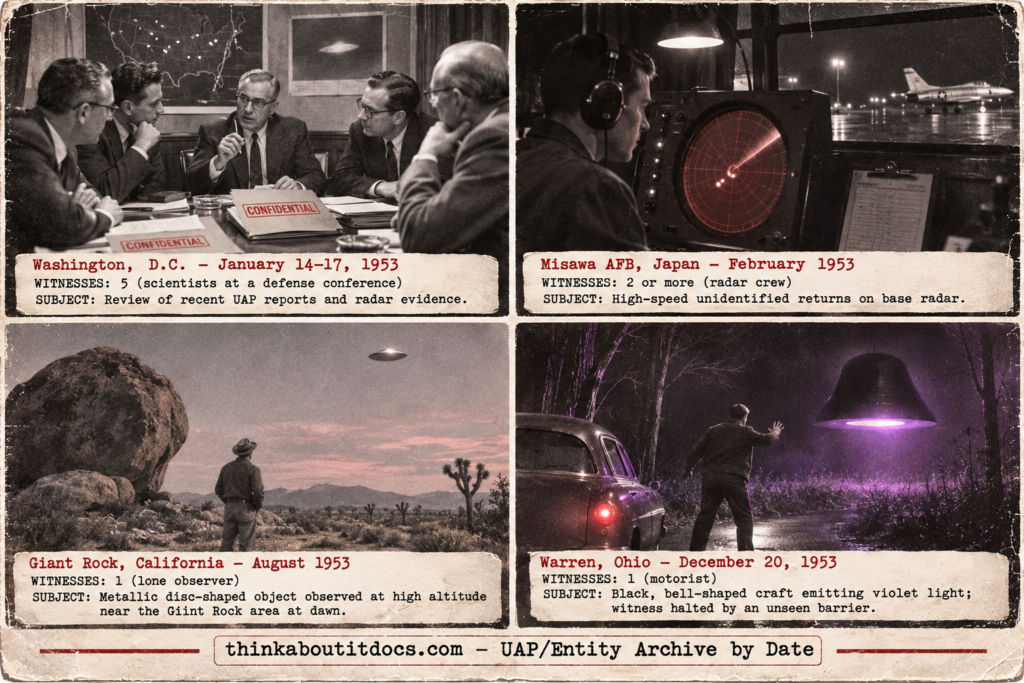
1953 in four scenes: the Robertson Panel, radar-tracked pursuits, Giant Rock and a Warren, Ohio roadside.
1953: UFO|UAP & Entity Sightings
The Complete Year
1953 opens with the U.S. government’s most consequential closed-door meeting on the subject to date and closes with one of American ufology’s founding personal mythologies taking root. Fourteen days into the year, the CIA convened the Robertson Panel to decide what the flood of sightings meant for national security, and January and February are dense with the radar-tracked military pursuits the panel was built to evaluate: Misawa, Offutt, Bergstrom, a Marine Corps jet outclimbed by 10,000 feet in seconds near the Virginia-North Carolina line. In August, George Van Tassel woke in the open desert beside Giant Rock, California, to an invitation that would launch the UFO convention circuit for years afterward. In November, a seven-year-old on the banks of Arkansas’s St. Francis River had an experience that would grow, over four decades, into one of the most elaborate contactee mythologies in the country. The same November holds the year’s most serious unresolved military mystery: an Air Force F-89 that vanished over Lake Superior chasing a radar target, two men lost, no wreckage ever found.
Between those poles sits a year of real range: Capt. Roderick Thompson’s gun-camera footage over the Colorado River, two women’s missing two hours in Tujunga Canyon, Dino Kraspedon’s fluent-Latin visitor in Angatuba, Brazil, a winged figure in a Houston pecan tree over a decade before Mothman, three Blue Book unknowns in December, and a scattering of crash-retrieval claims best named plainly rather than repeated as settled fact. This is the complete 1953 UFO sightings archive: twelve monthly indexes and an Unknown Date page, tracing the year the government moved to quietly evaluate the phenomenon at the exact moment ordinary people were starting to build a culture around it.
1953: January — Over twenty witnesses across four New Jersey towns, including a Navy pilot and several police officers, watch circling lights for ninety minutes on the night of January 1-2, a case J. Allen Hynek himself calculated at a 90,000 mph departure speed.
1953: February — Five days before the Robertson Panel convenes, a Marine Corps jet pilot chases an object that outclimbs him by 10,000 feet in seconds; a South Carolina radar case tracks a target violating restricted airspace over a sensitive nuclear facility with unusual precision.
1953: March — Project Blue Book gets actual gun-camera film from an F-84 pursuit over the Colorado River; two women in Tujunga Canyon, California lose more than two hours of memory in a case that would later become the subject of an entire book.
1953: April — A three-year-old in Bagley, Minnesota recalls breaking free from entities who told him he’d never remember them; in Angatuba, Brazil, Dino Kraspedon meets a visitor claiming Ganymede as home who speaks to him in fluent Latin and Greek.
1953: May — Miner John Q. Black watches a silvery, tripod-legged disc for the second time that spring at Brush Creek, California; engineer Arthur Stansel’s twenty-years-later affidavit describes a downed craft near Kingman, Arizona, one of the year’s best-known unverified crash-retrieval claims.
1953: June — Three neighbors in Houston watch a six-and-a-half-foot winged figure glowing yellow in a pecan tree, over a decade before Mothman; John Q. Black finally meets his disc’s occupant filling a bucket at the creek.
1953: July — A twelve-year-old’s twenty-five years of missing memory surfaces under hypnosis in the English Home Counties; a young Spanish cowherd gets slapped across the face by one of three tiny occupants of a landed craft.
1953: August — George Van Tassel wakes beside Giant Rock, California to an invitation from “Solgando,” a founding moment for American contactee culture; Ellsworth AFB, South Dakota produces one of Blue Book’s best-documented radar-visual pursuits.
1953: September — A witness in Tonnerre, France watches two landed craft and three helmeted entities depart, one vehicle extending wing-like panels before takeoff, documented by Jacques Vallée and corroborated by physical traces.
1953: October — Antonio Apodaca’s four-day account of an alien world, corroborated at least at its opening by multiple witnesses to the initial landing, stands as one of the year’s most internally detailed contact narratives.
1953: November — An Air Force F-89 vanishes over Lake Superior chasing an unidentified radar target, two men lost, no wreckage found; a seven-year-old on Arkansas’s St. Francis River begins what would become an elaborate contactee mythology.
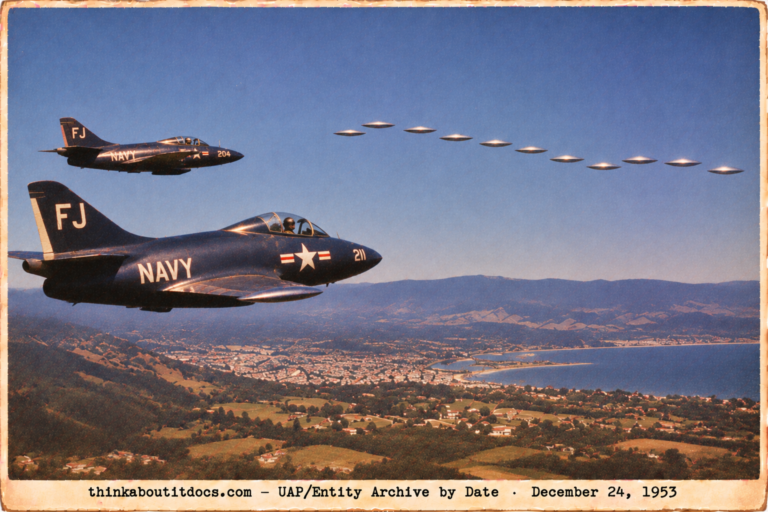
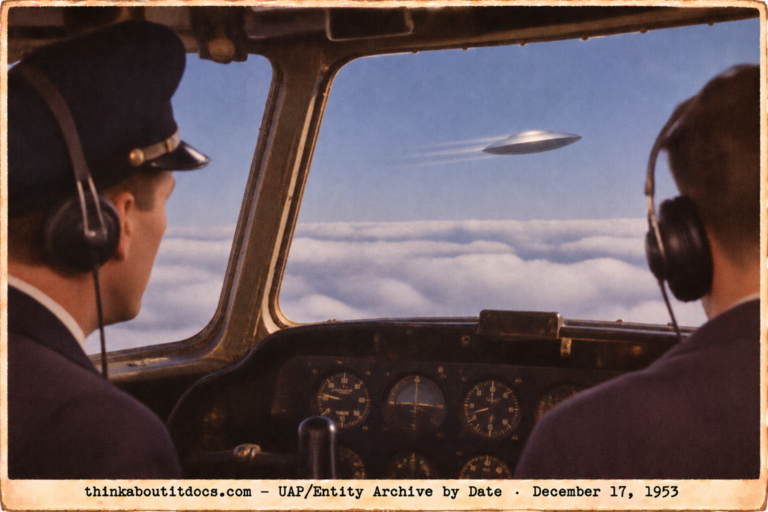
1953: December — Two Navy pilots over El Cajon, California watch ten silver ovals fly in formation at over 400 knots, and a Transair DC-3 crew over Sweden meets a metallic disc above the clouds; near Warren, Ohio, Al Como’s car vanishes twice beside a bell-shaped craft behind an invisible wall of force.
1953: Unknown Date — Eighteen entries whose exact dates never reached the surviving documentation, from a gold prospector’s masked-body discovery in the Venezuelan Amazon to a silent stranger in Rio de Janeiro.
The Robertson Panel and the Birth of American Contactee Culture
No single thread explains 1953, but two currents running in parallel come closer than anything else. In January, the CIA convened a panel of scientists under physicist H.P. Robertson to review the Air Force’s strongest UFO sightings and recommend a policy. The panel concluded that the phenomenon posed no direct security threat but that public fascination with it did, and that a program of public education and debunking was warranted. That posture shaped official treatment of the subject for the next two decades.
At the same time, an unofficial culture was taking root among ordinary witnesses and self-described contactees, one the government’s posture did nothing to slow. Kraspedon in Brazil, Van Tassel at Giant Rock and the origins of what became the Tujunga Canyon contacts: 1953 is the year several of American ufology’s most enduring personal narratives began or crystallized, independent of, and often in spite of, official skepticism.
Who Was Watching in 1953
The CIA and the Robertson Panel: Convened January 14-17, 1953, the panel reviewed the Air Force’s best-documented cases and recommended a public posture of education and debunking in place of open investigation, a decision visible in nearly every official response for the rest of the decade.
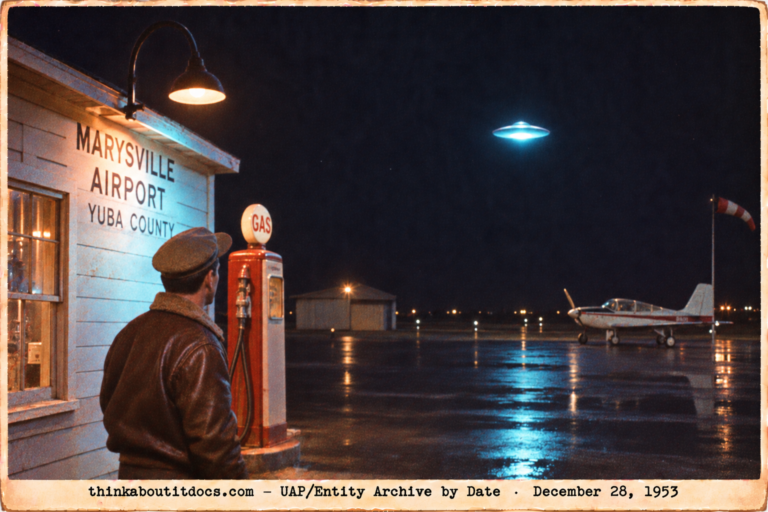
The Air Force: A year of genuine radar-visual density, with Misawa, Offutt, Bergstrom, Continental Divide, Turner AFB and Ellsworth AFB, plus one unresolved loss: the November disappearance of an F-89 and its two-man crew over Lake Superior. December adds three Blue Book unknowns: El Cajon, Hässleholm and Marysville.
The Contactees: Dino Kraspedon in Angatuba, Brazil; George Van Tassel at Giant Rock, California; the beginnings of the St. Francis River, Arkansas mythology. Three personal narratives, each destined to outlive the year that produced them by decades.
Ordinary Witnesses: A Houston pecan tree, a Tujunga Canyon cabin, a Spanish cowherd slapped by a tiny occupant, a Warren, Ohio driver whose car vanished twice. The year’s real texture, largely unconnected to either the government’s deliberations or the contactees’ public followings.
Read together, 1953 is a year of two institutions forming at once: an official one, deciding quietly how the subject would be managed from above, and an unofficial one, built in parallel by the people who claimed direct experience of it. Neither fully accounts for the other, and the record of the year holds both side by side.
“a silver saucer with illuminated windows”
— Witness Report, Craig, Montana, January 1953