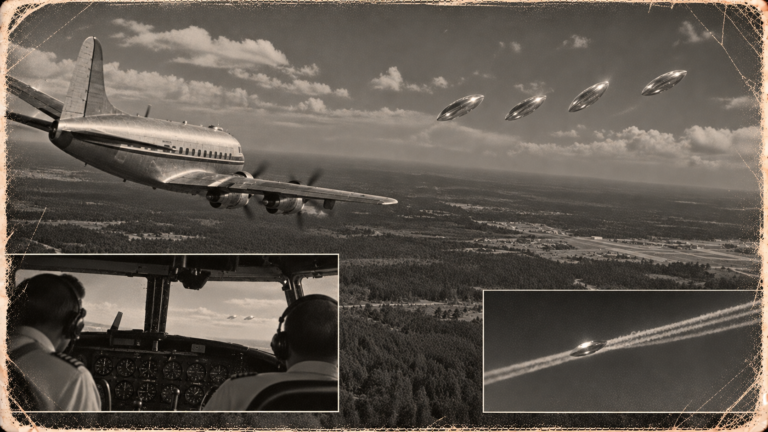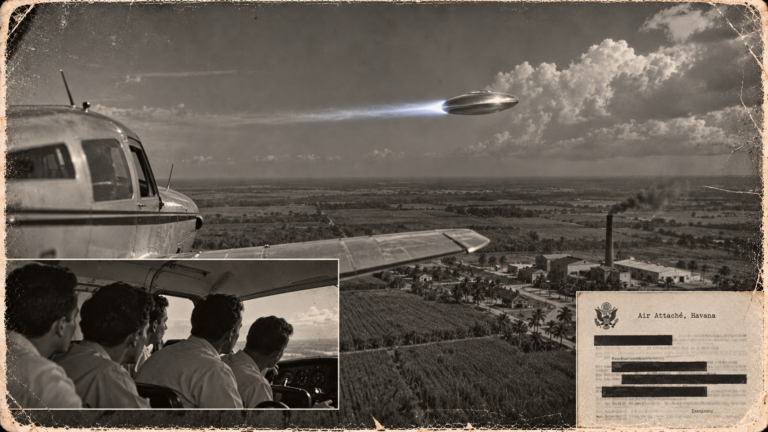
The March 29, 1952 Glen Burnie, Maryland case, in which two men encountered a hovering silver disc that stalled their car — a case its own source material flags as possibly a hoax.
THINK ABOUTIT UFO|UAP ENCOUNTER REPORT
1952: The Glen Burnie, Maryland Case
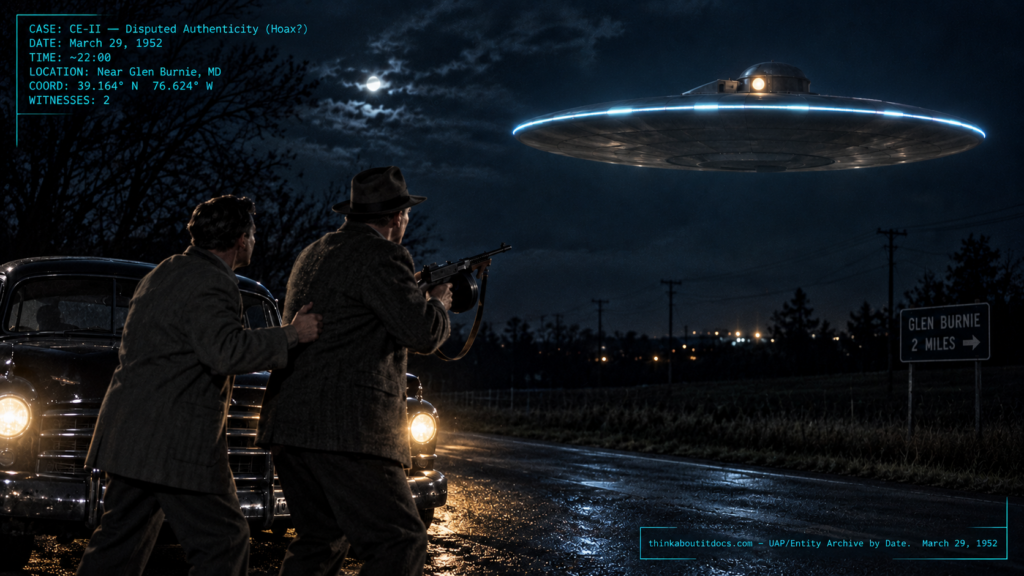
Two men driving near Glen Burnie, Maryland one March night in 1952 watched a 50-foot silver disc approach, hover a few hundred feet away, and stall their car’s engine — and one of them got out with a Thompson submachine gun, seriously weighing whether to open fire on it before his companion talked him down. The case drew the personal interest of the Secretary of the Air Force and a full AFOSI investigation, and it appears in J. Allen Hynek’s own published UFO report. It is also, per that same source material, explicitly flagged with a question mark: Hoax? This report preserves that uncertainty rather than resolving it either way — the case is presented here exactly as dramatically, and exactly as doubtfully, as the record leaves it.
Date: March 29, 1952 (possibly April 24, 1952 per one date-discrepancy note in the original record)
Sighting Time: 10:45 p.m.
Day/Night: Night
Location: Glen Burnie, Maryland
Urban or Rural: Roadside, suburban/rural Maryland
No. of Entity(‘s): Not applicable — no occupants seen
Entity Type: Not applicable
Hynek Classification: CE-II (Close Encounter of the Second Kind) — the reported physical/electromagnetic effects on the car place it in this category, though the case’s disputed authenticity should be weighed against the classification
Duration: Approximately 2-3 minutes for the hovering phase, per the original record’s own bracketed uncertainty
No. of Object(s): 1
Description of the Object(s): A flat, silver disc with a cupola or dome positioned off to one side, featuring a porthole and a hatch on the dome, with neon-like lighting — described as possibly pulsating — running around its edges
Shape of Object(s): Flat disc with an off-center cupola/dome
Size of Object(s): Approximately 50 feet across
Color of Object(s): Silver, with neon-like edge lighting
Distance to Object(s): The object approached the witnesses’ car directly and hovered several hundred feet away, at roughly 60° elevation from their position
Height & Speed: Approached from ahead to the northeast, then hovered and “wavered slightly” for two to three minutes several hundred feet off the ground before suddenly turning on edge and departing to the southwest faster than a jet aircraft, disappearing after about three and a half miles
Number of Witnesses: 2 (Donald F. Stewart, spelling possibly “Steward” in the original record, and George Tyler III)
Special Features/Characteristics: A whirring sound resembling a vacuum cleaner accompanied the object’s hover; the witnesses’ car engine died while the object hovered nearby; the witness Stewart retrieved a Thompson submachine gun from the vehicle and gave serious consideration to firing on the object, a decision his companion Tyler talked him out of; following the encounter, the witnesses reported their car’s wiring appeared “magnetized” and the vehicle’s paint had cracked; the case drew the personal interest of Secretary of the Air Force Thomas K. Finletter and a formal AFOSI (Air Force Office of Special Investigations) inquiry; the original compiled source material itself flags the case with an explicit “Hoax?” notation.
Case Status: Insufficient Data (explicitly disputed — the original source material itself questions the case’s authenticity)
Source: J. Allen Hynek, The UFO Report, pp. 196-198; Jan Aldrich; FUFOR Index; Loren Gross, UFOs: A History, January-May 1952, p. 25
Summary/Description: At 10:45 p.m. on March 29, 1952 (with one source noting a possible date discrepancy pointing to April 24, 1952 instead), Donald F. Stewart and George Tyler III were driving near Glen Burnie, Maryland when they saw a roughly 50-foot flat silver disc, with a cupola or dome to one side featuring a porthole and hatch, and neon-like — possibly pulsating — lighting around its edge. The object approached from ahead to the northeast at an estimated 60° elevation, then hovered and “wavered slightly” several hundred feet off the ground for two to three minutes, producing a whirring sound like a vacuum cleaner. During this time, the witnesses’ car engine died. Stewart got out of the vehicle with a Thompson submachine gun and seriously considered firing at the object; Tyler urged him not to. The disc then suddenly turned on edge and appeared to “roll across the sky,” departing to the southwest faster than a jet aircraft and disappearing from view after about three and a half miles. The witnesses later reported that their car’s wiring seemed to have become magnetized and that the vehicle’s paint had cracked. The case attracted the personal interest of Secretary of the Air Force Thomas K. Finletter and prompted a formal AFOSI investigation. It is documented in J. Allen Hynek’s own published UFO report, though the underlying compiled source material explicitly flags the case’s authenticity in question with a “Hoax?” notation, which this archive preserves rather than resolving.
Related Cases: 1950: Crash near Del Rio, Mexico (comparable case where a dramatic core claim carries serious, honestly-flagged doubt)
Detailed Report
The Glen Burnie case presents an unusual and genuinely difficult evidentiary puzzle: it is simultaneously one of the more institutionally significant cases in this archive’s 1952 record — drawing the Secretary of the Air Force’s personal attention and a formal AFOSI investigation — and one whose own underlying source material explicitly questions whether it happened as described at all. This combination is worth sitting with rather than resolving prematurely in either direction. A case that attracted senior government attention was not, by that fact alone, necessarily true; official interest can be generated by a report’s dramatic content and apparent detail just as easily as by its underlying reality, especially in a year when UFO reports were already drawing intense institutional scrutiny.
The specific details that make this case so vivid — the Thompson submachine gun, the “magnetized” wiring, the cracked paint, the vacuum-cleaner whirring sound — are exactly the kind of richly specific, sensory details that can cut either way in an evidentiary assessment. They could reflect genuine, precisely recalled memory of an extraordinary event; they could equally reflect a well-constructed and memorable fabrication, since specificity and vividness are hallmarks of a good story regardless of its truth value. Neither this archive nor, apparently, the Air Force investigators who examined the case at the time could resolve which explanation applies.
The witness’s own willingness to arm himself and seriously consider firing on the object is a genuinely distinctive behavioral detail rarely found elsewhere in this archive’s collection — most witnesses describe fear, paralysis, or curiosity, not calculated consideration of an armed response. Whether this detail reflects an authentically extreme reaction to a terrifying real event, or a narrative embellishment designed to heighten the story’s drama, cannot be determined from the available record.
The reported physical aftereffects — magnetized wiring and cracked paint — are, in principle, checkable claims that could have been verified by a period automotive examination, and the case’s genuine AFOSI investigation presumably would have looked into exactly this kind of physical evidence. That neither Hynek’s account nor the other compiled sources report a specific finding on the vehicle’s condition is a real gap in the record; if the investigation reached a definitive conclusion on the car’s alleged damage, that conclusion has not survived in the sources reviewed by this archive.
RESEARCHER’S NOTES
The Glen Burnie Case — Maryland 1952 and the Honesty of an Unresolved Verdict
- Classification issues: CE-II reflects the reported physical/electromagnetic effects (the stalled engine, the magnetized wiring), though given the case’s disputed authenticity, this classification should be read as descriptive of the claim rather than as an endorsement of its reality.
- Source chain assessment: Unusually, the case’s own primary compiled source (the material behind Hynek’s, Aldrich’s, and Gross’s accounts) carries an explicit “Hoax?” flag rather than presenting the case as straightforwardly credible — a rare instance of the source material itself building in the appropriate skepticism, which this archive preserves rather than smooths over in either the credulous or dismissive direction.
- Pattern context: The case belongs to a small category of 1950s UFO reports that drew genuine high-level government attention and formal investigation despite unresolved authenticity — comparable in structure, if not in specific content, to several other cases in this archive where institutional seriousness and evidentiary uncertainty coexist.
- Physical evidence and evidentiary weight: The claimed physical effects (magnetized wiring, cracked paint) were, in principle, verifiable by the AFOSI investigation that reportedly followed, but no surviving source in this archive’s review reports that investigation’s specific findings on the vehicle. This is a case where a resolving piece of evidence likely once existed in some Air Force file but is not available in the sources this archive has reviewed.
- Geographic and historical context: Glen Burnie sits near Baltimore and Washington, D.C., placing the sighting within the broader Mid-Atlantic corridor that would, four months later, become the epicenter of the far more famous July 1952 Washington, D.C. UFO flap.
The Glen Burnie case is preserved here exactly as its own source material presents it: dramatic, richly detailed, taken seriously enough by the Secretary of the Air Force to warrant a formal investigation, and explicitly flagged by the researchers who compiled it as possibly untrue. This archive does not resolve that tension, because the available record does not permit a resolution — the same details that make the case memorable (the submachine gun, the magnetized car) are equally consistent with an extraordinary real event and a well-told fabrication. It is catalogued here as Insufficient Data, in the specific sense that its own primary sources leave the question of authenticity explicitly, deliberately open.
Hoax?
— The original compiled source’s own notation on the March 29, 1952 Glen Burnie, Maryland case