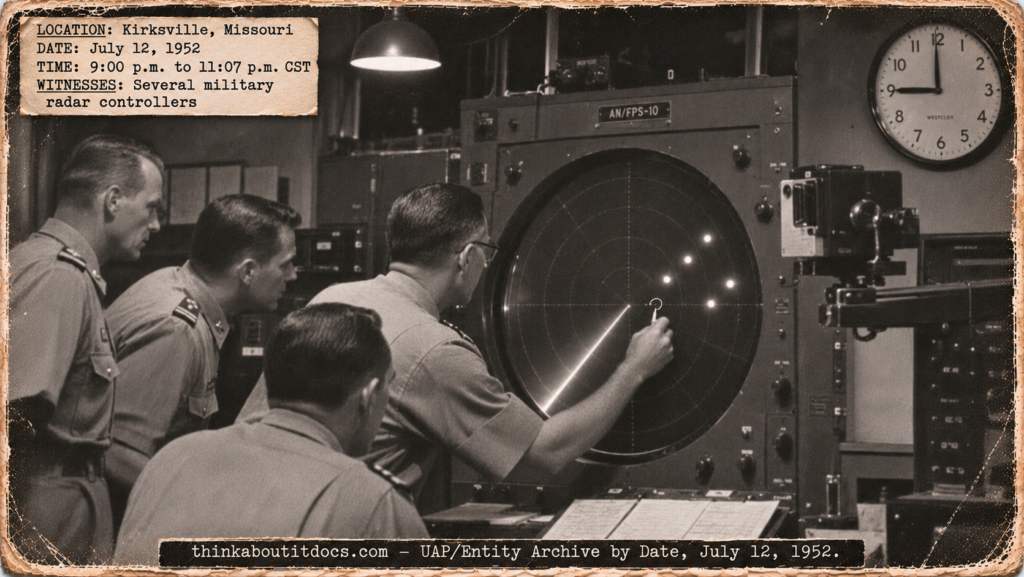
Kirksville, Missouri, July 12, 1952: blips at 1,500 knots.
THINK ABOUTIT UFO|UAP SIGHTINGS REPORT
Kirksville, Missouri Radar Tracks:
Military Controllers Follow Blips at 1,500 Knots and More, July 12, 1952
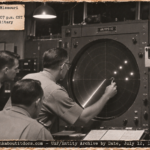
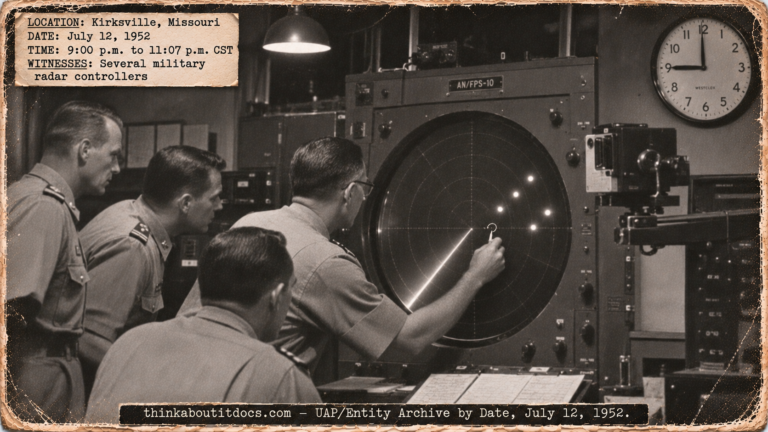
On the night of July 12, 1952, radar controllers at a Missouri air defense station watched large blips cross their scopes at speeds that no aircraft of the era could approach. The Kirksville, Missouri radar case, logged by military officers of the 790th Aircraft Control and Warning Squadron, put the first tracks at 1,500 knots, about 1,700 mph. Seven photographs of the scopes were taken. Nobody saw anything outside the building; the case is all radar.
Project Blue Book evaluated the Kirksville report as Unidentified, one of three July 10-14 reports it left that way. Brad Sparks’ analysis, quoted below, counts six separate radar tracks between 9:00 and 11:07 p.m. and calls them suggestive of real objects below about 20,000 feet. The July 1952 UFO sightings that night ran from Illinois to Wisconsin to Missouri, and Kirksville is the one with photographs of the scope.
Date: July 12 (or 13), 1952
Sighting Time: 9:00 p.m. to 11:07 p.m. CST (six tracks)
Day/Night: Night
Location: Kirksville, Missouri, United States (790th AC&W Squadron radar)
Urban or Rural: Rural
No. of Entity(‘s): Not Applicable
Entity Type: Not Applicable
Entity Description: Not Applicable
Hynek Classification: Radar only (no visual sighting; Hynek’s closest category, Radar-Visual, requires a visual sighting)
Duration: Six separate radar tracks over about two hours, according to Brad Sparks’ analysis
No. of Object(s): Several large radar blips; Sparks counts six tracks
Description of the Object(s): Large radar blips tracked on an FPS-10 radar by military radar controllers. No visual sighting was made
Shape/Size/Color of Object(s): Not applicable (radar returns only)
Distance to Object(s): Sparks estimates ranges of about 124 to 293 miles and says the tracks are suggestive of real objects below about 20,000 feet, within the lower beam of the FPS-10 radar
Height & Speed: Computed speeds from over 1,500 knots (1,700 mph) to 4,800 knots; Sparks estimates actual speeds of about 5,000 to 6,000 mph
Number of Witnesses: Several military radar controllers (officers), at the 790th AC&W Squadron
Special Features/Characteristics: Seven photographs of the radar scope in Blue Book photograph file 1436 (July 13, 1952); multiple independent tracks; no visual sighting
Case Status: Project Blue Book: Unidentified (Unknown)
Source: Berliner (BBU 1436); NICAP chronology; Brad Sparks (NICAP) analysis as quoted on realtvufos.blogspot.com; Project Blue Book photograph file 1436
Summary/Description: Military radar controllers at the 790th AC&W Squadron tracked large blips at 1,500 knots and faster. Seven scope photographs exist. Blue Book: Unidentified.
Related Cases: Belleville, Illinois, Arlington, Illinois and Dayton, Ohio radar and visual reports of July 12, 1952; Annapolis, Maryland, July 12, 1952
Detailed Report
The NICAP chronology entry for Kirksville, Missouri, July 12 at 9:00 p.m., reads: “Several big blips tracked on radar at 1,500 kts. (1,700 m.p.h.). There was no visual sighting.” The observers were radar controllers who were military officers.
Brad Sparks’ analysis, which dates the case July 12 (13?), expands on this. He reports six radar tracks between 9:00 and 11:07 p.m. CST by many FPS-10 radar controllers at the 790th AC&W Squadron, with speeds from over 1,500 knots to 4,800 knots. He estimates actual speeds of about 5,000 to 6,000 mph and ranges of roughly 124 to 293 miles, and writes that the tracks are suggestive of real objects below about 20,000 feet within the FPS-10’s lower beam.
The Blue Book photograph cover sheet for file 1436 is dated July 13, 1952, lists Kirksville, Missouri, and counts seven photographs. The photographs are images of the radar scope. Project Blue Book evaluated the Kirksville case as Unidentified in its July 10-12 evaluation list.
RESEARCHER’S NOTES
Reading the Kirksville Scope Photographs
- Why the date is split: NICAP lists July 12 at 9:00 p.m.; Sparks gives July 12 (13?); the photograph file is dated July 13. The tracks run past 11:00 p.m. CST, which is early July 13 in Zulu time. Both dates are defensible.
- Speed figures: 1,500 knots is the speed in the NICAP entry. Sparks cites tracks up to 4,800 knots and his own estimates of 5,000 to 6,000 mph. Those are different calculations of the same data, and I report both.
- A radar-only case: No one looked up. The case rests on the scope photographs and the controllers’ tracking. Anomalous propagation and weather returns are the usual explanation for fast, random radar tracks. Blue Book left this one Unidentified.
- The night of July 12: Radar and visual reports came from Illinois, Wisconsin, Ohio and Missouri the same evening. Blue Book evaluated the Belleville, Dayton and Indiana-Illinois reports as meteors, and Kirksville and Annapolis as Unidentified.
- What is missing: The Blue Book scans of the Kirksville case file, apart from the photograph cover sheet, were not available to me, so the controllers’ names and the squadron’s own analysis are not given here.
Kirksville is a radar case with a photographic record, unusual for 1952. It does not show what the objects were. It shows that trained military controllers tracked something that moved faster than any known aircraft, and that the Air Force had no explanation to offer.
“Several big blips tracked on radar at 1,500 kts. (1,700 m.p.h.). There was no visual sighting.”
— NICAP chronology, Kirksville, Missouri, July 12, 1952