July 29, 1952 — Ennis, Montana
THINK ABOUTIT UFO|UAP SIGHTINGS REPORT
1952 Ennis, Montana Case: Objects That Formed Their Own Clouds, Filmed by a Dozen Witnesses
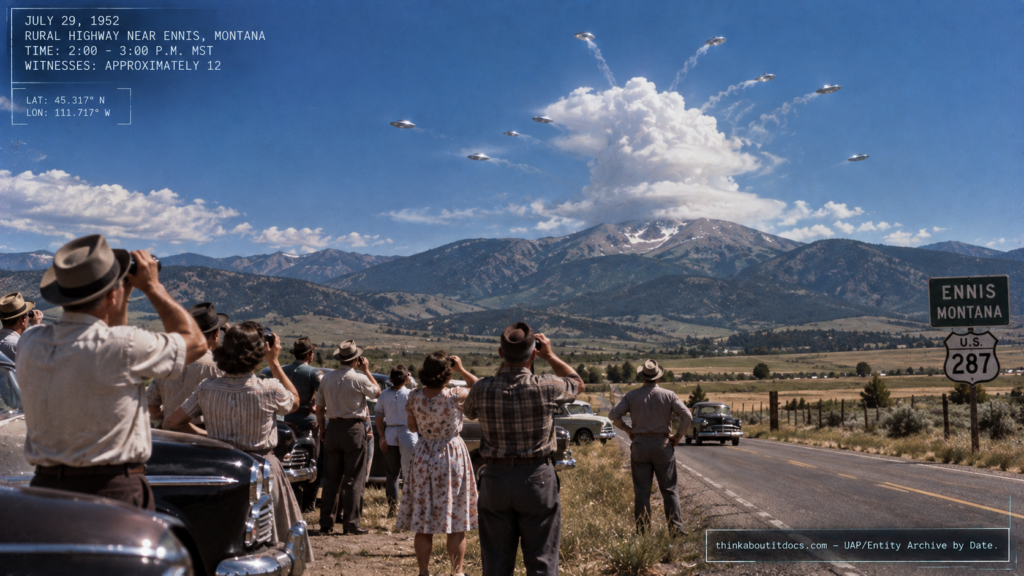
Sometime between 2 and 3 p.m. on July 29, 1952, a Montana rancher named Ben Shaffer was driving near Ennis when he spotted something hovering over a mountain and pulled over to watch — and within minutes, what had started as one man with a pair of binoculars had become roughly a dozen witnesses, two cameras rolling, and a sky full of small disc-shaped objects bursting out of self-forming clouds in overlapping waves that lasted the better part of thirty minutes. Shaffer’s own color movie film, along with still photographs, went straight to Major McCarthy of the 29th Air Division at Great Falls AFB — making this one of the rare 1952 cases where amateur footage was handed directly to a named Air Force officer on the same day the sighting occurred.
Date: July 29, 1952
Sighting Time: Between 2:00 and 3:00 p.m. MST
Day/Night: Day
Location: Near Ennis, Montana
Urban or Rural: Rural (roadside/mountain area)
No. of Entity(‘s): Not Applicable
Entity Type: Not Applicable
Entity Description: Not Applicable
Hynek Classification: DD (Daylight Disc)
Duration: Approximately 30 minutes, in two distinct phases
No. of Object(s): At least 8 (3 from the first cloud, 5 from the second), plus the two self-forming clouds themselves
Description of the Object(s): Small, disc-like objects that emerged from clouds which appeared to form around the objects themselves rather than being pre-existing weather formations
Shape/Size/Color of Object(s): Disc-shaped; size and color not precisely specified beyond being resolvable through 8-power and 50-power binoculars
Distance to Object(s); Distant enough to require binoculars for detail, close enough for Shaffer to film with a standard home-movie camera
Height & Speed: Objects moved in an arc formation after emerging; estimated speed approximately 200 mph for the initial group of three
Number of Witnesses: Approximately 12, including Ben Shaffer and passengers from at least 2 other vehicles Shaffer flagged down, one of whom carried 50-power binoculars
Special Features/Characteristics: The clouds themselves appeared to form specifically around the objects rather than being pre-existing weather features the objects emerged from; the sequence repeated in two distinct phases — first 3 discs bursting from a cloud and arcing away, then 5 more objects appearing in V formation nearby, each forming its own small cloud before entering the larger cloud one at a time; no other clouds were visible anywhere else in the sky during the observation; both color motion-picture film (Bell and Howell camera) and still photographs (Kodak Retina camera) were taken
Case Status: Unresolved — a genuinely multi-witness, multi-camera case with the film turned over to a named Air Force officer the same general period, though the outcome of any official analysis of Shaffer’s footage has not been located in available sourcing
Source: UFO Casebook; NICAP-derived Blue Book compilations
Summary/Description: Between 2:00 and 3:00 p.m. MST on July 29, 1952, Ben Shaffer, driving near Ennis, Montana, saw an object hovering over a mountain and stopped his car to watch. A cloud formed around the object, and shortly afterward, three smaller disc-like objects burst out of it from different angles, accelerating to an estimated 200 mph before arcing together and vanishing. Shaffer flagged down passing motorists, eventually assembling roughly 12 witnesses, including one carrying 50-power binoculars. Approximately 30 minutes later, five more objects appeared to the right of the original cloud in a V formation, moving slowly; each formed its own small cloud before entering the larger cloud one at a time. No other clouds were visible anywhere else in the sky throughout the observation. Shaffer filmed the events in color using a Bell and Howell movie camera and took still photographs with a Kodak Retina camera, later turning the undeveloped film over to Major McCarthy of the 29th Air Division at Great Falls AFB, Montana.
Related Cases: Shares the “objects forming their own clouds” motif with a small number of other 1950s daylight disc cases; comparable in evidentiary category (amateur film handed directly to Air Force officials) to the July 2, 1952 Tremonton, Utah Newhouse film earlier this month
Detailed Report
The Ennis, Montana case stands out for how quickly a single roadside sighting turned into a substantial, multi-witness, multi-camera event. Ben Shaffer was driving near Ennis sometime between 2:00 and 3:00 p.m. MST on July 29, 1952, when he noticed an object hovering over a mountain. He pulled his car over and began watching through 8-power binoculars.
A cloud formed around the hovering object. Shortly after, three smaller, disc-like objects burst out of the cloud from different angles, at an estimated speed of 200 mph, before arcing together into a single formation and disappearing. Rather than simply noting the sighting and moving on, Shaffer began flagging down other motorists on the road. He stopped two cars — one carrying an Ohio driver equipped with 50-power binoculars — and within a short time had assembled roughly a dozen people watching the sky together, some with the naked eye, others through binoculars of varying magnification.
The sighting was not over. Approximately 30 minutes after the first phase, five additional objects appeared on the right side of the original cloud, arranged in a V formation and moving comparatively slowly. Each of these five objects formed its own small individual cloud around itself, and then, one at a time, entered the larger original cloud. Throughout the entire sequence, no other clouds were visible anywhere else in the sky within range of vision — a detail Shaffer and the other witnesses specifically noted, since it ruled out the possibility that ordinary cloud cover was simply drifting through the area independent of the objects.
Shaffer had brought both a Bell and Howell movie camera, which he used to capture color motion-picture footage of the events, and a Kodak Retina still camera. After the sighting concluded, he turned the undeveloped film over to Major McCarthy of the 29th Air Division at Great Falls Air Force Base — placing the case’s physical evidence directly into official Air Force hands within the same general timeframe as the sighting itself, rather than the film surfacing years later through a researcher or compiler.
No further detail on the outcome of any official analysis of Shaffer’s footage has been located in the available record — whether the film was formally reviewed, what it was found to show, or whether it was ever returned to Shaffer remains unknown from surviving sources.
RESEARCHER’S NOTES
The Ennis Case — A Dozen Witnesses, Two Cameras, and Clouds That Formed Around the Objects
- The rapid escalation from one witness to roughly a dozen is a genuine strength of this case. Shaffer’s decision to actively flag down passing motorists, rather than simply watching alone, produced an unusually large group of independent witnesses assembled specifically to observe the same ongoing event together in real time.
- Both still and motion-picture cameras were used, a rare combination for this period. Most 1952 cases rely on witness testimony alone; having two independent forms of physical documentation from the same event, however their outcome, is a meaningfully stronger evidentiary base.
- The self-forming clouds are the case’s most distinctive and hardest-to-explain detail. Ordinary aircraft or balloons don’t generate localized cloud formations around themselves in clear otherwise-cloudless sky — this detail, if accurately observed by multiple witnesses, resists easy conventional explanation.
- The film’s fate after being handed to Major McCarthy is a significant unresolved gap. Unlike the Tremonton, Utah case from earlier the same month, where the film’s missing frames are specifically documented, no outcome at all survives for the Ennis footage — it may simply never have been followed up on in any source that has reached the present record.
- The witnesses themselves remain largely unnamed beyond Shaffer. Roughly a dozen people watched this event together, but only Shaffer is identified by name in the available sourcing, limiting any further direct follow-up research into the other observers’ accounts.
The Ennis case combines a rapidly assembled group of independent witnesses with dual-camera physical documentation and a genuinely distinctive, hard-to-explain visual detail in the self-forming clouds — a strong case on its internal merits, even though the ultimate fate of Shaffer’s film and the identities of most of his fellow witnesses remain lost to the record.
“There were no other clouds visible in the sky within range of vision.”
— Witness account, Ennis, Montana, July 29, 1952