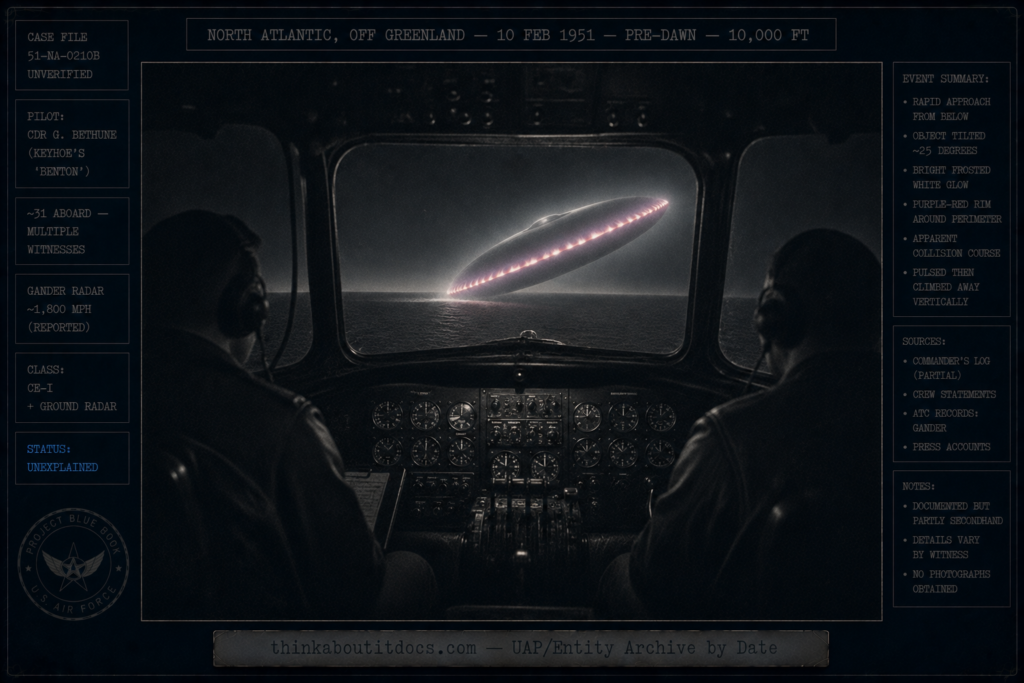
The February 10, 1951 North Atlantic encounter — Cmdr. Graham Bethune (Keyhoe's "George Benton") and 30+ airmen watched a 300-foot glowing disc rise from the sea and nearly strike their R5D; Gander reportedly tracked it past 1,800 mph. Logged Unexplained. (thinkaboutitdocs.com — UAP/Entity Archive by Date)
THINK ABOUTIT UFO|UAP|ENTITY ENCOUNTER REPORT
1951: UFO Sighting Over the North Atlantic (Cmdr. Graham Bethune / Navy R5D)
For decades this was the case of a pilot with no name. In Donald Keyhoe’s telling he was “George Benton,” a pseudonym to shield an officer still on active duty; the man who actually flew the plane was Commander Graham E. Bethune, a Navy aviator who would later serve as a VIP transport pilot in Washington and who finally told the story under his own name in 1999. Before dawn on February 10, 1951, Bethune was at the controls of a Navy R5D transport westbound from Keflavik, Iceland, toward Newfoundland, more than thirty military airmen aboard, when a yellow glow on the black ocean ahead swelled into a circle of light, went dark, and then rose off the water as a glowing disc that climbed toward the aircraft on what looked like a collision course. He shoved the nose down; the object — translucent, 200 to 300 feet across, ringed in purple-red fire — checked its rush, paced the plane for a long moment a hundred feet below and tilted at an angle, then backed away and was gone in seconds. Gander, he was later told, tracked it past 1,800 mph. With a named, exceptionally credentialed pilot, dozens of military witnesses, a Blue Book entry, and a ground-radar correlation, this is among the strongest aircraft encounters of the early 1950s — and the archive can at last file it under the right man’s name.
Date: February 10, 1951 (some early write-ups, including NICAP’s, give February 8)
Sighting Time: Pre-dawn, roughly 3.5 hours out of Iceland at the flight’s mid-point
Day/Night: Night
Location: North Atlantic, off the southern tip of Greenland, on the Keflavik (Iceland) to Argentia (Newfoundland) route
Urban or Rural: Airborne (aircraft at 10,000 ft over open ocean)
No. of Entity(‘s): None reported
Entity Type: Not applicable (witnesses regarded it as a controlled craft, but saw no occupants)
Entity Description: Not applicable
Hynek Classification: CE-I (Close Encounter I) — a structured object observed at very close range (near-collision) with no physical traces; corroborated separately by Gander ground radar (the prior “RV” implied airborne radar, which the R5D did not have)
Duration: Roughly 8 to 10 minutes from first glow to closest approach, then about a minute pacing the aircraft, then gone in a few seconds
No. of Object(s): 1
Description of the Object(s): A glow on the ocean that brightened from yellow to orange to fiery red, rose at great speed, and resolved into a translucent or metallic saucer with a purple-red fiery ring around its perimeter and a frosted white glow over the whole object; tilted about 25 degrees; departed by appearing to “back up” roughly 170 degrees from its approach without turning
Shape of Object(s): Saucer / disc
Size of Object(s): Estimated 200 to 300 feet in diameter
Color of Object(s): Frosted white glow overall, with a purple-red fiery ring around the rim
Distance to Object(s): At closest approach about 100 feet below and 200 to 300 feet ahead of the aircraft
Height & Speed: Aircraft at 10,000 ft, ground speed over 200 knots (about 230 mph); object’s visual departure estimated in excess of 1,500 mph, and reportedly tracked by Gander radar in excess of 1,800 mph
Number of Witnesses: Multiple — about 31 aboard, including the pilot (Bethune), plane commander Al Jones (Keyhoe’s “Peter Mooney”), the relief crew, and two VIP crews; many passengers also observed it
Special Features/Characteristics: Near-collision with a maneuvering structured object; abrupt deceleration and station-keeping alongside the aircraft; reverse departure without turning; separate ground-radar correlation at Gander; intelligence interrogation on landing at Argentia and a full report to Navy Intelligence; later Project Blue Book entry; the case anchors Chapter 1 of Keyhoe’s “Flying Saucers: Top Secret” (1960)
Case Status: Unexplained
Source: Cmdr. Graham E. Bethune, first-person account (“George Benton” in Keyhoe’s “Flying Saucers: Top Secret,” 1960; identified and self-published by Bethune in 1999); NICAP “UFO Investigator,” October 1970; John R. Colombo, “UFOs Over Canada” (1991); Project Blue Book file
Summary/Description: Before dawn on February 10, 1951, Navy pilot Cmdr. Graham Bethune (publicized for decades only under Keyhoe’s pseudonym “George Benton”) was flying an R5D transport at 10,000 feet from Iceland toward Newfoundland with about 31 aboard when a glow on the ocean rose at high speed into a 200–300 foot glowing saucer that approached on an apparent collision course, decelerated to pace the aircraft about 100 feet below it, then backed away and vanished in seconds. The crew was interrogated by intelligence officers at Argentia; Bethune was later told Gander radar had tracked the object beyond 1,800 mph. The case remains unexplained.
Related Cases: 1951: Cigar-Shaped UFO Over Mt. Kilimanjaro | 1952: B-29 Radar-Visual Over the Gulf of Mexico | 1957: RB-47 electronic-intelligence radar-visual case
DETAILED REPORT
The flight was a Navy R5D transport — the military version of the Douglas DC-4 — designated Flight 124, westbound from Keflavik, Iceland, to Argentia, Newfoundland, in the pre-dawn hours of February 10, 1951. At the controls was Commander Graham E. Bethune, a 1943 Pensacola graduate and seasoned transatlantic aviator; beside him in the right seat was the plane commander, Al Jones. The aircraft carried roughly thirty-one men, including a relief crew and two additional VIP crews returning from foreign duty, most asleep in the cabin. The plane was on autopilot at 10,000 feet, ground speed over 200 knots, heading roughly 230 to 240 degrees — figures preserved in Bethune’s own cockpit sketch.
About three and a half hours out of Iceland, near the flight’s mid-point off the tip of Greenland and not long after passing a station weather ship, Bethune noticed a yellow glow on the ocean perhaps thirty to thirty-five miles ahead, low and slightly right. His first thought was a small coastal town, then a cluster of ships; the navigator confirmed they were on course with no land or shipping plotted nearby, and the weather ship’s radio operator confirmed no vessels in the area. As the plane closed — over three miles a minute — the glow resolved into a circular pattern of bright white lights. The relief crew was roused and came forward; the consensus at first was that it had to be a ship they were overtaking.
Then the lights went out. A yellow halo appeared on the water, deepened to orange and fiery red, and began rushing toward the aircraft at tremendous speed, the rim turning a bluish red. Given its rate of climb, size, and bearing, it looked to Bethune as though the plane would be engulfed. He disconnected the autopilot and pushed forward to dive beneath it; men standing behind the seats were thrown about, some striking their heads. The object checked its rush and settled into formation off the bow, about 100 feet below and 200 to 300 feet ahead, tilted roughly 25 degrees. For a minute or so it held station there, and the crew got a sustained look: a translucent or metallic saucer, 200 to 300 feet across, a purple-red fiery ring around its perimeter and a frosted white glow over the whole, the ring reminiscent of the glow around an automobile generator’s commutator at night. Then it pulled away, appearing to back up about 170 degrees from its approach without turning, and was out of sight within seconds. Cameras were within reach, but no one was composed enough to use them.
Going aft afterward, Bethune found that most of the passengers had seen it too. He asked the senior medical officer aboard, a Navy commander, whether he had observed it; the doctor said he had but had refused to look closely, because it was a flying saucer and he did not believe in such things. Bethune told the crew to keep quiet — in 1951, reporting a saucer was a fast route to being thought unstable — but it was already too late: Jones had radioed Gander to ask whether the object could be tracked on radar. At Argentia they were met by intelligence officers whose questioning, Bethune felt, seemed designed to lead them; it was evident there had been other sightings in the area. A full report went to Navy Intelligence, and the case later entered the Project Blue Book file. Months afterward, Bethune said, he learned that Gander radar had tracked the object in excess of 1,800 mph — though he never saw that report himself, and in 1957 personnel at Wright-Patterson told him they had his account and many similar ones.
Two source notes matter for accuracy. First, the man: Keyhoe called him “George Benton” and the plane commander “Peter Mooney” to protect officers on active duty; the real names are Graham Bethune and Al Jones, and Bethune went public himself in 1999 and testified in the 2001 Disclosure Project. Second, the aircraft: Bethune’s own account and the Blue Book record specify an R5D, consistent with his cockpit drawing; in the dramatized Chapter 1 of “Flying Saucers: Top Secret,” Keyhoe changed the aircraft to an R7V-2 Super Constellation and shifted some details, so later retellings sometimes disagree with the witness’s own version. Where they conflict, this entry follows Bethune.
What the object was has never been resolved. A 200-to-300-foot luminous disc that rises off the ocean at high speed, decelerates from an apparent intercept to pace a transport in close formation, and then withdraws without turning fits no aircraft of 1951, and the prosaic candidates the crew themselves first reached for — a town, ships, another plane — were ruled out in real time by navigation, the weather ship, and the object’s behavior. With a highly credentialed primary witness, dozens of corroborating military observers, an intelligence interrogation, a Blue Book file, and a ground-radar correlation, it stands among the most solid aircraft cases of the period.
RESEARCHER’S NOTES
The Bethune Encounter — North Atlantic 1951 and the Pilot Behind the Pseudonym
- Identity restored — the central correction: The single most important fix is naming the witness. For sixty years this case circulated under Keyhoe’s protective pseudonym “George Benton,” and the prior page reproduced that fiction without resolving it, leaving readers with an anonymous pilot. The witness was Commander Graham E. Bethune, a real and identifiable Navy aviator who later flew VIP transport in Washington, went public under his own name in 1999, and testified at the Disclosure Project in 2001. The plane commander “Peter Mooney” was Al Jones. A chronological archive should attach the event to the man who lived it; this entry does.
- Classification correction (RV to CE-I): The prior page filed this RV, and its tags even listed NL. Neither is right. The R5D carried no air-intercept radar, so the witnesses did not have radar — meaning this is not a radar-visual case in the RV sense. It is a close encounter of the first kind: a structured object observed at very close range, a near-collision, with no physical traces. The Gander tracking is real corroboration but it was separate ground radar, reported to Bethune secondhand. CE-I, with the ground-radar correlation noted, describes the evidence accurately; RV overstates what the aircrew themselves had.
- Source-chain assessment and the figures: The account is unusually well-attested for the era — a named, credentialed pilot; roughly thirty military witnesses; a 1970 NICAP write-up with the witness’s own sketches; John Colombo’s “UFOs Over Canada”; and a Blue Book entry. Two numbers need care. The departure speed appears as both “in excess of 1,500 mph” (Bethune’s visual estimate) and “in excess of 1,800 mph” (the Gander radar figure he was told months later); these are different figures from different sources and are kept distinct here rather than blurred. The date likewise needs fixing: Bethune, the Blue Book record, and the Canadian listing give February 10, 1951, while the NICAP write-up the prior page followed used February 8 — a discrepancy the page itself half-noted and that is resolved here in favor of the witness and the official file.
- Why it remains strong, and the honest limits: The case’s strengths are real: multiple credentialed witnesses, sustained close observation, ruled-out mundane candidates, official interrogation, and an independent radar correlation. The limits are equally honest: the radar figure was relayed to Bethune, not seen by him; the detailed first-person narrative was given years after the event (the 1970 NICAP interview and Bethune’s 1990s account); and Keyhoe’s dramatized version introduced inconsistencies, including the wrong aircraft, that have muddied later retellings. None of this dissolves the core multi-witness near-collision, which is why the status is Unexplained rather than merely intriguing — but the archive credits the witnesses’ own account over the dramatized one and marks the secondhand elements as such.
The North Atlantic encounter is one of the genuinely strong early aircraft cases, and for most of its life it has been told slightly wrong — under a false name, on the wrong date, in the wrong aircraft, in a class that overstated the evidence. Set right, it is sturdier, not weaker: Commander Graham Bethune and some thirty fellow airmen watched a 300-foot glowing disc rise from the Atlantic and nearly run them down before pacing their transport and withdrawing at impossible speed, on February 10, 1951, in an R5D, in a close encounter that Gander’s radar is said to have caught at over 1,800 mph. Filed under the right man’s name and the right class, it stands where the evidence leaves it: Unexplained.

Predawn sighting occurred on second leg of trans-Atlantic flight. “X” marks spot where encounter took place.

Eyewitness sketch depicts UFO at various stages of its ascent toward aircraft. Shrouded in white glow, object had fiery ring at outer edge.

Pilot’s drawing shows view from cockpit as strange object rose from ocean’s surface and approached aircraft on apparent collision course