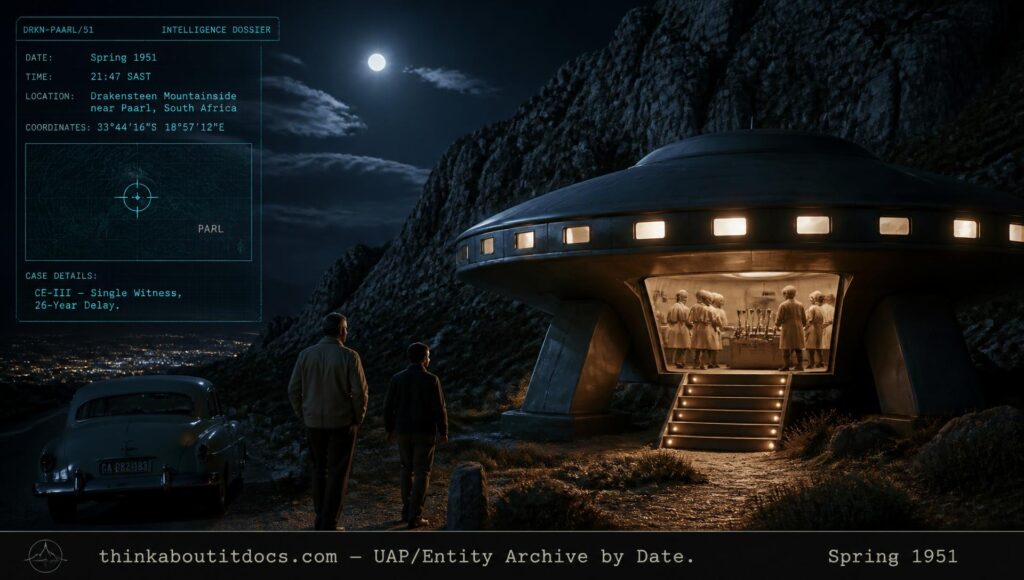
The Spring 1951 Drakensteen Mountain contact near Paarl, South Africa, in which a British engineer was shown the workings of a landed craft's gravity-nullifying propulsion.
THINK ABOUTIT
UFO|UAP & ENTITY ENCOUNTER REPORT
1951: The Drakensteen Mountain Contact
Near Paarl, Cape Town, South Africa
Late one night in the spring of 1951, a British instrumentation engineer identified only as “H.M.” was flagged down partway up a mountain road near Paarl, South Africa by a young man asking, urgently, for water. What began as an ordinary roadside errand ended, by H.M.’s account, with an invitation aboard a landed craft, a conversation with its short, calmly dressed occupants about how it flew, and an explanation of gravity-defying propulsion that reads less like typical contactee mysticism and more like an engineer’s attempt to describe an unfamiliar technology in his own professional terms. The account went unreported for 26 years, surfacing only when H.M. — by then working in Spain — told his story to a visiting investigator almost as an aside.
Date: Spring 1951 (exact date not recorded; the account did not surface until 1977)
Sighting Time: 11:15 p.m. onward, roughly 45 minutes total
Day/Night: Night
Location: The Drakensteen mountain, approximately 7 miles from Paarl, near Cape Town, South Africa
Urban or Rural: Rural, mountainous
No. of Entity(‘s): 5 (the initial contact and four others aboard the craft)
Entity Type: Humanoid
Entity Description: Short in stature (5 to 5’3″), of otherwise normal human appearance with somewhat pronounced foreheads, short chestnut-colored hair, no facial hair, and delicate, almost feminine hands; all wore belted, beige, knee-length laboratory-style gowns over trousers and shoes. The initial contact appeared roughly 19 years old; the one who conversed at length with H.M. appeared older, perhaps over 40. One occupant lay on a couch, reportedly recovering from “a slight accident” that had left him burned.
Hynek Classification: CE-III (Close Encounter of the Third Kind)
Duration: Approximately 45 minutes from initial contact to departure
No. of Object(s): 1
Description of the Object(s): A lenticular craft standing on two broad support legs, with squarish windows around its circumference and a lighted opening reached by a flight of steps between the legs. The interior held a circular bench or couch running around the full circumference, a central array of roughly eight three-foot hand levers projecting from a rectangular floor aperture (each ending in a fork resembling an old-fashioned hand brake), and a piano-shaped console beyond them with no visible dials or instruments. The interior light came from no identifiable source.
Shape of Object(s): Lenticular (lens-shaped)
Size of Object(s): Approximately 35-50 feet in diameter, about 13 feet high
Color of Object(s): Not specified beyond the description of squarish windows and a lighted interior visible from outside
Distance to Object(s): H.M. drove to within about 100 yards of the object, then boarded it and stood inside
Height & Speed: Grounded throughout the observation; per the occupant’s account, the craft used no engines, instead “nullifying gravity” via levers connected to a heavy fluid circulated through a tube at near-light velocity
Number of Witnesses: 1 (H.M., a British instrumentation engineer)
Special Features/Characteristics: A detailed in-craft technical exchange about the propulsion system, in which the occupant described gravity nullification via a fluid circulating through a tube at near-light speed, explaining the physically paradoxical claim that “when the fluid is leaving the tube, it is already entering the other end, thus its relative speed is infinite” when H.M. objected that such a speed was impossible; “very strange marks” found at the site the following day; the occupants’ complete disinterest in H.M. beyond the initial exchange, continuing their own activities and largely ignoring him throughout the visit.
Case Status: Insufficient Data
Source: Juan José Benítez, Flying Saucer Review Vol. 24 #2
Summary/Description: In the spring of 1951, a British instrumentation engineer identified in the source only as “H.M.” had driven partway up the Drakensteen mountain, roughly 7 miles from Paarl, near Cape Town, and was turning back when a young man, apparently about 19, flagged down his car asking urgently for water. H.M. had none but offered to drive him to a nearby stream, and the man got in, bringing an oilcan as a container. Once they reached the water, the man instead directed H.M. toward a shadowed area of the mountainside, where, about 100 yards from the road, stood a lenticular object roughly 35-50 feet across and 13 feet high, resting on two broad support legs with a lit stairway visible between them. The man invited H.M. aboard, and, with what H.M. described as a “friendly gesture,” persuaded him to enter. Inside, H.M. found a circular bench running around the craft’s circumference, a central array of roughly eight hand levers rising from a floor aperture, and a piano-like console with no visible dials, all lit by a source he could not identify. Four more men were inside, one lying on the couch recovering from a burn injury sustained in “a slight accident”; all were short, normally proportioned but for somewhat pronounced foreheads, with short chestnut hair, no facial hair, and delicate hands, dressed in belted beige lab-style gowns. Most of the occupants ignored H.M. entirely. His initial contact, acting as translator or spokesman, gave the injured man water when H.M. asked whether a doctor was needed, and was told no. When H.M. asked about the craft’s engines, the man replied that it had none, and that the levers were used to “nullify gravity” — the craft rose because a heavy fluid was circulated through a tube at nearly the speed of light, generating a magnetic effect; when H.M. objected that such a speed was physically impossible, the man responded that because the fluid was simultaneously leaving one end of the tube and entering the other, its relative speed was, in effect, infinite. Asked where they came from, the man only pointed skyward, saying “From there,” and declined to answer more specific questions. After roughly 15-20 minutes of conversation, the man indicated it was time for H.M. to leave, which he did; the entire encounter, from the initial roadside stop to his departure, lasted about 45 minutes. Returning to the site the next day, H.M. found unusual marks on the ground. He did not tell anyone about the experience until 1977, when, working in Spain for a firm there, he related the story to investigator Juan José Benítez.
Related Cases: 1950: The Samuel Eaton Thompson Venusian Contact, Washington | 1950: The Daniel Fry White Sands Incident, New Mexico (comparable technical-explanation contact narratives)
Detailed Report
The Drakensteen contact belongs to a small subgenre of early-1950s encounter narratives — alongside Daniel Fry’s White Sands account from the previous July — in which the witness is a technically trained professional and the contact centers on an explanation of the craft’s workings rather than a moral or philosophical message. That framing shapes how the account should be read: H.M.’s stated profession as an instrumentation engineer gives him a plausible basis for pressing his hosts on a technical point (objecting that near-light-speed fluid circulation was physically impossible) rather than accepting the explanation uncritically, and the reply he received — however strange — is at least internally structured as an attempt to resolve his specific objection rather than a vague appeal to advanced technology beyond human understanding.
The propulsion explanation itself is worth examining on its own terms rather than dismissed purely because it is exotic. The claim that a fluid’s relative velocity becomes “infinite” because it simultaneously exits one end of a closed tube and enters the other is not simply nonsensical technobabble; it is a specific (if physically confused) attempt to describe a closed-loop or circulating system, and it is the kind of explanation a layperson inventing a story out of general 1950s “flying saucer” tropes would be less likely to construct than someone drawing loosely, and imperfectly, on real physics concepts. Whether this reflects a genuine account of something the witness encountered and struggled to fully understand, or an elaborate personal narrative built by someone with some technical background, cannot be determined from the source material alone.
The entities’ behavior is also distinctive. Rather than treating H.M. as a chosen recipient of a message, as in many contactee narratives, the beings in this account largely ignore him, continue their own activities, and treat the visit as a mundane, almost transactional exchange — he provides no water himself but is shown around, given limited answers to his questions, and then asked to leave once the conversation runs its course. This lower-key, less reverential framing is unusual for the genre and arguably lends the account a degree of narrative restraint that more dramatic contactee stories of the same era generally lack.
The 26-year gap between the claimed event and its first telling is a genuine limitation. H.M.’s only stated reason for finally sharing the story was that he happened to be speaking with an investigator while working abroad — not any deliberate decision to come forward, publish, or seek attention, which is itself mildly against the pattern of self-promotion seen in many of the era’s more famous contactee accounts. That absence of an obvious motive for fabrication is a point in the account’s favor, though it does not substitute for corroboration, physical evidence, or a witness willing to be named.
RESEARCHER’S NOTES
The Drakensteen Mountain Contact — South Africa 1951 and the Engineer’s Objection
- Classification issues: CE-III is straightforwardly correct — a witness boarded and interacted at close range with the craft’s occupants, though the case’s calm, low-drama tone sets it apart from more emotionally charged CE-III accounts.
- Source chain assessment: The case rests entirely on a single, anonymized witness’s account, related once, 26 years after the fact, to investigator Juan José Benítez and published in Flying Saucer Review. No independent verification of “H.M.” or his stated profession is available in the sources this archive has reviewed, and his full identity has apparently never been disclosed.
- Pattern context: The technical, engineering-inflected framing of this contact places it closer to the Daniel Fry White Sands account than to more overtly spiritual or philosophical contactee narratives of the same period, suggesting a recognizable subtype within the broader contactee genre: encounters mediated through a witness’s professional or technical vocabulary rather than religious or moral language.
- Physical evidence and evidentiary weight: H.M. reported finding unusual ground marks at the site the following day, but no photograph, sample, or independent examination of those marks is documented. The case’s evidentiary weight rests entirely on the internal detail and consistency of a single, uncorroborated, anonymized account.
- Geographic and historical context: South Africa produced relatively few widely circulated contactee-style narratives compared to the United States, France, or Latin America during this period, making the Drakensteen case a notable, if isolated, entry in the country’s early UFO record.
The Drakensteen Mountain contact endures as one of the more unusual entries in this archive’s 1951 record — a technically framed, relatively unadorned account from an engineer who pressed his hosts on a specific physical objection rather than accepting their explanation at face value, told only once, decades later, with no apparent motive for self-promotion. It rests entirely on one anonymized witness’s word, given a quarter-century after the fact, with no corroborating evidence beyond unexamined ground marks. It is catalogued here as Insufficient Data: a carefully told, oddly restrained story that this archive can neither verify nor dismiss.
“We don’t have any engines… we nullify gravity; that is how we rise.”
— Account of “H.M.,” on the Spring 1951 Drakensteen Mountain contact near Paarl, South Africa