An unattributed account describes a Navy destroyer off Cape May, New Jersey radar-tracking an object that climbed to 100 miles altitude in March 1951.
THINK ABOUTIT UFO|UAP SIGHTINGS REPORT
1951: The Cape May, New Jersey Destroyer Radar Case
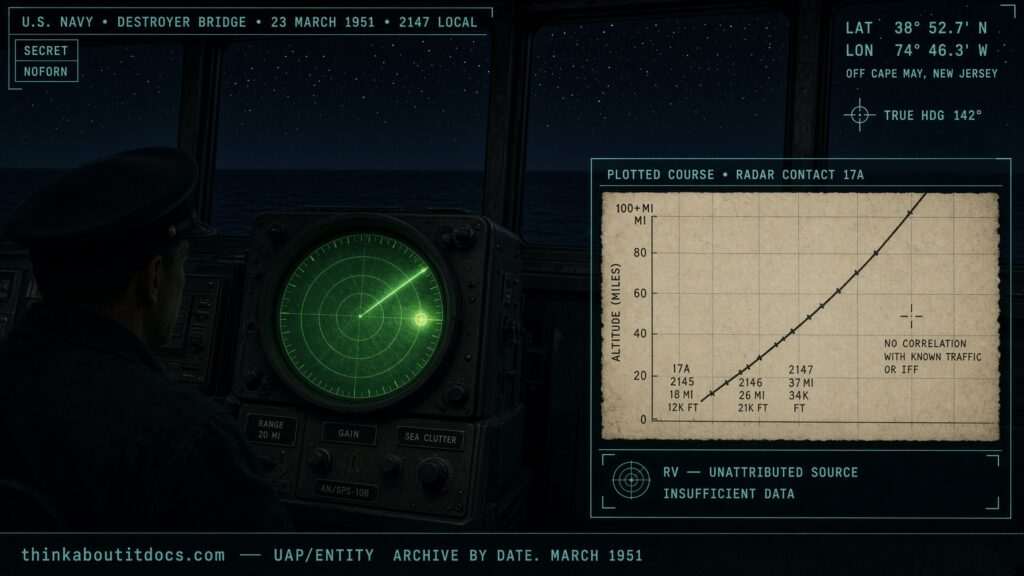
According to an account with no named source or witness, a Navy destroyer on Korean War-era coastal watch off Cape May, New Jersey tracked an unidentified radar target that hovered mid-flight, evaded pursuit by accelerating to roughly 5,000 kilometers per hour, and then climbed vertically until altitude-determining radar lost it — still ascending — at 100 miles above the earth, with a report said to have reached the Pentagon. It is, on its face, one of the most extraordinary performance claims in this entire archive. It is also one of the thinnest-sourced: no ship’s name, no officer’s name, and no citation of any kind survives in the record this archive has access to, and this report is built and framed accordingly.
Date: March 1951 (exact date not recorded)
Sighting Time: 11:30 p.m. onward
Day/Night: Night
Location: Off Cape May, New Jersey, over the Atlantic coastal watch corridor
Urban or Rural: At sea
No. of Entity(‘s): Not applicable
Entity Type: Not applicable
Hynek Classification: RV (Radar/Visual) is the closest fit in name only — no visual correlate is described anywhere in the account, making this functionally a radar-only case; this archive notes the classification is imperfect for that reason.
Duration: Roughly 30 minutes to an hour, from initial detection to the object’s final vertical departure
No. of Object(s): 1
Description of the Object(s): Not described — this is a radar-only account with no visual observation reported at any point
Shape of Object(s): Not established
Size of Object(s): Not established
Color of Object(s): Not applicable (no visual observation)
Distance to Object(s): Initially detected roughly 30 miles from the destroyer; closed to within about 15 miles before its final rapid departure
Height & Speed: Initially tracked at 3,000-4,000 feet altitude and 85-90 knots; after hovering and being approached by the ship, it reportedly accelerated to an estimated 5,000 km/h on a northerly course, then, roughly 35-40 miles south of Nantucket Island, turned to a vertical climb tracked by altitude-determining radar to 100 miles above the earth’s surface, still ascending when contact was presumably lost
Number of Witnesses: Unspecified — described only as unnamed radar/watch personnel aboard an unnamed Navy destroyer, relayed through the ship’s bridge to an unnamed captain
Special Features/Characteristics: The object came to a complete stop and hovered when first approached by the destroyer; it accelerated only once the ship had closed to within about 15 miles; its final vertical ascent was reportedly tracked by radar to an altitude (100 miles) generally understood to be far beyond the operational ceiling of any known 1951-era aircraft, effectively at the edge of space by modern definitions; the account states a report was made to the Pentagon.
Case Status: Insufficient Data
Source: Unattributed — no witness name, ship name, or citation survives in the source material available to this archive
Summary/Description: According to an account with no named source, during the Korean War a Navy destroyer stationed off Cape May, New Jersey was maintaining coastal watch for aircraft approaching from the northeast, east, and southeast, plotting all air traffic along the coast inland to the Appalachians. At approximately 11:30 p.m. in March 1951, the ship’s radar picked up an object approaching from due east at 85-90 knots and 3,000-4,000 feet altitude. The object closed to within roughly 30 miles of the destroyer and then stopped, hovering in place. The watch informed the bridge, which informed the captain, who ordered the ship to close on the object’s position. Approximately 30 minutes later, with the destroyer now within about 15 miles, the object suddenly accelerated away on a northerly course at an estimated 5,000 km/h. Continuing to be tracked, it reached a position roughly 35-40 miles south of Nantucket Island and abruptly turned into a vertical climb. Altitude-determining radar aboard the ship followed the object’s ascent to 100 miles above the earth’s surface, with the object reportedly still climbing when the account’s description ends. A report of the incident was said to have been made to the Pentagon. No further detail — including the destroyer’s name, the names of any personnel involved, or any documentary trail confirming the Pentagon report — survives in the source material.
Related Cases: 1950: The Mt. Vernon, Virginia DC-6 Near-Collision | 1950: The June 24th Multi-State Fireball (comparable extreme-altitude/speed radar claims from the same broader period)
Detailed Report
This case has to be assessed differently from almost every other entry in this archive, because its sourcing problem is total rather than partial. Most thinly documented cases in this record still carry a witness’s name, a ship or unit designation, or at minimum a secondary compiler’s citation that can, in principle, be traced back toward a primary source. This account has none of those things. It reads, in structure and detail, like a genuine radar-tracking narrative — specific speeds, specific bearings, a specific chain of shipboard command (watch to bridge to captain) — but that internal specificity is not itself evidence of authenticity; a fabricated or garbled account can be told with just as much apparent precision as an accurate one, and without any way to verify the ship’s identity or check contemporaneous Navy or Air Force records, this archive has no way to distinguish between the two possibilities.
The claim’s substance is also worth weighing carefully on its own terms, independent of the sourcing problem. A radar target climbing vertically and continuously to 100 miles above the earth’s surface, in 1951, describes a rate of ascent and a final altitude that would place the object well above the operational ceiling of any aircraft — piloted or unpiloted — known to exist at the time, and indeed close to the edge of what is now defined as space. That is a genuinely extraordinary claim, and it is the kind of claim that, if true and properly documented, would represent one of the most significant single data points in the entire history of the UFO phenomenon. The absence of any surviving primary documentation for a claim of that magnitude is itself analytically significant — either the supporting Pentagon report was never made public, was lost, remains classified, or, more mundanely, the account as passed down through secondary UFO literature has drifted substantially from whatever more modest event, if any, actually generated it.
A plausible mundane candidate exists for at least the case’s early stages: a radar target that approaches, stops, and hovers before resuming course is a documented radar-clutter or anomalous-propagation pattern in some circumstances, and 1950s naval and aviation radar of this era was known to occasionally register false or ambiguous returns, particularly at long range and low altitude over water. The final vertical-ascent-to-100-miles portion of the account is much harder to explain by ordinary radar artifacts, however, which is part of why this case cannot simply be waved away as a routine misidentification either.
RESEARCHER’S NOTES
The Cape May Destroyer Radar Case — 1951 and the Limits of an Unsourced Claim
- Classification issues: RV is applied loosely and imperfectly here, since no visual sighting accompanies the radar track at any point in the account — this is more precisely a radar-only case, and readers should not assume any visual confirmation exists.
- Source chain assessment: This is the weakest source chain of any case in this archive’s 1951 record to date — no witness name, no ship name, no citation, no secondary compiler credited. This archive preserves the account because deleting unverifiable material silently would itself be a form of record manipulation, but readers should weight this case accordingly: as an unattributed claim, not as documented history.
- Pattern context: Extreme-altitude and extreme-speed radar claims recur periodically throughout the UFO literature of this era (see also the June 24, 1950 multi-state fireball and various Korean War-theater radar cases already documented in this archive), and this case’s claimed 100-mile altitude sits at the far outer edge of that pattern — worth noting as a comparison point even where, as here, the underlying sourcing cannot support strong conclusions.
- Physical evidence and evidentiary weight: None. No radar log, no ship’s log, no personnel testimony, and no confirmation that a Pentagon report was ever actually filed survives in any source this archive has located. This case should be treated as an anecdote circulating in secondary UFO literature rather than a documented incident.
- Geographic and historical context: The Korean War-era Atlantic coastal watch described in the account’s framing is historically accurate context — U.S. Navy vessels did maintain such watches during this period — which lends the account’s setting plausibility even though it does nothing to verify the specific claims made within it.
The Cape May case is preserved here not because this archive can vouch for it, but because omitting an unverifiable claim entirely would be its own kind of editorial distortion. Taken at face value, it describes one of the most extraordinary radar-tracked ascents in the entire UFO literature — a target climbing, under active radar observation, to the edge of space. Taken skeptically, it is an unattributed secondhand story with no name, no ship, and no surviving documentation to check it against. Both readings are honest responses to the same thin record. It is catalogued here as Insufficient Data, in the fullest sense of that phrase: there is simply not enough here to know.
“Altitude-determining radar tracked the object up to 100 miles above the earth and still going straight up.”
— Unattributed account, on the March 1951 Cape May, New Jersey destroyer radar case