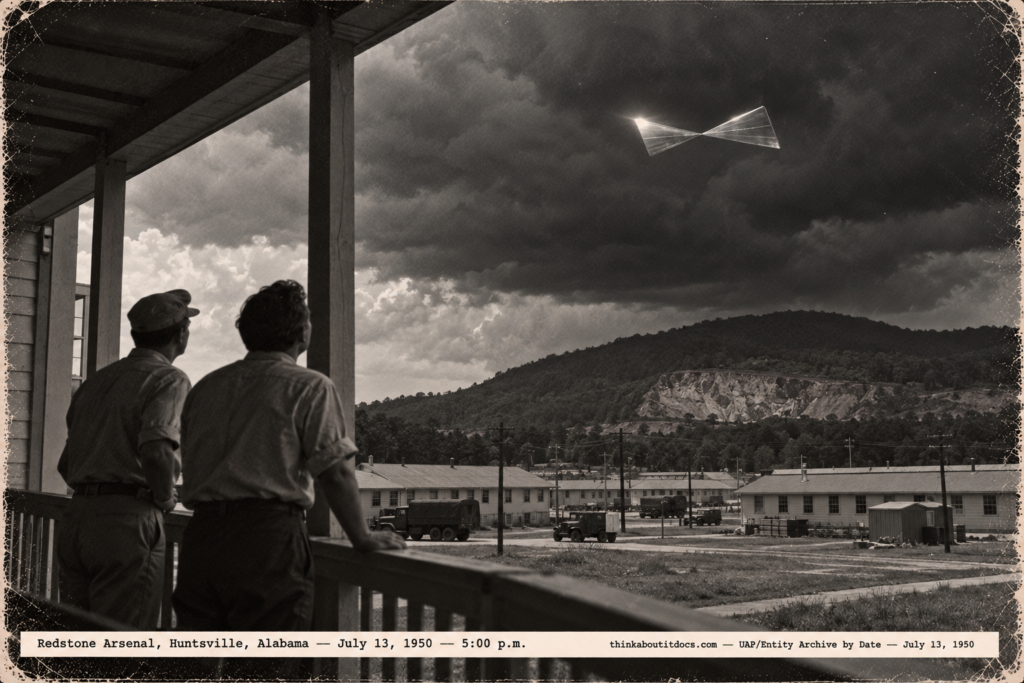
On July 13, 1950, two Redstone Arsenal employees watched a bow-tie object flap its two triangles and turn a right angle.
THINK ABOUTIT UFO|UAP SIGHTINGS REPORT
1950: Redstone Arsenal, Huntsville, Alabama — The Tumbling Bow Tie
At about 5:00 p.m. on July 13, 1950, two men on the rear porch of the civilian bachelor’s quarters at Redstone Arsenal, the Army’s rocket center at Huntsville, Alabama, saw a polished aluminum object about the size of a standard door flying level at about 1,000 feet and 100 to 125 mph. It was shaped like a bow tie, two triangular sections joined point to point. They followed it five to eight miles to the quarry on Madkin Mountain, where the two triangles appeared to flap, the leading one turning clockwise and the rear one counter-clockwise, each about a quarter turn, for roughly half a minute. Then the object turned a hard right angle and accelerated out of sight in under three seconds.
The witnesses were a Chief Signal Office employee from Washington and an engineer aide at the Ordnance Rocket Center, people who worked around aircraft and rockets. The Project 10073 card reads Unidentified. The Redstone Arsenal UFO case rests on a one-page Army “Report of Unusual Incident” that records a detail the witnesses themselves flagged: the sky was heavily overcast, with a black thunderhead behind the object, yet the object gave off a very brilliant light.
Date: July 13, 1950 (Thursday)
Sighting Time: About 5:00 p.m. (card: 1700)
Day/Night: Day (heavily overcast)
Location: Redstone Arsenal, Huntsville, Alabama; seen from the rear right porch of the civilian bachelor’s quarters and followed to the quarry pit on the northwest end of Madkin Mountain
Urban or Rural: Military reservation
No. of Entity’s: 0 — Not Applicable
Entity Type: Not Applicable
Entity Description: Not Applicable
Hynek Classification: DD (daylight disc)
Duration: Not stated overall; followed 5 to 8 miles, about half a minute of flapping motion, then out of view in under 3 seconds
No. of Object(s): One
Description of the Object(s): A polished aluminum object, shaped like a bow tie from two triangular sections; very brilliant light
Shape/Size/Color of Object(s): Triangular in two sections joined at the points; about the size of a standard door, perhaps slightly larger with a tapered effect; highly polished aluminum
Distance to Object(s): Not stated; first seen about 30 degrees northeast of the right-hand corner of the quarters
Height & Speed: About 1,000 feet; judged airspeed 100 to 125 mph in level flight, then accelerated at high speed
Number of Witnesses: 2: an employee of the Chief Signal Office, Washington, and an engineer aide at the Ordnance Rocket Center (names redacted; a Mr. Washburn per Berliner)
Special Features/Characteristics: The two triangular sections moved in opposite directions about a quarter turn each; sharp right-angle turn over the quarry; heavy overcast with a large black thunderhead directly behind the object
Case Status: Unidentified (Project 10073 Record Card; BBU #758)
Source: Project 10073 Record Card; Report of Unusual Incident, Redstone Arsenal, July 13, 1950; Third Army letter to Air Materiel Command, July 21, 1950; Berliner; FUFOR Index
Summary/Description: Two rocket-center employees watched a bow-tie-shaped aluminum object flap its two triangles in opposite directions, then turn a right angle and vanish.
Related Cases: None established; Fort Peck, Montana (same date, weather-recon crew, evaluated Balloons)
Detailed Report
The report. Third Army headquarters at Fort McPherson, Georgia, transmitted the case to Air Materiel Command on July 21, 1950 under control number A-1917, as “report of unconventional aircraft sighted over Redstone Arsenal, 13 July 1950.” The attached Army “Report of Unusual Incident” is typed as an unconventional-aircraft report, giving the place as the rear right porch of the civilian bachelor’s quarters, the date as July 13, and the time as approximately 1700 hours.
The first sighting. The first witness noticed the object in the sky about thirty degrees northeast of the right-hand corner of the quarters, flying at about 1,000 feet and a judged air speed of 100 to 125 miles per hour in a level parallel. It appeared triangular in shape and made of two sections, about the size of a standard door from the distance involved, perhaps slightly larger with a tapered effect. A sketch in the report shows two triangles meeting point to point, like a bow tie, with an arrow marking the direction of flight.
The light. The object appeared to be highly polished aluminum and gave a very brilliant light. The report adds that the weather at the time was very overcast, with a large black thunderhead directly behind the object and no sun rays possible.
The flight. The two men followed it for about five to eight miles. When the object reached a line parallel with the quarry pit on the northwest end of Madkin Mountain, it appeared to be in some type of flight trouble: the triangles were seen to move or flap, the leading section turning clockwise and the rear section counter-clockwise, each through about 25 percent of a rotation. That lasted about half a minute, after which the object returned to stable flight. Both men then saw it turn at a right angle over the quarry and accelerate at high speed, taking it out of view in less than three seconds.
The card. The Project 10073 card gives the date of information as July 13, 1950, a civilian engineer as the source, 1700, a triangular shape, door size, aluminum color, a speed of 100 to 125 mph, an altitude of 1,000 feet, two in the group, a ground observation and the maneuvers as two triangular sections turned in opposite directions and the object turning at a right angle. The evaluation is handwritten as Unidentified.
RESEARCHER’S NOTES
A Bright Object Under a Dark Sky
- The brightness problem: Both the card and the report stress that the object looked brilliantly polished while the sun was blocked by overcast and a thunderhead. The witnesses raised the point themselves; the report does not resolve it.
- Witnesses: Both men worked in rocket and signal work at an Army arsenal. The report does not describe any verification of their experience; only their jobs are stated.
- “Flight trouble”: The witnesses read the flapping as a malfunction, as if the object were a damaged craft. The report records that interpretation as theirs.
- The tapered effect: The bow-tie sketch and “tapered effect” suggest each triangle narrowed toward the center; the sketch is the only detail on how the sections joined.
- Names: The witnesses’ names are redacted in the scan; Washburn comes from Berliner.
- Related catalog: Berliner and the FUFOR Index catalog the case as BBU #758.
The Redstone case is a short, plainly written report by two people who saw something move in a way they did not expect and wrote down what it did. The Air Force card calls it Unidentified, and nothing in the file offers a candidate for what flapped.
“some type of flight trouble”
— Report of Unusual Incident, Redstone Arsenal, July 13, 1950