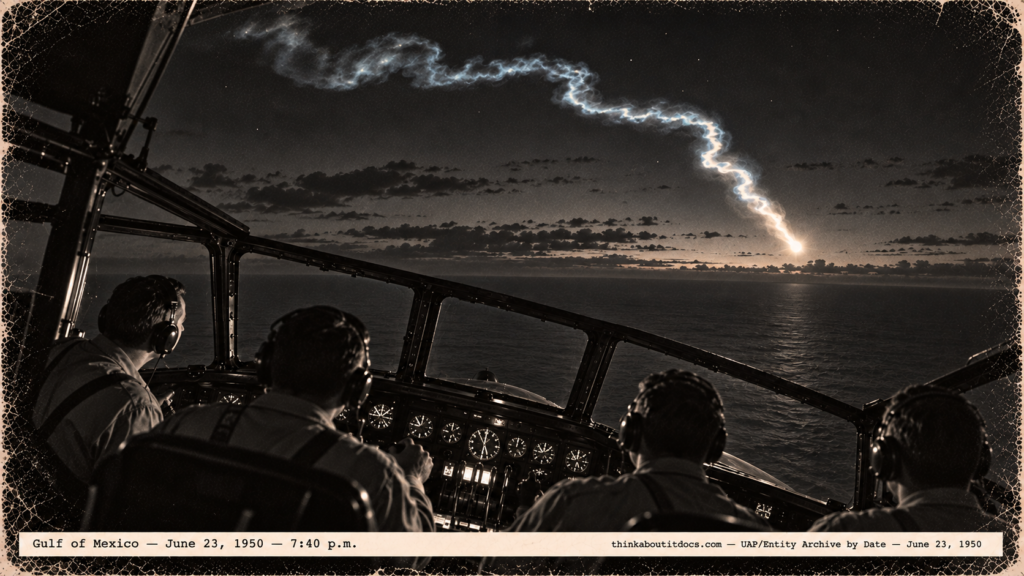
On June 23, 1950, a weather-reconnaissance crew watched a fireball spiral down over the Gulf of Mexico and leave a 20-minute trail.
THINK ABOUTIT UFO|UAP SIGHTINGS REPORT
1950: Gulf of Mexico — The Pelican Crew’s Spiral Fireball
At 7:40 p.m. on June 23, 1950, the crew of a 308th Reconnaissance Group “Pelican” weather flight out of Tinker AFB, Oklahoma, flying at 10,000 feet over the Gulf of Mexico, watched a huge ball of fire descend in a slow, wavy spiral from at least 50,000 feet to about 20,000 feet, where it faded. It left an extremely bright bluish-white trail that lingered for roughly twenty minutes. Witnesses in Alabama, Mississippi and Texas, including a National Airlines pilot near Mobile, reported the same flash.
Both Air Force record cards on the Gulf of Mexico fireball close the case as Astro (Meteor), and a weatherman is quoted calling it a large meteorite. Several catalogs, however, list it as a Blue Book Unknown. This page lays out what the two cards actually say and where the details sit uneasily with a meteor.
Date: June 23, 1950 (June 24 at 01:40Z)
Sighting Time: 7:40 p.m. CST (19:40)
Day/Night: Dusk to night
Location: Gulf of Mexico, with the descent estimated near 28°45’N, 89°45’W; observed from a weather-reconnaissance aircraft at 10,000 feet and from the Alabama, Mississippi and Texas coasts
Urban or Rural: Over open water
No. of Entity’s: 0 — Not Applicable
Entity Type: Not Applicable
Entity Description: Not Applicable
Hynek Classification: NL (nocturnal light)
Duration: Descent of about 90 seconds; the trail persisted about 20 minutes (the card says 15 to 30 minutes)
No. of Object(s): One
Description of the Object(s): A huge ball of fire descending in a wavy or erratic S-shaped spiral and fading at about 20,000 feet, leaving an extremely bright bluish or blue-white vapor trail
Shape/Size/Color of Object(s): Ball of fire; size not stated; bluish or blue-white trail
Distance to Object(s): Estimated at roughly 270 miles from the aircraft, by triangulating the trail from a baseline of about 60 miles (Aldrich; the figure is marked uncertain in the catalog)
Height & Speed: From at least 50,000 feet down to about 20,000 feet in about 90 seconds
Number of Witnesses: 4-man aircrew (1st Lt. Donald D. Sherr, Sgt. Elbert C. Bishop, T/Sgt. John W. Horn, Sgt. Claudio S. Gonzales) plus numerous others, including National Airlines Capt. James L. Hansen near Mobile and J. A. Ellis of Rosedale, Alabama
Special Features/Characteristics: A trail persisting about 20 minutes, with about 15 minutes at full brightness; seen across several states at once; a weatherman’s on-the-record opinion that it was a large meteorite
Case Status: Astro (Meteor) on both Project 10073 cards; catalogs list it as a Blue Book Unknown
Source: Project 10073 Record Cards (crew card, 23 June 1950; Mobile card, 25 June 1950); Jan Aldrich; FUFOR Index
Summary/Description: A weather-recon crew watched a fireball spiral down over the Gulf and leave a 20-minute trail; the Air Force called it a meteor.
Related Cases: June 23, 1950 New Orleans (Patterson, photographed); June 23 border area of Alabama, Mississippi, Louisiana and Texas, 19:40; June 24, 1950 Gulf of Mexico, 19:40 (Weinstein), probably the same event; the June 24, 1950 multi-state fireball the next evening is a separate event
Detailed Report
The crew’s account. According to Jan Aldrich’s catalog, citing the FUFOR Index, the Pelican flight was at 10,000 feet heading about 30 degrees and turned to 326 degrees at 7:44 p.m., at a ground speed of 173 knots. The crew were navigator 1st Lt. Donald D. Sherr, scanner Sgt. Elbert C. Bishop, engineer T/Sgt. John W. Horn and radio operator Sgt. Claudio S. Gonzales. At 7:40 p.m. they saw a huge ball of fire at a relative bearing of about 80 degrees descend slowly over about a minute and a half in a wavy spiral or erratic S-shaped path, from at least 50,000 feet to 20,000 feet. It faded at an estimated position of 28°45′ N, 89°45′ W, leaving an extremely bright glowing bluish or blue-white smoke or vapor trail that persisted about 20 minutes, without dimming for the first 15, and finally faded into a soft blur at about 8:00 p.m.
Other witnesses. The same catalog lists numerous other witnesses in Alabama, Texas and Mississippi, including National Airlines pilot Capt. James L. Hansen flying near Mobile and J. A. Ellis of Rosedale, Alabama.
The record cards. The crew card gives the date of information as June 23, 1950, the location as 28°45′ N 89°45′ W, an aircraft crew as the source, 19:40 CST, a bluish trail, an altitude of 50,000 feet and an observation of 15 to 30 minutes. It records one object, aerial observation, a spiral descent with the light fading at 20,000 feet, and one sketch. The evaluation is handwritten as Astro (Meteor). A second card, for Mobile, Alabama, dated June 25, 1950, cites a newspaper report from an airline pilot, time 19:40, and carries the remark that a weatherman stated the flash seen was probably a large meteorite. It too reads Astro (Meteor).
RESEARCHER’S NOTES
A Meteor Answer and the Questions It Leaves
- What the cards decided: Both Blue Book cards say meteor, and the second records a weatherman’s opinion as the basis.
- What fits a meteor: A fireball that fades at altitude, with a bluish persistent trail seen over several states at once, is the kind of event meteors produce, and persistent trails from bright fireballs can last for minutes.
- What strains it: A descent lasting about 90 seconds, along a wavy, erratic spiral path, is long and unusual for a meteor. These details come from the crew’s own recollection and catalog summaries, not from the cards.
- Catalog versus cards: Catalogs list the case as a Blue Book Unknown; both cards in the file read Astro (Meteor). This archive follows the cards and does not tag it BBU.
- Date drift: The cards’ time group (24/0140Z) falls on June 24 in UTC, which probably explains why the same event appears under June 24 in some catalogs.
- The cluster: New Orleans, the border-area report and the June 24 Gulf entry all describe the same hour and region, and are most likely the same event.
The Gulf fireball is unusual mainly for how many people saw it and how long it lasted, and the Air Force answer was the easiest one available. A meteor is a reasonable explanation for some of what was reported and a strained one for the rest, and the file records no investigation beyond a weatherman’s remark.
“Weatherman stated flash seen was probably a large meteorite.”
— Project 10073 Record Card, Mobile, Alabama, June 25, 1950