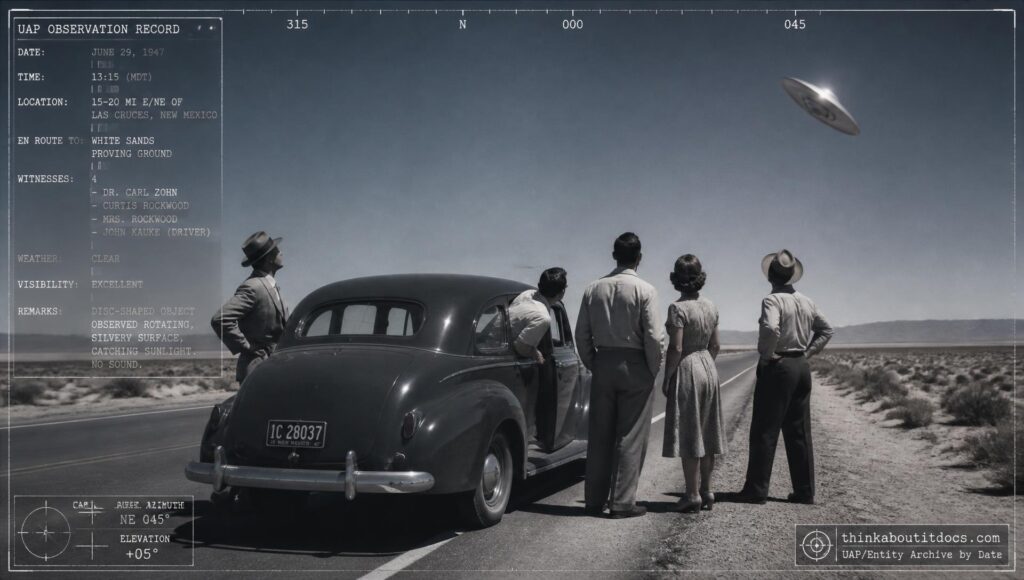
June 29, 1947 — near White Sands Proving Ground, New Mexico. Naval Research Laboratory scientists Carl Zohn and Curtis Rockwood watched a rotating silvery disc vanish instantly from a perfectly clear sky.
THINK ABOUTIT UFO SIGHTINGS REPORT
1947: The White Sands Rocket Scientists — Zohn, Rockwood, and Kauke
Five days after Kenneth Arnold’s sighting made “flying saucer” a household phrase, three government scientists working at the birthplace of American rocketry watched a silvery disc cross a perfectly clear sky and simply vanish. These weren’t excitable civilians new to the concept — they were professional rocket engineers, trained to distinguish real aerospace hardware from anything else, driving to work at White Sands Proving Ground when something none of them could identify crossed their path in broad daylight.
Date: June 29, 1947
Sighting Time: Approximately 13:15-13:20
Day/Night: Day, clear and cloudless
Location: A highway roughly 15-20 miles east-northeast of Las Cruces, New Mexico, en route to White Sands Proving Ground
Urban or Rural: Rural — New Mexico desert highway
No. of Entity(s): Not Applicable
Entity Type: Not Applicable
Entity Description: Not Applicable
Hynek Classification: DD — Daylight Disc. A structured object observed in clear daylight conditions by multiple witnesses, exhibiting an instantaneous disappearance inconsistent with known aircraft, with no landing or entity involved.
Duration: Nearly 60 seconds
No. of Object(s): 1
Description of the Object(s): A rotating, silvery or shiny disc or sphere, with no visible wings, tail, propellers, or other appendages, reflecting sunlight as it moved, possibly with a pulsating quality to the light.
Shape of Object(s): Disc or sphere (witnesses were not fully certain which)
Size of Object(s): Not specified
Color of Object(s): Silvery/shiny
Distance to Object(s): Not precisely specified; described as crossing the sky to the witnesses’ front-right
Height & Speed: Altitude estimated at 8,000-10,000 feet; described as moving at high speed, heading north
Number of Witnesses: 4 — Dr. Carl J. Zohn (Administrative Assistant, Rocket Sonde Section, U.S. Naval Research Laboratory, temporarily assigned to White Sands Proving Ground), NRL scientist Curtis C. Rockwood, Rockwood’s wife, and WSPG technician John R. Kauke, who was driving
Special Features/Characteristics: The witnesses’ professional backgrounds are the case’s most significant feature — Zohn and Rockwood were both credentialed rocket scientists actively working at the epicenter of American postwar rocketry research, precisely the kind of observers positioned to recognize a test rocket, weather balloon, or experimental aircraft if that’s what they were seeing; Kauke, the driver, independently and separately observed a brief vapor trail at one point during the sighting that neither of the other witnesses reported, a detail worth noting as a point of partial rather than total corroboration between the observers; Zohn specifically rolled down his window from the passenger seat to obtain an unobstructed view, indicating a deliberate, attentive observation rather than a fleeting glance; the object’s disappearance was instantaneous (“suddenly disappeared in mid-air”) rather than a gradual fade from view, distance, or cloud cover, since the sky was explicitly described as clear and cloudless.
Case Status: Unexplained
Source: Declassified FOIA records; Edward J. Ruppelt, The Report on Unidentified Flying Objects, p. 20; FUFOR Index; Kevin Randle and Donald Schmitt; Ted Bloecher, Report on the UFO Wave of 1947 (1967)
Related Cases: 1947: June UFO|UAP & Entity Sightings Archive (see also the June 24 Kenneth Arnold sighting and Fred Johnson’s Mount Adams corroboration, five days earlier)
Detailed Report
Shortly after 1:00 in the afternoon on June 29, 1947, four people were driving along a desert highway roughly 15 to 20 miles east-northeast of Las Cruces, New Mexico, en route from Las Cruces to White Sands Proving Ground headquarters. Two of the four — Dr. Carl J. Zohn, an administrative assistant with the Rocket Sonde Section of the U.S. Naval Research Laboratory, and NRL scientist Curtis C. Rockwood — were professional rocket scientists, temporarily assigned to White Sands, the primary American testing ground for captured German V-2 technology and the nation’s earliest domestic rocket programs in the immediate postwar period. Rockwood’s wife and WSPG technician John R. Kauke, who was driving, completed the group.
To their front-right, the group observed a rotating, silvery or shiny disc or sphere — witnesses were not entirely certain which — with no visible wings, tail, propellers, or other conventional aircraft features. It reflected sunlight as it moved, crossing the sky heading north at an estimated altitude of 8,000 to 10,000 feet, at high speed. Dr. Zohn, in the passenger seat, rolled down his window to get an unobstructed view of the object. The sighting lasted nearly a full minute — an unusually long observation window for this category of case.
The object’s departure was as notable as its appearance: it did not fade into distance, climb out of view, or pass behind any obstruction — the sky was explicitly described as clear and cloudless — but rather disappeared suddenly, in mid-air. Kauke, who had stopped the car during the sighting, reported briefly seeing a short vapor trail at one point; neither Zohn nor the Rockwoods reported this detail, making it a point of partial rather than complete agreement among the four witnesses.
The case entered the historical record through multiple independent channels: declassified FOIA documentation, Air Force officer Edward Ruppelt’s own official published account of the early UFO investigation era, the FUFOR Index, Kevin Randle and Donald Schmitt’s research, and Ted Bloecher’s landmark 1967 compilation of the entire 1947 wave — giving it one of the more thoroughly cross-referenced documentary trails of any case from this period.
RESEARCHER’S NOTES
Witnesses Who Knew Exactly What a Rocket Looks Like
- On why the witnesses’ expertise matters more here than in most cases: Unlike the great majority of 1947-wave sightings, where witnesses’ unfamiliarity with aircraft or rocket technology is an open question, this case removes that ambiguity almost entirely. Zohn and Rockwood were professional rocket engineers stationed at the specific facility where American rocket testing was actively underway in mid-1947. If the object had been a V-2 test firing, a weather balloon, or any known WSPG test article, these are precisely the two people in America best positioned to recognize it as such. Their inability to identify the object carries meaningfully more evidentiary weight than an equivalent report from witnesses without this specific technical background.
- On the partial disagreement over the vapor trail: Kauke’s report of a brief vapor trail, unreported by the other three witnesses, is worth treating honestly rather than glossing over. This kind of partial, non-uniform corroboration among multiple witnesses to the same event is common in genuine eyewitness testimony — different observers, at slightly different angles or moments of attention, often catch different details — and is generally considered a marker of authentic independent observation rather than a coordinated or rehearsed account, which would more likely produce uniform testimony.
- On the instantaneous disappearance: An object vanishing suddenly in a clear, cloudless sky, rather than fading with distance or passing behind an obstruction, is one of the more analytically difficult details in this category of case. It resists straightforward explanation by ordinary aircraft (which don’t vanish, only recede) and complicates a simple misidentification explanation, though it remains consistent with several proposed mechanisms in the broader UFO literature (extreme acceleration beyond visual tracking ability, atmospheric optical effects, or an object that was never physically as close as its apparent size suggested).
- On the case’s place in the broader wave: Occurring just five days after Kenneth Arnold’s sighting, this case is part of an extraordinary run of independently sourced reports from credentialed government, military, and technical personnel across the final week of June 1947 — pilots, forest service lookouts, railroad engineers, and here, rocket scientists — that collectively make this the best-corroborated week in this archive’s entire chronological record.
Two rocket scientists, on their way to work at the birthplace of the American space program, watched something neither of them could identify simply disappear from a clear desert sky. If anyone in 1947 America had the professional standing to say “that was one of ours,” it was Carl Zohn and Curtis Rockwood. They didn’t say that. They said they didn’t know.