April 29, 1947 — Tucson, Arizona. Two witnesses watched nine white discs and a tenth object weave in and out of an isolated cloud for six minutes, an account later documented in a formal RAND Corporation research paper.
THINK ABOUTIT UFO SIGHTINGS REPORT
1947: Ten Objects in a Tucson Sky
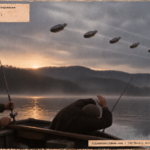
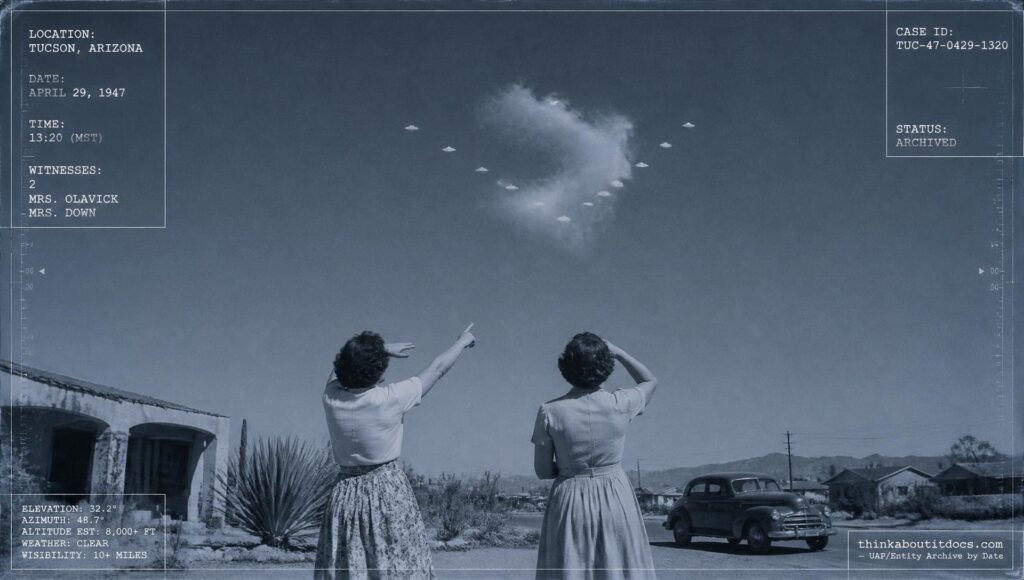
In a completely clear Arizona sky, a single strange cloud hung by itself — and out of it, nine white discs and a tenth companion object wove in and out for nearly six minutes, holding a loose V-formation, moving up and down with no apparent regard for anything resembling normal flight. Two women watched the whole thing. Decades later, their account surfaced not in a UFO magazine but in a formal RAND Corporation research document — a pedigree few 1947 cases can claim.
Date: April 29, 1947
Sighting Time: 13:20
Day/Night: Day
Location: Tucson, Arizona
Urban or Rural: Urban/suburban desert setting
No. of Entity(s): Not Applicable
Entity Type: Not Applicable
Entity Description: Not Applicable
Hynek Classification: DD — Daylight Disc. Multiple structured objects observed in clear daylight, exhibiting maneuvering behavior inconsistent with known aircraft, with no landing or entity involved.
Duration: Approximately 5-6 minutes
No. of Object(s): 10 (nine white discs plus one additional object)
Description of the Object(s): Nine white, disc-shaped objects arranged in a rough V-shaped formation, along with a tenth object, all moving in and out of a single, isolated cloud that appeared “steamy” and, per the witnesses, unnatural in an otherwise completely clear sky.
Shape of Object(s): Disc-shaped (the nine); the tenth object’s shape is not separately specified in the surviving account
Size of Object(s): Not estimated
Color of Object(s): White
Distance to Object(s): Not specified
Height & Speed: Not numerically specified; movement described as erratic vertical motion (“up and down”) combined with repeated entry and exit from the cloud formation
Number of Witnesses: 2 — Mrs. Olavick and Mrs. Down, both of Tucson, Arizona
Special Features/Characteristics: The presence of a single, isolated “unnatural” cloud in an otherwise completely clear sky is itself a notable detail — the witnesses specifically distinguished it from ordinary cloud cover, describing it as “steamy,” language that suggests either a genuinely anomalous atmospheric phenomenon or an artificial obscuring effect associated with the objects themselves; the objects’ repeated movement in and out of this cloud, rather than simply flying past it, suggests either a deliberate association between the objects and the cloud or a shared cause behind both; the formation maintained a loose V-shape while individual objects moved erratically within it, a combination of coordinated group structure and individual unpredictability that doesn’t map neatly onto either a natural phenomenon (which would not maintain formation) or a simple aircraft explanation (which would not move as erratically as described).
Case Status: Unexplained
Source: George Kocher, UFO’s: What to Do?, RAND Corporation Document, 1968
Related Cases: 1947: April UFO|UAP & Entity Sightings Archive
Detailed Report
At 1:20 in the afternoon on April 29, 1947, two women in Tucson, Arizona — identified only as Mrs. Olavick and Mrs. Down — observed something distinctly out of place in an otherwise completely clear sky: a single cloud, described as steamy and unnatural in appearance, sitting alone with nothing else around it. Within and around this cloud, nine white, disc-shaped objects moved in a loose V-formation, joined by a tenth object of unspecified shape.
Over the course of roughly five to six minutes, the ten objects moved erratically up and down, repeatedly passing into and out of the cloud rather than simply transiting past it. The witnesses did not report the objects making any sound, nor did they describe any conventional aircraft features — wings, engines, exhaust — associated with any of the ten.
The account survives through an unusually institutional channel: George Kocher’s UFO’s: What to Do?, a RAND Corporation research document published in 1968. RAND, a nonprofit global policy think tank with deep historical ties to U.S. Air Force research, is not a typical source for popular UFO case compilations, which lends this entry a distinct evidentiary character — the case was significant enough, or well-enough documented by 1968, to warrant inclusion in a formal institutional research product rather than only appearing in enthusiast literature.
RESEARCHER’S NOTES
An Institutional Source for an Unusual Formation
- On why the RAND Corporation sourcing matters: RAND’s involvement with UFO-related research in the postwar decades typically reflects a policy-analysis interest in the phenomenon’s broader implications — public reaction, reporting patterns, government response — rather than uncritical case-collecting. A specific, detailed 1947 case appearing in a 1968 RAND document suggests it had already achieved enough documentary standing over two decades to be considered worth citing in that kind of formal research context, which is a meaningfully different bar than appearing only in a UFO enthusiast’s personal case file.
- On the “unnatural cloud” detail: A genuinely isolated cloud — with nothing else in an otherwise clear sky — is itself somewhat unusual meteorologically, though not impossible under specific atmospheric conditions. What makes this case harder to explain conventionally is the combination: an anomalous cloud, plus ten structured objects specifically using that cloud as a point of repeated entry and exit, for several continuous minutes. Neither element alone would be especially remarkable; together, they resist an easy natural explanation.
- On the limits of a two-witness account: Despite the strength of its documentary source, this remains fundamentally a two-witness sighting with no photograph, physical trace, or independent third-party corroboration located by this archive. The RAND citation establishes that the case was taken seriously enough to document formally; it does not, on its own, independently verify the witnesses’ specific observations beyond what they themselves reported.
A cloud that had no business being alone in a clear Arizona sky, and ten objects that moved through it like nothing anyone had a name for yet — nearly two months before “flying saucer” entered the language. Two women watched it happen, told someone, and their account somehow made its way, decades later, into a formal RAND Corporation policy document. Whatever it was, it left enough of an impression to outlast the century it started in.