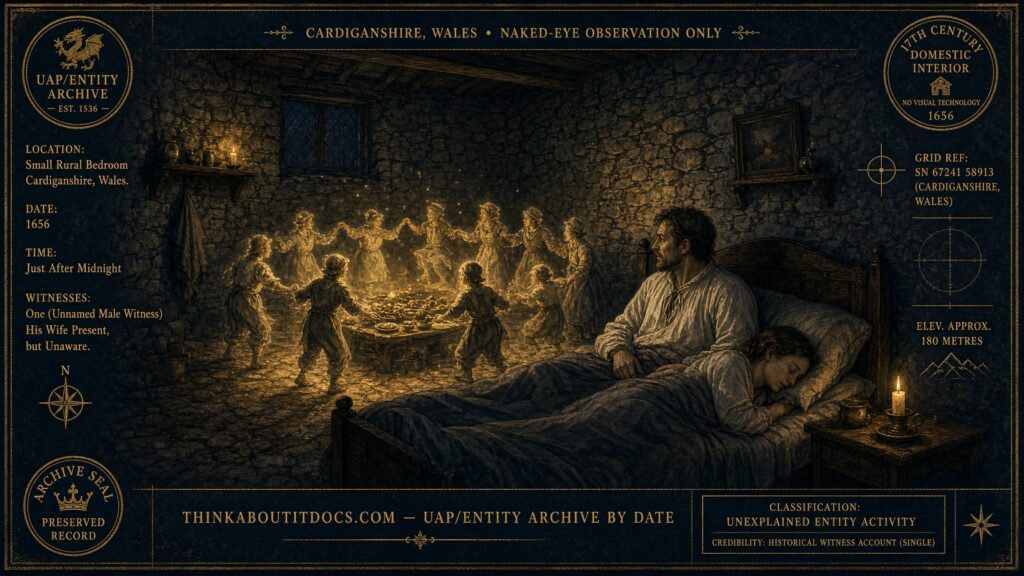
Four hours with the little people — Cardiganshire, Wales, 1656
THINK ABOUTIT ENTITY ENCOUNTER REPORT
1656: The Cardiganshire Visitation | Small Beings in a Welsh Bedroom
Just after midnight, a light enters a sleeping man’s bedroom and the room itself seems to change — wider, brighter than before. A dozen small figures walk in: men, two or three women, small children in their arms. They dance, they feast, they invite him to eat with them. His wife sleeps through all four hours of it, and when the man finally wakes his household, he cannot find the door.
Date: 1656
Sighting Time: Just after midnight, lasting approximately four hours
Day/Night: Night
Location: Cardiganshire, Wales
Urban or Rural: Rural — a private home
No. of Entity(‘s): “A dozen or so” — described as men, two or three women, and small children
Entity Type: Small humanoid figures, described in the shape of men and women with children, consistent with the British “little people” / fairy folk tradition
Entity Description: Human-shaped figures of small stature, arriving as a group including adult men, two or three women, and small children carried in arms; capable of dancing, feasting, and speaking in whispered Welsh
Hynek Classification: Not Applicable — no craft described; classified as a CE-III-type entity encounter outside the standard Hynek scale
Duration: Approximately four hours
No. of Object(s): Not Applicable
Description of the Object(s): Not Applicable — a light was described entering the room prior to the entities’ appearance
Shape of Object(s): Not Applicable
Size of Object(s): Not Applicable
Color of Object(s): Not Applicable
Distance to Object(s): Not Applicable
Height & Speed: Not Applicable
Number of Witnesses: One direct witness (the unnamed man); his wife and family were asleep and could not be woken during the event
Special Features/Characteristics: The bedroom appeared to change in size and illumination during the visitation; the witness could perceive no voice from the beings except an occasional whisper in Welsh telling him to hold his peace; the witness was unable to wake his sleeping wife throughout the encounter, and afterward could not find the door or the way back to bed until he cried out
Case Status: Unexplained
Source: William E. A. Axon, Welsh Folk-lore of the Seventeenth Century, Y Cymmrodor, Vol. XXI (1908), p. 116, reproducing a letter written by John Lewis describing the experience of an acquaintance
Summary/Description: A man lay in bed at night while his family slept. Just after midnight, he perceived a light entering his small room. A dozen or so small beings “in the shape of men, and two or three women, with small children in their arms” walked in. The room seemed to change — appearing wider and more illuminated than before. The beings danced and partook of a feast, inviting the witness to try the meat. This continued for four hours, during which he perceived no voice from them except an occasional whisper in Welsh telling him to hold his peace. He could not wake his wife throughout. Eventually the party moved their dancing into another room and then departed. The witness cried out at last, waking his family, but for reasons the account does not explain, he could not find the door or the way back into bed.
Related Cases: 1655: Blue-clad woman, Częstochowa, Poland
Detailed Report
The account survives through a letter written by John Lewis describing the experience of an acquaintance, preserved and later published in William E. A. Axon’s scholarly 1908 study of 17th-century Welsh folklore. As a secondhand account — Lewis relaying what he was told rather than a direct firsthand statement — it lacks the strongest possible chain of custody, but it is preserved with a specificity of detail (the four-hour duration, the whispered Welsh admonition, the inability to wake the sleeping wife, the altered perception of room size) that is more granular than typical folkloric summary and reads as a genuine attempt to record a specific, remembered personal account rather than a generic fairy-tale motif.
The account’s structural elements — a light preceding the entities’ arrival, an altered perception of the physical space, a shared meal offered to the witness, near-total silence from the visitors apart from a single cautionary whisper, and a companion’s inability to be woken or perceive the event — are recognizable across multiple entity-contact accounts in both this archive’s earlier medieval entries and its subsequent modern abduction-era cases, suggesting either a durable folkloric template applied across centuries or a genuinely recurring experiential pattern independent of any single era’s interpretive framework.
RESEARCHER’S NOTES
The Cardiganshire Visitation — Wales 1656 and Four Hours of Small Beings
- Source chain assessment: The account is secondhand — a letter relaying an acquaintance’s experience rather than firsthand testimony — but is preserved with enough granular, specific detail to distinguish it from a generic folkloric summary, and was recorded and later published by a credentialed 20th-century folklore scholar rather than embellished by a sensationalist compiler.
- Pattern context / comparative cases: The structural elements of this account — preceding light, altered perception of space, offered food, near-silence apart from a single warning, a sleeping companion unaware of the event — recur across this archive’s broader entity-contact record spanning centuries, forming a recognizable pattern distinct from the aerial-object sightings that dominate most of the surrounding archive.
- Classification issues / corrections: This account fits within the British “Good Neighbors” / fairy-folk tradition documented elsewhere in this archive rather than the aerial-craft category, and no Hynek classification is applied, consistent with the archive’s treatment of similar entity-only accounts.
- Physical evidence / evidentiary weight: No physical trace, artifact, or independent corroborating witness is recorded; the account rests entirely on the single witness’s own retelling as relayed through John Lewis, with the witness’s wife specifically noted as having perceived nothing.
The Cardiganshire visitation stands as one of the most detailed small-entity contact accounts in the mid-17th-century British record — not a passing glimpse but a sustained, four-hour, multi-sensory encounter remembered and relayed with enough specific texture to distinguish it from generic fairy-tale convention, even as its ultimate nature remains as unresolved as the witness’s own account of not being able to find his bedroom door.
“He could perceive no voice, except for the occasional whisper in Welsh bidding him hold his peace.”