"Boy, boy, come away" — the Boston lights of January 1644
THINK ABOUTIT UFO|UAP|ENTITY ENCOUNTER REPORT
1644: The Boston Bay Colony Lights | “Boy, Boy, Come Away”
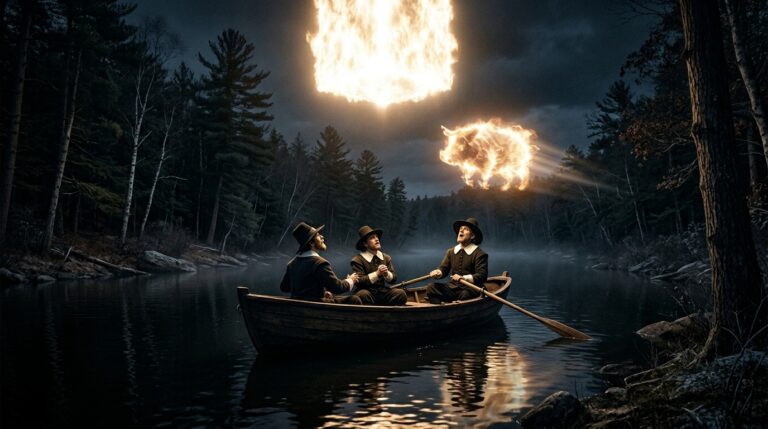
Two lights, each the size of the full moon, rise from the sea near Boston Bay and play a strange game of hide-and-seek across the January sky — while, aboard a boat between Dorchester and Boston, several sober and pious witnesses hear a voice repeat the same two words some twenty times: “Boy, boy, come away.” Governor John Winthrop, the Massachusetts Bay Colony’s own chronicler, wrote it down.
Date: January 18, 1644 (with a related, closely similar recurrence January 25–26, 1644)
Sighting Time: Approximately 8:00 p.m.
Day/Night: Night
Location: Boston Bay Colony, Massachusetts (with the voice heard by witnesses aboard a boat between Dorchester and Boston)
Urban or Rural: Coastal colonial settlement and adjacent waterway
No. of Entity(‘s): Two man-shaped light forms; a disembodied voice heard separately
Entity Type: Man-shaped luminous forms; unseen vocal source
Entity Description: Two lights, each the apparent size of the full moon, emerging from the sea and taking on a man-like shape, observed engaging in apparent hide-and-seek movement between each other
Hynek Classification: NL (Nocturnal Light), with an associated auditory entity element outside the standard Hynek scale
Duration: Not precisely recorded; described as an extended sequence of movement (“celestial ballet”) with the vocal calls repeated approximately twenty times
No. of Object(s): Two lights
Description of the Object(s): Two lights rising first from the sea/northeast and east respectively, described as man-shaped, engaged in a mutual pursuit pattern likened by Winthrop to hide-and-seek
Shape of Object(s): Man-shaped
Size of Object(s): Each described as the apparent size of the full moon
Color of Object(s): Not specified beyond luminosity comparable to the moon
Distance to Object(s): Not recorded — visible to inhabitants near the sea in the immediate area
Height & Speed: Not precisely recorded; described as moving between apparent hiding and reappearing positions
Number of Witnesses: Multiple — three men initially reported seeing the lights come out of the sea; several inhabitants near the water separately observed the moon-sized lights; several additional persons described as “sober and pious” aboard a boat between Dorchester and Boston heard the voice
Special Features/Characteristics: A voice, described by witnesses as speaking in “a most terrible voice,” repeated the words “Boy, boy, come away” approximately twenty times from various directions; a similar recurrence of lights and the same vocal phenomenon was independently recorded a week later on January 25–26
Case Status: Unexplained
Source: Governor John Winthrop, Winthrop’s Journal, “History of New England” (1630–1649) (New York: Barnes and Noble, 1959)
Summary/Description: Three men coming to Boston reported seeing two “man-shaped lights” come out of the sea. Around 8:00 p.m., several inhabitants of an area of Boston near the sea saw a light the size of the full moon rise in the northeast, shortly followed by a second light appearing in the east; witnesses described the two lights engaging in an apparent game of hide-and-seek. During this display, several persons known to be sober and pious, aboard a boat between Dorchester and Boston, reported hearing a voice in the sky speaking in a most terrible tone, repeating the words “Boy, boy, come away” from various directions approximately twenty times. A closely similar recurrence — luminous objects sparkling and emitting flames, along with the same “Boy, boy, come away” calls — was recorded again on January 25–26, 1644.
Related Cases: 1638/1639: Charlton, Massachusetts — Muddy River light
Detailed Report
Governor John Winthrop’s journal is among the most historically significant primary sources for the founding decades of the Massachusetts Bay Colony, maintained as an ongoing administrative and personal record by the colony’s own chief magistrate. Winthrop was not a folklorist or sensationalist chronicler — his journal is the standard scholarly source for early colonial New England history, which lends unusual institutional weight to his inclusion of this account among his other entries on governance, weather, crops, and colonial affairs.
The account has two distinct components that Winthrop records together: a visual phenomenon (two moon-sized, man-shaped lights engaged in apparent mutual pursuit) and an auditory phenomenon (a disembodied voice repeatedly calling “Boy, boy, come away,” heard by a separate group of witnesses aboard a boat). Winthrop’s specific emphasis on the character of the boat’s witnesses — explicitly described as “sober and pious” — reflects a period concern with establishing witness credibility, since testimony from individuals of established moral and religious standing carried particular evidentiary weight in Puritan New England. The near-identical recurrence of both the lights and the vocal phenomenon a week later, independently recorded, strengthens the account’s internal consistency, though it does not provide independent corroboration from outside Winthrop’s own record-keeping.
RESEARCHER’S NOTES
The Boston Lights — Massachusetts 1644 and “Boy, Boy, Come Away”
- Source chain assessment: Governor John Winthrop is among the most credible and historically verifiable single sources in this entire archive — a sitting colonial governor recording contemporaneous events in an administrative journal that remains a standard primary source for American colonial history, not a secondhand chronicle or later compilation.
- Classification issues / corrections: The visual lights component is classified NL, consistent with a nocturnal aerial light phenomenon; the separately reported directional voice repeating specific words falls outside standard Hynek visual classification and is noted as a distinct auditory element rather than folded into the light sighting.
- Pattern context / comparative cases: This account belongs to a documented cluster of early colonial Massachusetts sightings recorded in the same general period and region, including the 1638/1639 Charlton “Muddy River light” case, which similarly describes a light changing shape and moving at high speed, with witnesses afterward reporting a form of missing time.
- Geographic or historical context: The account reflects the documentary style of Puritan New England, where witness moral character (explicitly noted as “sober and pious”) was treated as directly relevant to a report’s credibility, distinct from the religious-omen framing common in contemporary European accounts of the same period.
The Boston lights of January 1644 stand among the best-attributed entries in the early American record — recorded not by an anonymous pamphleteer but by the colony’s own governor, describing a repeated, multi-witness phenomenon with both visual and auditory components that neither Winthrop nor his sources attempted to explain away.
“Boy, boy, come away…”