"Truly a dragon" — Christophorus Schere's 1619 report over Lake Uri
THINK ABOUTIT ENTITY SIGHTINGS REPORT
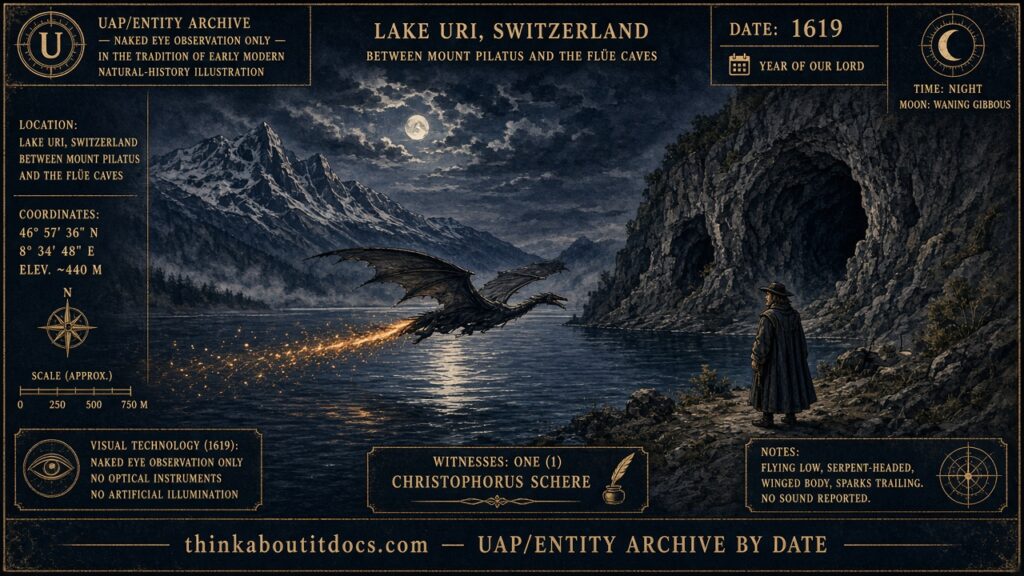
1619: The Schere Dragon Report | Flüelen, Switzerland, Published by Athanasius Kircher
A Swiss county prefect watches a long, serpent-headed, fire-shedding form fly between two mountain caves across Lake Uri — and rather than keep the account to himself, submits a formal written report that Athanasius Kircher, one of the great polymaths of the age, later published in his 1665 encyclopedic survey of the underground world.
Date: 1619
Sighting Time: Night
Day/Night: Night
Location: Flüelen, on Lake Uri, Switzerland (between Mount Pilatus and the Flüe caves)
Urban or Rural: Rural — mountainous lakeside terrain
No. of Entity(‘s): One
Entity Type: Described by the witness as a dragon
Entity Description: A long-bodied, long-necked, long-tailed flying form with a serpent’s head bearing visible teeth, agitated wings, and sparks emitted from its body resembling those thrown by an incandescent iron struck on an anvil
Hynek Classification: NL (Nocturnal Light), with an entity/creature description overlaid — the witness explicitly ruled out a meteor
Duration: Not recorded
No. of Object(s): Not Applicable — described as a single living form rather than a craft
Description of the Object(s): Not Applicable
Shape of Object(s): Not Applicable
Size of Object(s): Not recorded, described only as long in body, tail, and neck
Color of Object(s): Bright, fiery in color
Distance to Object(s): Observed flying across Lake Uri between two mountain caves; exact distance not recorded
Height & Speed: Flew with agitated wing motion described as celerity (rapid movement); exact height not recorded
Number of Witnesses: One named witness (Christophorus Schere, prefect of Uri County)
Special Features/Characteristics: The witness, a county prefect, explicitly considered and rejected a meteor explanation, citing the visible motion of the creature’s body parts as evidence of a living form; the account was submitted as a formal written report and later published by Athanasius Kircher
Case Status: Unexplained
Source: Athanasius Kircher, Mundus Subterraneus (Amsterdam, 1665), Lib. VIII, pp. 93–94, reproducing the report of Christophorus Schere, prefect of Uri County
Summary/Description: Christophorus Schere, prefect of Uri County, reported: “As I was contemplating the serene sky by night, I saw a very bright dragon flying across from a cave in a great rock in the mount called Pilatus toward another cave, known as Flue, on the opposite side of the lake. Its wings were agitated with much celerity; its body was long as well as its tail and neck. Its head was that of a serpent with teeth, and when it was flying, sparkles were coming out of it like the ones thrown by an incandescent iron when struck by smiths on an anvil. At first, I thought it was a meteor, but after observing more closely, I saw it was truly a dragon from the recognizable motion of the members. This I write to you with respect, that the existence of dragons in nature is not to be doubted any more.” The account was later published by the Jesuit polymath Athanasius Kircher in his 1665 encyclopedic work on the subterranean world.
Related Cases: Not Applicable
Detailed Report
Christophorus Schere’s report survives because it was selected for inclusion by Athanasius Kircher, a Jesuit scholar whose Mundus Subterraneus (1665) was among the most ambitious encyclopedic works of the 17th century, covering geology, volcanology, hydrology, and — reflecting the period’s still-fluid boundary between natural history and cryptozoology — accounts of dragons reported from across Europe. Kircher was not a credulous folklorist; he was one of the most respected polymaths of his generation, and his decision to include Schere’s account, attributed to a named county official rather than an anonymous rumor, reflects the seriousness with which such reports could still be treated within the era’s natural philosophy.
Schere’s own account is notable for its explicit self-correction: he states plainly that his first hypothesis was a meteor, and that he revised this judgment only after continued observation revealed what he interpreted as purposeful, anatomically coordinated motion — “the recognizable motion of the members” — inconsistent with a simple falling or burning object. Whether Schere witnessed an actual unknown animal, an unusual atmospheric phenomenon whose behavior he over-interpreted, or something else entirely, his account represents a genuine attempt at empirical reasoning by a period observer working without modern categories for describing anomalous aerial phenomena.
RESEARCHER’S NOTES
The Schere Dragon Report — Flüelen 1619 and Early Science’s Approach to the Unexplained
- Source chain assessment: The account is attributed to a named, identifiable official (a county prefect) and preserved by a major, independently verifiable 17th-century scholarly figure (Athanasius Kircher) in a formally published scientific work — one of the strongest institutional chains of custody for any entity account in this period of the archive.
- Classification issues / corrections: Schere’s own explicit meteor hypothesis, later rejected by him on the basis of observed coordinated motion, is preserved here as his own reasoning rather than an independent modern conclusion; this archive does not adopt his “true dragon” interpretation, nor rule out an unusual atmospheric or bioluminescent phenomenon he interpreted through the period’s available zoological categories.
- Pattern context / comparative cases: “Flying dragon” reports of this kind were a recognized category in 17th-century natural history compilations, reflecting a period in which large flying nocturnal creatures (real, misidentified, or invented) occupied a genuine — if now-obsolete — place in scholarly zoological classification.
- Geographic or historical context: Kircher’s inclusion of Schere’s account in Mundus Subterraneus, alongside genuine geological and volcanological observations, illustrates the still-permeable boundary in early modern natural philosophy between what would later be separated into “science” and “folklore” — a boundary this specific, named, officially reported account sits directly astride.
Whatever Christophorus Schere actually saw over Lake Uri in 1619, his report stands out for the rigor of its own internal reasoning — a witness who considered and explicitly rejected the era’s standard mundane explanation before committing his account to writing, preserved for posterity by one of the period’s most respected scholars.
“At first, I thought it was a meteor, but after observing more closely, I saw it was truly a dragon from the recognizable motion of the members.”