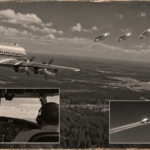
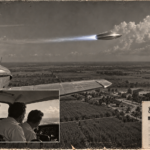
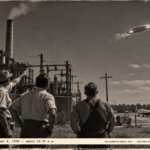
George Pedley witnessed a disc-shaped object rise from Horseshoe Lagoon near Tully, Queensland, leaving behind a famous circular nest of displaced reeds, January 19, 1966.
THINK ABOUTIT ENCOUNTER REPORT
The 1966 Tully Saucer Nest: Australia’s Classic UFO Physical Trace Case
At 9 a.m. on a clear January morning in 1966, banana farmer George Pedley was driving his tractor near Horseshoe Lagoon outside Tully, Queensland, when a hissing sound stopped him in his tracks — and a grey, saucer-shaped object rose out of the swamp, hovered at treetop height, then vanished at tremendous speed. What he found when he reached the lagoon became one of the most famous UFO physical trace cases in the world: a huge, precisely circular mat of reeds, swirling and displaced in a pattern no known local phenomenon could fully account for. Nearly six decades of investigation by Australian UFO researcher Bill Chalker followed, including original RAAF files, scientific testing, and Pedley’s own later, more measured recollections.
Date: January 19, 1966
Sighting Time: 9:00 a.m.
Day/Night: Day
Location: Horseshoe Lagoon, near Euramo/Tully, North Queensland, Australia
Urban or Rural: Rural — banana and sugar cane farmland
No. of Entity(‘s): None documented
Entity Type: None documented
Entity Description: None documented
Hynek Classification: CE-II (Close Encounter II) — corrected from the source material’s duplicated “CE2 CE-II” label. One of the most substantial physical-trace cases in Australian ufology
Duration: Reported inconsistently across sources — the witness’s original 1966 account gave about 4 seconds; the official RAAF file recorded approximately 15 seconds; in a 1981 interview, the witness estimated the total sighting at around 30 seconds. This page does not resolve the discrepancy, since none of the three figures is clearly more authoritative than the others
No. of Object(s): 1
Description of the Object(s): A solid-appearing object resembling two saucers joined face to face, convex on both top and bottom, with no portholes, antennae, or visible occupants reported
Shape of Object(s): Disc — described by the witness as resembling two saucers placed face to face
Size of Object(s): Approximately 25 feet in diameter and 8 to 9 feet thick at the center
Color of Object(s): Silver-grey to blue-grey, non-reflecting and dull in appearance
Distance to Object(s): Approximately 25 yards from the witness at first sighting
Height & Speed: First seen at treetop height (approximately 30 feet), rising to roughly 60 feet before departing at a 45-degree climbing angle; described as far faster than any aircraft, with no numeric speed given
Number of Witnesses: One direct witness to the object itself (George Pedley); property owner Albert Pennisi and others witnessed only the resulting physical trace, not the object
Special Features/Characteristics: A hissing sound and an apparent tractor misfire preceded the sighting; a large, precisely circular area of swirling, reed-cleared water was found immediately at the site; a floating mat of uprooted reeds, radially distributed in a clockwise pattern, surfaced within hours and showed a distinct downward-thrust impression roughly 6 to 8 feet across at its center; a patch of couch grass nearby had been clipped and removed at water level; unexplained teardrop-shaped ground markings were found in an adjoining ploughed field, though never confirmed as connected to the sighting; a faint sulphur smell was reported after the object’s departure; the reeds turned from green to brown within roughly 8 hours, a timeline inconsistent with ordinary submersion-based browning; scientific testing found no significant radioactivity and no botanical evidence of burning or parasitic infestation; the property owner separately reported his dog behaving erratically that same morning and described having had recurring dreams of a flying saucer landing on his property in the preceding week — an anecdotal, unconfirmed detail presented here with that caveat; official RAAF investigation proposed a “willy willy” (small circular wind vortex) as the probable cause, an explanation the case’s principal investigator has argued does not fit the local topography, weather conditions, or the volume of reeds actually displaced
Case Status: Unexplained — extensively investigated by RAAF officers, government meteorologists, university botany and physics departments, and Australian UFO researcher Bill Chalker across more than two decades; the official “willy willy” explanation was never conclusively established and has been directly challenged on multiple factual grounds by the case’s most thorough investigator
Source: UFO Research Queensland case files; Bill Chalker, “The 1966 Tully Saucer ‘Nest’: A Classic UFO Physical Trace Case” (1997); Chalker, 1996, pp. 111–114; Flying Saucer Review, Vol. 12, No. 2, Mar.–Apr. 1966; original RAAF case files including Sgt. A.V. Moylan’s on-site report; personal interviews conducted by Bill Chalker with George Pedley and Albert Pennisi
Summary/Description: Banana farmer George Pedley witnessed a grey, disc-shaped object rise from Horseshoe Lagoon near Tully, Queensland, and depart at high speed. He immediately found a large circular area of swirling, cleared water at the site, which developed into a precisely patterned floating mass of uprooted reeds bearing a clear downward impression. The case became one of the most thoroughly investigated UFO physical trace reports in Australian history, involving RAAF officers, government scientists, and decades of follow-up research, without ever being conclusively explained.
Related Cases: 1963: The Willow Grove Close Encounter — cited by the case’s own investigator as a parallel example of Australian authorities proposing a “tornado-like meteorological manifestation” explanation for a well-documented physical encounter
Detailed Report

The original Tully “saucer nest,” Horseshoe Lagoon. (Image courtesy Paul Jackson, TUFOIC)
At about 9 a.m. on January 19, 1966, George Pedley, a 28-year-old banana farmer, was driving a tractor along a track on a neighboring cane farmer’s property near Horseshoe Lagoon, close to the town of Tully in North Queensland. Approaching the lagoon, he thought he heard the tractor engine misfire, then a distinct hissing sound he initially mistook for a leaking tire. Looking up, he watched a large, grey, saucer-shaped object rise out of the swamp, ascend to roughly treetop height, tilt slightly, and then depart at extraordinary speed toward the southwest. He estimated the object at about 25 feet in diameter and 8 to 9 feet thick, silver-grey in color, with no visible portholes, antennae, or occupants. The entire sighting lasted only a few seconds by his original account.
Pedley immediately went to the lagoon and found a large, near-circular area of water completely cleared of reeds, slowly rotating where the object had apparently risen. Nearby, a patch of giant couch grass had been clipped short at water level and removed. He restarted his tractor — uncertain afterward whether he had switched it off or it had simply stalled — and continued his work. Returning later that day, he found the cleared water area gone, replaced by a large floating mass of uprooted reeds, radiating outward in a clearly clockwise pattern. The reeds were still green at that point.
By mid-afternoon, Pedley brought property owner Albert Pennisi to see the site. Pennisi found he could swim beneath the floating reed mass in clear, unobstructed water, and both men were struck by an unmistakable impression left on the surface — a sharply downward-thrust outer perimeter with a distinct circular depression roughly 6 to 8 feet across at its center, as though pressed down by a large inverted disc. Pennisi photographed the site over the following two days. By late afternoon, roughly eight hours after the sighting, the reeds on top of the nest had turned brown, while the undersides remained green — a timeline that later botanical testing found inconsistent with ordinary submersion-based decay, which typically takes several days to produce browning.
A separate observer, Christine Rounland, later found unusual teardrop-shaped markings in the loose soil of an adjoining ploughed field, leading away from the lagoon area — about 3 to 4 inches long, spaced roughly 12 inches apart in a straight line. No plaster casts were taken, and no confirmed connection between these markings and the sighting was ever established.
Pedley reported the incident to Tully police that evening. The following morning, a police sergeant accompanied him to the site and contacted the RAAF base at Townsville. The RAAF’s official report, based on a standard sighting questionnaire completed with Pedley, recorded the object rising vertically to about 60 feet before departing at a 45-degree climbing angle, and documented a clearly defined circular depression in the swamp grass measuring roughly 32 by 25 feet, with reeds flattened in a clockwise pattern to water level. Notably, the investigating sergeant’s own typed report initially recorded the rotation as anticlockwise before being corrected by hand to clockwise — a small but telling illustration of how easily even official on-the-spot documentation introduced confusion into the case’s later retelling.
The investigating sergeant privately favored a mundane explanation, suggesting Pedley may have mistaken a small helicopter’s rotor, glinting in early morning sunlight, for a solid object — though he noted that a much more suitable, clear landing area existed nearby, which a helicopter pilot would likely have used instead of the position Pedley described near trees. A local resident separately suggested a whirlwind picking up water from a nearby waterspout as an alternative explanation. RAAF headquarters ultimately favored the theory that the depression was caused by a small, isolated waterspout or “willy willy” — a conclusion later formalized in official correspondence, which described the case as most likely explained by a circular wind phenomenon that flattened the reeds and lifted debris into a saucer-like shape before dissipating.
Samples of reeds, mud, and water from the site were sent for scientific testing at the University of Queensland. Radioactivity readings were negligible across all but one sample, which showed a small increase in beta activity considered insignificant by the university’s staff physicist. The university’s botany department concluded the grass had likely died from submersion, though this finding conflicted with Pennisi’s own follow-up testing, which found that reeds deliberately submerged for comparison took roughly three days to brown — far longer than the roughly eight hours observed at the actual nest site.
In the weeks and years that followed, numerous additional “nests” were found at Horseshoe Lagoon and nearby, including two smaller nests found the following day and further examples discovered over subsequent decades, eventually totaling more than twenty by 1990. None of the later nests carried the same direct connection to an observed UFO, and given the heavy public and media traffic to the site following the initial publicity, the case’s principal investigator has explicitly noted that hoaxing cannot be ruled out for several of the later finds — a caveat that does not apply to the original Pedley nest itself.
In a 1981 interview with researcher Bill Chalker, Pedley offered a more measured account than some of the sensationalized 1966 press coverage had suggested, explicitly denying he had ever called the object a “spaceship” and clarifying that he saw it already in the air rather than rising directly out of the lagoon itself — attributing the discrepancy to media misquotation rather than a change in his own story. He confirmed the object’s size, shape, and color consistent with his original report, and estimated the total sighting duration at around 30 seconds when he and Chalker worked through his recollection together.
Researcher’s Notes
The Tully Saucer Nest — 1966 and Why the Official Explanation Doesn’t Fit Its Own Evidence
- This is one of the strongest physical-trace cases in the Australian record. Unlike many UFO reports resting on testimony alone, the Tully case combines a direct witness account with same-day physical evidence, photographed within 48 hours, and follow-up scientific testing — a combination rarely available for cases of this age.
- The official “willy willy” explanation has documented factual problems. The case’s principal investigator has laid out specific objections: the surrounding topography doesn’t favor localized wind vortex formation, the weather that morning was calm and clear rather than conducive to whirlwind activity, the witness described a close-range, detailed object rather than an indistinct funnel, and — critically — there was no evidence that a sufficient volume of reeds had actually been lifted away from the site to account for the visual impression Pedley described. None of this proves a non-mundane explanation, but it does mean the official “probable cause” label oversimplifies a case its own investigating officers couldn’t fully reconcile with the evidence.
- Even the official paperwork shows signs of confusion. The investigating sergeant’s own report initially recorded the reed pattern’s rotation direction incorrectly before correcting it by hand — a small detail, but one that shows how easily even contemporaneous, on-site documentation could introduce errors that later fueled decades of conflicting secondary accounts about which direction the nest actually swirled.
- The witness’s later, calmer account is a useful corrective to press sensationalism. Pedley’s 1981 clarification that he never described the object as a “spaceship,” and that he saw it already airborne rather than rising directly from the water, shows how contemporary newspaper coverage shaped the popular version of this case in ways that outran what the witness himself actually said. This is a good example of why source discipline — going back to the witness directly rather than relying on decades of secondhand retelling — matters.
- Later “nests” at the same site dilute rather than strengthen the case. More than twenty additional nests were documented at Horseshoe Lagoon in the decades following 1966, but only the original Pedley nest carries a direct, same-day connection to an observed object. The case’s own investigator has flagged the later finds as potentially compromised by hoaxing, given the heavy foot traffic the site received after it became famous — a distinction worth preserving rather than treating all “Tully nests” as equally significant.
- Even skeptical theories built on this case have had their own sourcing errors. A later crop-circle “vortex” hypothesis, developed independently in England, was partly built on a mistaken assumption that Pedley’s sighting occurred at 9 p.m. rather than 9 a.m. — a basic factual error in the foundational reasoning of a theory sometimes cited as an explanation for this very case.
The Tully saucer nest endures as one of the most methodically investigated UFO physical trace cases in the world — not because every anomalous detail has been proven inexplicable, but because the available physical evidence, scientific testing, and documented investigation consistently fall short of fully supporting the one official explanation offered for it.
“I have really seen something!”
— George Pedley, January 19, 1966