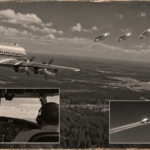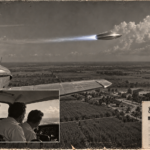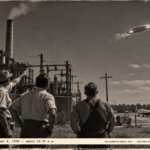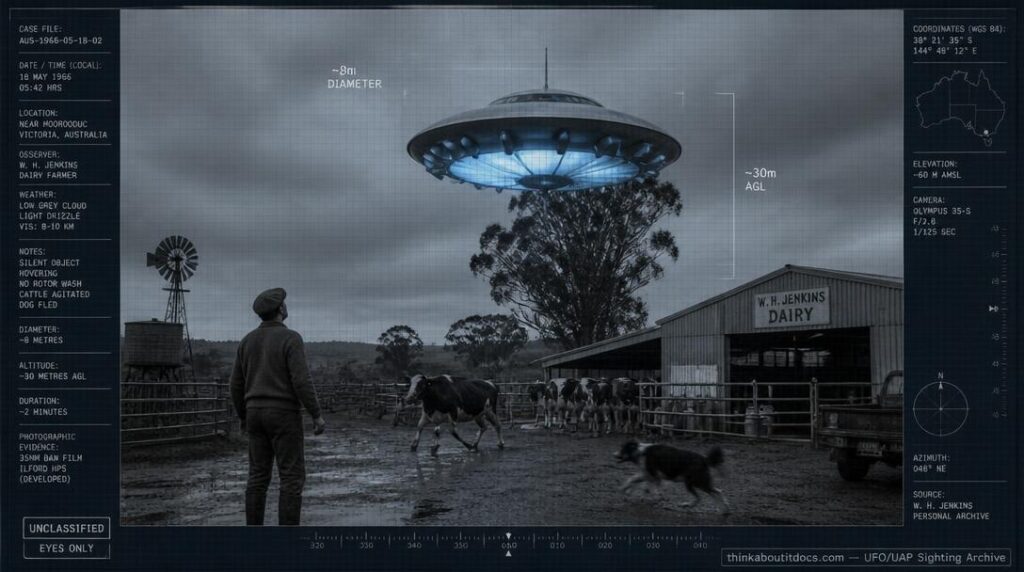
Farmer Charles Brew described a metallic grey disc hovering roughly 30 metres above his dairy farm near Moe, Victoria, February 15, 1963.
THINK ABOUTIT UFO ENCOUNTER REPORT
1963 Willow Grove Close Encounter: The Moe, Victoria UFO Case
At 7 a.m. on February 15, 1963, dairy farmer Charles Brew watched a battleship-grey disc descend slowly out of the clouds over his farm near Moe, Victoria — close enough to see a rotating, glowing underside and a chrome mast on top, and close enough to leave him with a headache he’d later describe to a government meteorologist as feeling like “beams of magnetic current.” The RAAF investigated, official meteorologists proposed a tornado, and one of the era’s most respected UFO physicists later called the case extremely difficult to explain by any conventional means.
Date: February 15, 1963 (BBU-catalogued)
Sighting Time: 7:00 a.m.
Day/Night: Day
Location: ‘Willow Grove‘ farm, near Moe, Victoria, Australia
Urban or Rural: Rural — working dairy farm
No. of Entity(‘s): None documented
Entity Type: None documented
Entity Description: None documented
Hynek Classification: CE-II (Close Encounter II) — upgraded from the source material’s original CE-I. Brew reported a physiological effect (a headache) and a felt sensation he described as “beams of magnetic current” between himself and the object — exactly the kind of physical/medical or electromagnetic effect that defines CE-II, not just close-range observation
Duration: A few seconds of stationary hovering explicitly documented; total encounter including descent and climb-away was likely longer, though not separately timed in the source
No. of Object(s): 1
Description of the Object(s): A metallic disc with a transparent, glass-like dome on top from which a two-metre chrome-like mast or aerial protruded, roughly as thick as a broom handle. The base or underside glowed pale blue and featured scoop-like protuberances around its outer edge, rotating at approximately one revolution per second and producing a turbine-like swishing noise
Shape of Object(s): Disc
Size of Object(s): Approximately 8 metres in diameter and 3 metres high, with a 2-metre mast on top
Color of Object(s): Battleship grey, metallic lustre on the upper section; pale blue glow on the underside
Distance to Object(s): Approximately 30 metres at closest hover point, over a stringy-bark tree
Height & Speed: Hovered at approximately 30 metres altitude; descended and later climbed away slowly, continuing westward before disappearing into cloud cover
Number of Witnesses: Two — Charles Brew (direct visual witness) and his 20-year-old son Trevor Brew (did not see the object but independently confirmed hearing its distinctive turbine-like sound from inside the milking shed)
Special Features/Characteristics: Cattle and a pony reacted violently to the object’s approach; both farm dogs fled; Charles Brew reported a headache coinciding with the object’s approach and a felt sensation described as “beams of magnetic current” between himself and the object; Trevor independently described the sound as resembling a didgeridoo or bull-roarer; a local newspaper’s claim that cattle “turned somersaults” was later denied by the Brews themselves; the RAAF formally investigated, interviewing Brew and consulting Commonwealth meteorologists; physicist Dr. James McDonald personally visited the site and interviewed Brew in 1967
Case Status: Unexplained — officially attributed by the Department of Air to a “tornado-like meteorological manifestation,” but the meteorological data used to support that explanation directly conflicts with Brew’s own wind-direction account, and physicist Dr. James McDonald’s independent 1967 review concluded the case remained extremely difficult to explain in conventional terms
Source: Bill Chalker (1996); “Summary of Unidentified Aerial Sightings reported to Department of Air, Canberra, ACT, from 1960”; Magonia 563
Summary/Description: Dairy farmer Charles Brew and his son Trevor witnessed a metallic grey disc descend to roughly 30 metres over their farm near Moe, Victoria. The object featured a rotating, glowing blue underside and a transparent domed top with a chrome mast, and produced a turbine-like noise before climbing away into cloud cover. Brew reported physical effects including a headache and a felt electromagnetic sensation. The RAAF investigated and officially attributed the sighting to a tornado-like phenomenon, though the explanation’s own supporting data was internally inconsistent.
Related Cases: None documented
Detailed Report

The Willow Grove object, based on the original witness sketch preserved in RAAF case files. (Credit: Bill Chalker)
At 7 a.m. on February 15, 1963, Charles Brew was working in the milking shed on his family’s farm, ‘Willow Grove,’ near Moe, Victoria, with his 20-year-old son Trevor. It was daylight, though rain clouds hung low overhead. Standing in an open area with a clear view of the eastern sky, Brew saw a strange object appear and begin descending very slowly toward the milking shed. As it approached, the farm’s cattle and a pony reacted violently, and both dogs fled the area. A local newspaper later reported that the cattle had “turned somersaults” during the encounter — a detail the Brews themselves subsequently denied.
The object descended to roughly 30 metres, coming to hover directly over a stringy-bark tree near the shed. Brew described it as approximately 8 metres in diameter and 3 metres high, with a transparent, glass-like dome on top from which a two-metre mast or aerial protruded — as thick as a broom handle and resembling bright chrome. The upper section of the disc was battleship grey with a metallic lustre, while the underside glowed pale blue and featured scoop-like protuberances around its outer rim. This lower section rotated slowly, at roughly one revolution per second, generating a swishing, turbine-like noise that was clearly audible to both Brew and his son, despite Trevor being inside the shed near an operating diesel milking machine at the time.
Brew described his eyes being drawn toward the object “as though beams of magnetic current” connected him to it, and reported a headache that began as the object approached. After hovering for only a few seconds, the object began to climb, continuing on a westward course before disappearing back up into the cloud deck. Trevor never directly saw the object, but independently confirmed the unusual sound, comparing it to a didgeridoo or bull-roarer — Aboriginal instruments capable of producing a pulsating, wind-rushing tone.
The RAAF formally investigated the case. Flight Lieutenant N. Hudson and Squadron Leader A.F. Javes interviewed Brew directly and came away impressed with his credibility, but the poor weather conditions at the time — heavy rain, low cloud, and a fresh wind — led investigators to pursue a meteorological explanation. On March 6, Commonwealth meteorologists Dr. Berson and Mr. Clark were consulted on whether a tornado-type condition could account for the sighting. They agreed it was possible, noting that the object’s reported rotation direction was consistent with known Southern Hemisphere tornado behavior, and that the blue coloring could plausibly result from electrical discharge, which would typically be accompanied by an ozone smell. However, their own report flagged a significant inconsistency: Brew stated the wind was blowing from the east at the time, while the nearest official meteorological reading — taken at Yallourn, roughly 20 kilometres away — recorded a westerly wind. Investigators noted this discrepancy could plausibly be explained by local weather variation given the distance between the two locations, but did not resolve it definitively.
Despite these unresolved details, the RAAF report concluded that Brew had witnessed something real, most likely a natural phenomenon, probably a tornado — noting the absence of any reported damage as evidence the phenomenon, if a tornado, was weak. The Department of Air’s public response to a civilian UFO group inquiry was more cautious, acknowledging tornado-like meteorological manifestations as a possibility while stopping short of a firm conclusion. Later official sighting summaries dropped that caution, listing the case’s “possible cause” simply as a “tornado-like meteorological manifestation.”
Dr. Berson personally visited Brew at the Willow Grove property following the sighting, specifically interested in the headache Brew had described, which Berson reportedly tied to his own theory of a possible electromagnetic component to the incident. Asked about the experience afterward, Brew’s own words stood in contrast to the clinical “tornado-like manifestation” label: “I wished it would come again. It was beautiful. I could feel the life pulsating from it.”
In 1967, physicist Dr. James McDonald — one of the most credentialed scientific investigators to take UFO reports seriously during that period — visited Australia and interviewed Brew directly at the site of the 1963 sighting. McDonald’s assessment, like his conclusions on many other credible witness cases he investigated, was that the incident remained extremely difficult to explain in conventional scientific or technological terms.
Researcher’s Notes
The Willow Grove Encounter — 1963 and an Official Explanation That Doesn’t Hold Its Own Weight
- This is a CE-II case, not CE-I. The original source material classifies this as CE-I, close-range observation only. But Brew’s reported headache and his description of a felt “electromagnetic” connection to the object are physical/medical effects — the defining feature of CE-II. Dr. Berson himself treated the headache as evidence for a possible electromagnetic component, which reinforces the reclassification rather than undermining it.
- The official tornado explanation contains its own documented contradiction. The RAAF’s meteorologists built their tornado theory partly on wind direction, but Brew’s own account of an easterly wind directly conflicted with the nearest official weather station reading of a westerly wind. Investigators acknowledged this discrepancy and attributed it to possible local variation over 20 kilometres, but never resolved it — meaning the official explanation’s own supporting data doesn’t fully agree with itself.
- Multiple layers of official caution collapsed into a flat label over time. The Department of Air’s contemporaneous public statement was notably hedged, calling a tornado-like explanation only a possibility and explicitly declining a firm conclusion. Later official summary documents dropped that hedge entirely, listing “tornado-like meteorological manifestation” as a flat, unqualified cause — a good example of how nuanced official uncertainty can flatten into a false-certainty label in later records.
- Independent scientific witnesses treated this case as serious and unresolved. Both RAAF investigators and, later, physicist Dr. James McDonald came away from direct interviews with Brew convinced of his credibility. McDonald in particular was known for rigorously separating credible witness cases from explainable ones, and his 1967 conclusion — that the case remained extremely difficult to explain conventionally — carries real evidentiary weight.
- Cross-corroborated sensory detail strengthens the account. Trevor Brew never saw the object but independently reported the same distinctive turbine-like sound his father described, offering partial corroboration of at least one sensory element of the encounter from a second, differently positioned witness.
The Willow Grove case stands as one of the more thoroughly investigated Australian sightings of the 1960s — formally examined by the RAAF, personally reviewed by a Commonwealth meteorologist and later by one of American ufology’s most credentialed scientific investigators, and ultimately left with an official explanation that its own supporting data doesn’t cleanly support.
“I wished it would come again. It was beautiful. I could feel the life pulsating from it.”
— Charles Brew, 1963