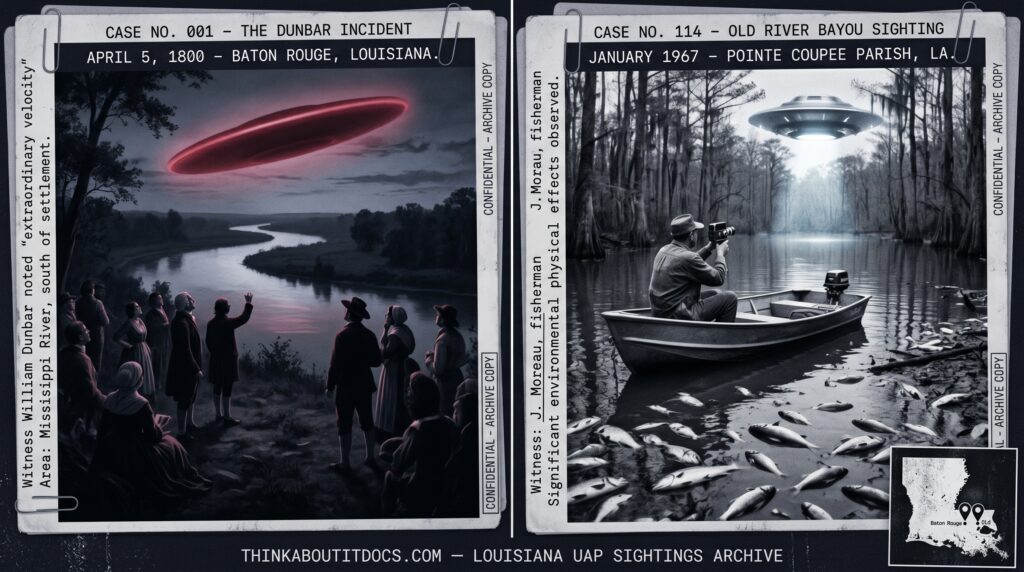
Louisiana UAP archive: April 5 1800 Baton Rouge crimson-red disc communicated by Thomas Jefferson to the American Philosophical Society Transactions — the oldest formally published UAP observation in the US record, and January 1967 Old River north Baton Rouge encounter with two photographs and hundreds of dead fish on the riverbank. 5 documented cases 1800–2011.
Louisiana UFO|UAP & Alien Sightings Archive
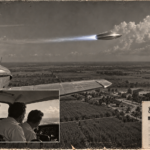
Louisiana’s five-case UAP archive spans more than two centuries and opens with one of the most historically significant documented aerial observations in the American record. On the night of April 5, 1800, a crimson-red disc-shaped object approximately 70 to 80 feet in length was observed at Baton Rouge, moving rapidly from southwest to northeast at an altitude of approximately 200 yards and crossing the visible sky in a quarter of a minute. The account was written by William Dunbar, a scientist and planter, and communicated by Thomas Jefferson — then President of the American Philosophical Society — to the Society’s Transactions, where it was formally published in Volume III and read on January 16, 1801. The dual chain of custody — a trained scientific observer filing a formal written account, routed through the President of the United States to the nation’s leading scientific institution and published in their official proceedings — gives the 1800 Baton Rouge observation a documentary provenance that no other pre-19th century American UAP report approaches. The observation describes a disc-shaped object, crimson red, approximately 70 feet long, moving at high speed at a specific altitude over a specific location, with sufficient proximity to produce an impression of its dimensions on multiple observers. It is the oldest formally documented UAP observation in the Louisiana state archive and one of the most impeccably sourced observations of any era.
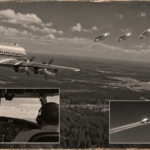
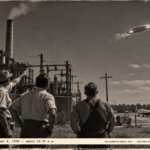
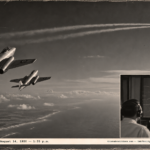
The state’s modern record shifts from the Mississippi River corridor to the Old River drainage north of Baton Rouge, where in January 1967 an anonymous fisherman photographed a vacuum-cleaner-sounding object on two successive nights, found hundreds of dead fish along the riverbank in association with the event, and produced two photographs subsequently published with analysis. The 2011 formation of orbs crossing Louisiana sky — multiple witnesses, organized movement — and the 2003 aerial photography of a metallic object from a commercial aircraft add modern documentation to a state whose geography — bayous, river corridors, Gulf Coast — provides a maritime and inland-water dimension to its UAP record consistent with the regional USO pattern.
- 1800: Baton Rouge, Louisiana Sighting/Crash
- 1967: Baton Rouge Louisiana Encounters
- 1977: Brightly lit UFO seen over Louisiana
- 2003: Metallic object seen and photographed from plane
- 2011: Witness says orbs crossed Louisiana sky in formations
- 1953: The Camp Polk, Louisiana Crash-Retrieval Claim
- 1956: Monroe, Louisiana: The Object That Came Back for a Second Pass
- 1950: Near Bogalusa, Louisiana — August 12, A Tilted Object and a Peal of Thunder
Executive Summary
The Jefferson Document and the River Corridor — Louisiana’s Historical Record
Louisiana’s UAP archive is the most historically anchored in the national database by source provenance. The 1800 Baton Rouge observation sits in a category of its own: a scientific account published in the Transactions of the American Philosophical Society, transmitted by a sitting U.S. President, describing a crimson-red disc-shaped object with specific dimensions observed by multiple witnesses at a specific altitude on a specific date. No other pre-20th century American UAP observation has this combination of scientific publication, presidential transmission, and formal institutional record. The observation was not sensationalized, not published in a newspaper, not recalled retrospectively — it was filed as a scientific description of a natural phenomenon by a man trained to observe and record, routed through the highest available scientific authority, and published in the record that authority kept. That is the pre-modern equivalent of a formal government UAP acknowledgment, and it predates the modern era by 147 years. The 1967 Baton Rouge river encounter adds a photographic dimension and the dead-fish environmental effect that appears in a small number of other river-adjacent UAP cases. Louisiana’s five cases are thin in count and extraordinary in historical depth.