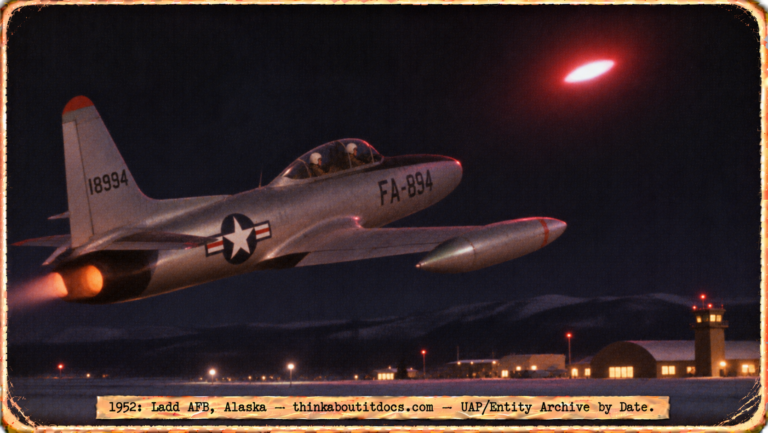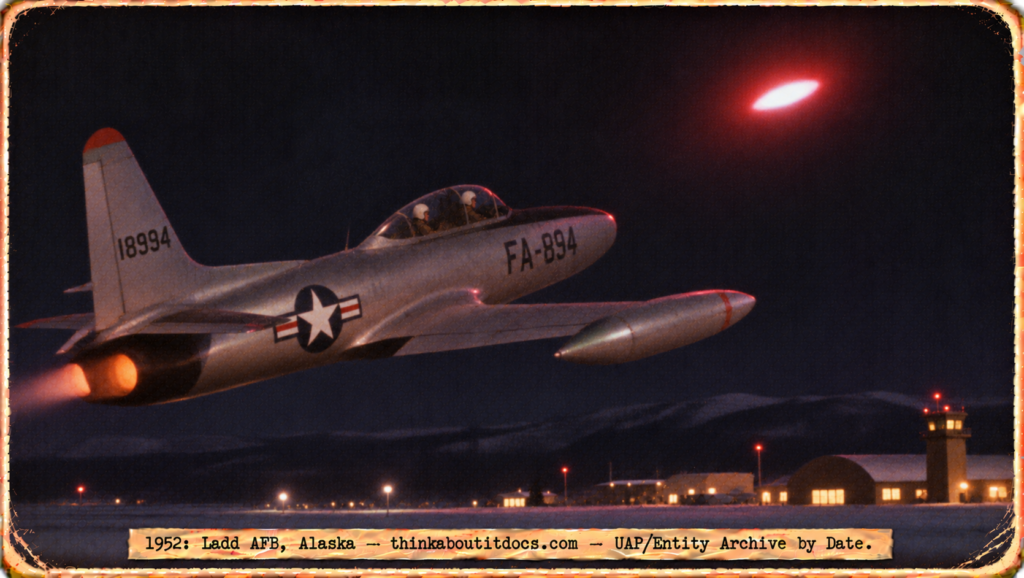
Ladd AFB, Alaska, December 8, 1952: the erratic climbing light.
THINK ABOUTIT UFO|UAP SIGHTINGS REPORT
1952: Ladd AFB, Alaska
The F-94 Crew’s Erratic Climbing Light (BBU 2266)
On the night of December 8, 1952, an F-94 jet interceptor crew scrambled from Ladd Air Force Base, Alaska watched a white oval light turn red as it climbed, flew straight and level for two minutes, then broke into a phenomenally fast, erratic climb unlike anything their own aircraft could match. After they landed, the object was still visible, moving without sound, before it finally sped off to the south, brightening as it descended. Catalogued as Blue Book Unknown 2266, the case survives in crew statements with no proposed conventional explanation.
Date: December 8, 1952
Sighting Time: 8:16 p.m.
Day/Night: Night
Location: Ladd Air Force Base, Fairbanks, Alaska
Urban or Rural: Rural, near an air base
No. of Entity(‘s): None
Entity Type: Not applicable
Entity Description: Not applicable
Hynek Classification: NL (Nocturnal Light) with airborne pursuit; no structure resolved, no entity involved
Duration: About 10 minutes
No. of Object(s): 1
Description of the Object(s): A white oval light that turned red as it gained altitude
Shape of Object(s): Oval (as a light source; no solid structure resolved)
Size of Object(s): Not recorded
Color of Object(s): White, turning red at higher altitude and brightening to a deeper red again during its final descent
Distance to Object(s): Not recorded precisely; within visual and presumed radar range of the intercepting F-94
Height & Speed: Flew straight and level on a 240° heading for 2 minutes, then climbed at what the crew described as phenomenal speed on an erratic path; after the F-94 landed, the object was still visible moving erratically without sound for roughly 3 more minutes before taking up a 160° heading, gaining speed while descending
Number of Witnesses: 2 (1st Lt. D. Dickman, pilot, and 1st Lt. T. Davies, radar operator, aboard F-94 s/n 49-2522)
Special Features/Characteristics: A color change from white to red correlated with altitude; an abrupt transition from straight, level flight to an erratic, phenomenally fast climb; continued visible erratic motion with no audible sound even after the intercepting jet had landed; a final acceleration while descending and brightening, on a different heading than its earlier flight path
Case Status: Unexplained — catalogued as Blue Book Unknown 2266
Source: Berliner; cf. Hynek-CUFOS re-evaluation; Jan Aldrich
Summary/Description: On December 8, 1952, USAF pilot 1st Lt. D. Dickman and radar operator 1st Lt. T. Davies, flying an F-94 jet interceptor out of Ladd AFB, Alaska, watched a white oval light turn red as it climbed, holding a straight and level 240° heading for two minutes before breaking into an erratic climb at phenomenal speed. After the interceptor landed, the object remained visible for about three more minutes, moving erratically and silently, before taking up a 160° heading, gaining speed, descending, and brightening to a deeper red. The encounter lasted about ten minutes and is catalogued as Blue Book Unknown 2266, with no conventional explanation on record.
Related Cases: December 1952 archive | the Madison, Wisconsin T-33 pursuit, December 9, 1952 (BBU 2267)
DETAILED REPORT
An F-94 jet interceptor, crewed by pilot 1st Lt. D. Dickman and radar operator 1st Lt. T. Davies, was airborne near Ladd Air Force Base in Fairbanks, Alaska on the night of December 8, 1952, when the crew spotted a white oval light. As it gained altitude the light’s color shifted to red, and for about two minutes it held a straight, level course on a heading of 240 degrees — behavior consistent, at that point, with a conventional aircraft or even an astronomical body low on the horizon.
That changed abruptly. The object broke from its level flight into a climb the crew described as phenomenally fast and erratic in its path, behavior well outside what their own F-94, one of the era’s front-line jet interceptors, could have matched. The crew tracked it as long as they could before bringing their aircraft back down to land at Ladd.
What makes this case unusual is what happened next: even after the F-94 was on the ground, the object remained visible in the sky, continuing its erratic motion for roughly three more minutes with no audible sound reaching the ground observers. It then settled onto a new heading of 160 degrees, picked up speed while descending, and brightened back toward red as it did so, before the sighting ended. The total encounter, from first sighting to final loss of visual contact, ran about ten minutes.
The case entered the Project Blue Book record as Unknown number 2266 and has been independently cited by researcher Don Berliner and cross-referenced in a Hynek/CUFOS re-evaluation, as well as by Jan Aldrich’s compilation work. No proposed conventional identification — aircraft, balloon, or astronomical body — is recorded as fitting the described flight profile, particularly the sustained visibility and continued erratic motion after the intercepting aircraft itself had already landed.
RESEARCHER’S NOTES
A Blue Book Unknown With a Trained Two-Man Crew
- Classification, and what it leaves out: NL covers the basic observational type — a light with no resolved solid structure — but the case’s real weight comes from the flight-performance detail: a sudden transition from level flight to an erratic, extremely fast climb, sustained well beyond the endurance or capability the crew’s own jet could demonstrate in response.
- A two-man, trained-crew sighting: Unlike many single-witness nocturnal light cases, this one carries a pilot and a radar operator together, both professionally trained to observe aircraft behavior and relative motion at night. Their agreement on the sequence — level flight, color shift, erratic climb, continued visibility after their own landing — strengthens the account considerably over an isolated civilian observation.
- Official “Unknown” status carries weight: Blue Book’s own internal case-closure categories reserved “Unknown” for reports that could not be fit to a conventional explanation after review. BBU 2266’s survival in that category, rather than being folded into “balloon,” “aircraft,” or “astronomical,” is itself evidence that Air Force analysts at the time found no satisfying mundane fit either.
- No radar-lock detail specified: The source material reviewed does not state whether Lt. Davies, as radar operator, achieved an onboard radar lock on the object itself, as opposed to tracking it visually alongside his pilot. That gap is left open rather than assumed one way or the other.
A two-man F-94 crew near Ladd AFB watched a light perform in a way their own jet interceptor could not match, remain visible and erratic even after they themselves had landed, then accelerate away on a new heading. Catalogued as Blue Book Unknown 2266, it carries no conventional explanation in the record reviewed. It stands as Unexplained.
“The object could still be seen moving erratically without sound for 3 more minutes, then took up a 160° heading, gaining speed while descending and growing brighter red.”
— Case summary, Ladd AFB, Alaska, December 8, 1952 (Blue Book Unknown 2266)