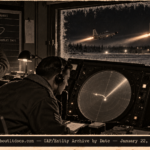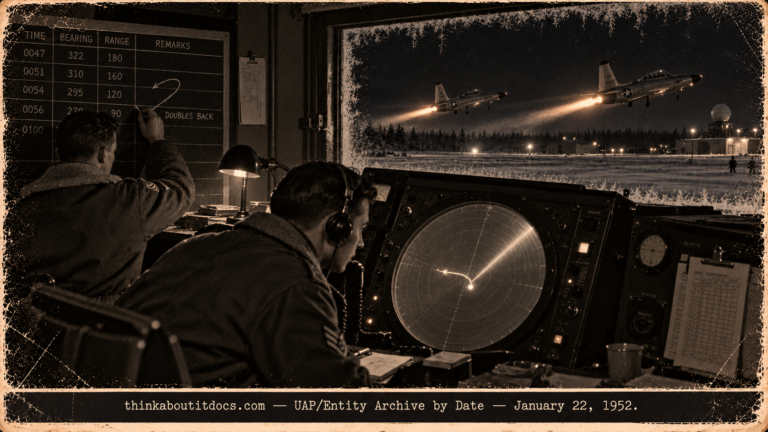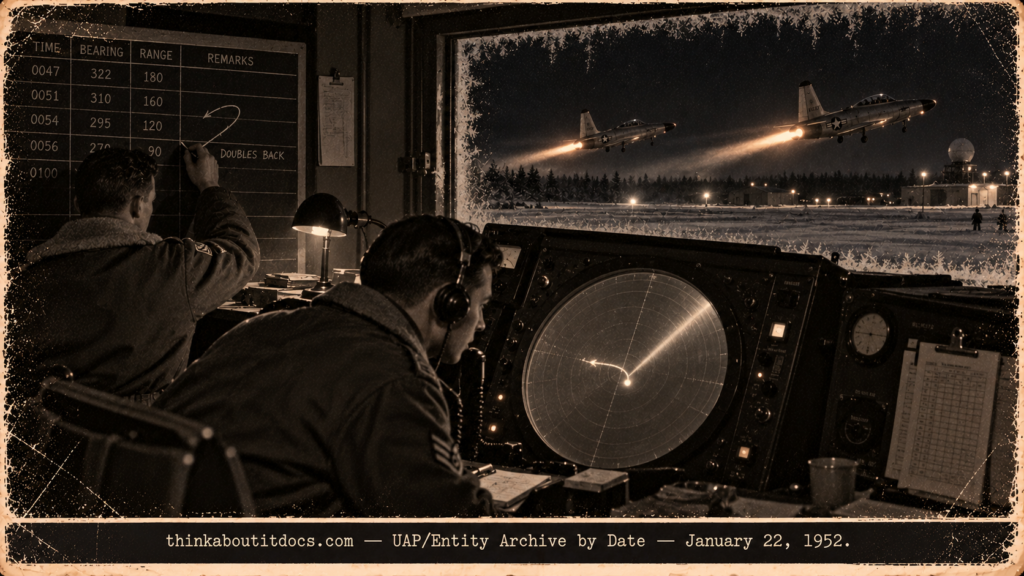
A radar operator at Murphy Dome tracks a fast-reversing target as F-94s scramble, January 22, 1952.
THINK ABOUTIT UFO|UAP SIGHTINGS REPORT
1952: A Radar Target Over Alaska Reverses Course in an Eight-Mile Turn and Outruns Two F-94 Jets
At 47 degrees below zero, a few minutes after midnight on January 22, 1952, a radar operator at Murphy Dome, near Fairbanks, Alaska, watched a target on his CPS-6B scope that was moving at between 1,500 and 2,400 miles per hour. After ten to twelve sweeps of the antenna he called twice for an interception. Two F-94 jets were scrambled into the Arctic night.
When the first jet was vectored toward the target, the target reversed course in an eight-mile turn, roughly five g’s at that speed, and left at more than 1,500 miles per hour. The F-94 crew got airborne radar contacts, lost them, circled for an hour, and at one point closed to about 200 yards before pulling up to avoid a collision, without ever seeing anything. This Nenana, Alaska radar UFO case, taken from Brad Sparks’ catalog of Blue Book unknowns and the opening of Edward Ruppelt’s Chapter 10, stands among the best-known radar encounters of early 1952.
Date: January 22, 1952
Sighting Time: About 12:20 a.m. to 2:13 a.m. AHST
Day/Night: Night
Location: East of Nenana, Alaska (about 64°35’N, 149°20’W), tracked from ADC radar site F-2, Murphy Dome AFS, about 19 miles west-northwest of Fairbanks
Urban or Rural: Rural; Arctic interior
No. of Entity’s: Not Applicable
Entity Type: Not Applicable
Entity Description: Not Applicable
Hynek Classification: RV (Radar; no visual contact reported)
Duration: Tracked in segments for roughly two hours; one inbound track of about 1 minute at 45 miles range; the airborne contacts lasted from seconds to about 3 minutes
No. of Object(s): 1 on ground radar; the first F-94 reported two targets, one strong and one faint
Description of the Object(s): Radar targets only; no visual description. No F-94 crew reported seeing anything.
Shape/Size/Color of Object(s): Not Applicable (radar return only)
Distance to Object(s): Ground radar: about 45 miles inbound; airborne radar: from about 24,000 yards down to about 200 yards
Height & Speed: Ground radar: about 1,500 to 2,400 mph; a secondary account gives 1,500 mph at 23,000 feet. First F-94 at 30,000 feet, later at 25,000 feet
Number of Witnesses: At least 4 radar operators and aircrew: the ground radar operator and the crews of 2 or more F-94 jets
Special Features/Characteristics: Reversal of course over an 8-mile turn radius (roughly 5 g’s at that speed); lock-on attempts failed; closing speed too rapid to follow by hand control of the antenna; a head-on closure that forced a pull-up
Case Status: Carried as a Blue Book unknown (BBU) in Sparks’ catalog; a secondary source says Status Report 7 marked it “Case Explained” and that the Air Force called the returns weather-related. No Blue Book record card was in the file reviewed here
Source: Sparks #350; Project Blue Book Status Report 7; Edward J. Ruppelt, The Report on Unidentified Flying Objects, Chapter 10; NICAP; Jan Aldrich; McDonald files
Summary/Description: A CPS-6B radar operator at Murphy Dome tracked a target at 1,500–2,400 mph that reversed course in an 8-mile turn as an F-94 was vectored on it. F-94 crews got airborne radar contacts and closed to about 200 yards without a visual before breaking off.
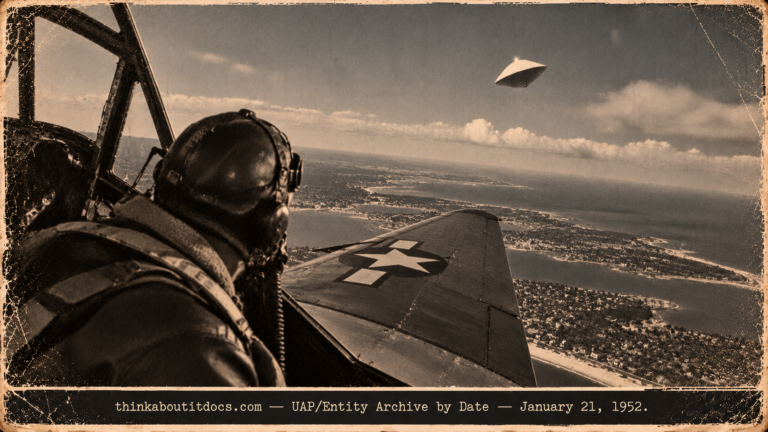
Related Cases: Mitchel AFB Navy TBM chase (January 21, 1952); Korea B-29 orange sphere (January 29, 1952); January 1952 archive
Detailed Report
The account below follows Brad Sparks’ catalog of Project Blue Book unknowns, which draws on Blue Book Status Report 7, the McDonald files and Jan Aldrich, and Edward Ruppelt’s opening of Chapter 10 in The Report on Unidentified Flying Objects. No Blue Book record card for this case was available for this page.
Ruppelt opens the chapter with the incident. Just twenty minutes after midnight on January 22, 1952, nineteen and a half hours after the Navy lieutenant commander had chased the UFO near Mitchel AFB, “another incident involving an airplane and something unknown was developing in Alaska.” According to the detailed account ATIC received, the temperature that night was 47 degrees below zero. The ground radar was at Aircraft Control and Warning site F-2 on Murphy Dome, about 19 miles west-northwest of Fairbanks.
A USAF lieutenant operating a CPS-6B radar tracked a target at 210 degrees azimuth, inbound or outbound, at about 1,500 to 2,400 mph. After 10 to 12 sweeps of the antenna, 12 seconds each, he urgently called twice, at 12:25 and 12:26 a.m., for interception. Two F-94 jets were scrambled. Sparks notes that the target may have reversed direction several times in this interval.
At 12:52 to 12:53 a.m. an unidentified target was tracked inbound at 210 degrees, heading north, at 45 miles range for about a minute. The first F-94, at 30,000 feet, was vectored on a 180-degree heading to intercept at a projected range of 20 miles from the radar site. The target reversed course over an 8-mile radius of turn, roughly 5 g’s at that speed, and headed outbound at more than 1,500 mph, south and away from both the radar site and the jet.
The pilot and the radar observer of the first F-94 tracked two targets on airborne radar, one strong and one faint, at 25,000 feet and a range of 24,000 yards, at 40 degrees to the right (220 degrees azimuth). The targets rapidly crossed to the left and disappeared at a range of 200 yards, 55 degrees left of the jet’s heading. The closure rate was too rapid to follow by hand control of the antenna, and the crew could not lock on. The F-94 circled for an hour before getting another target at 12 o’clock low, dropped to 25,000 feet with a 100-knot closure rate, and had to pull up at 200 yards to avoid a collision. There was no visual contact. It was released to return to base at 2:13 a.m.
A second F-94, from Galena AFS, obtained a radar lock-on during the same period to a target at 12 o’clock high at 17,000 yards range for two to three minutes. A secondary summary of the case reports a third jet closing to about 900 feet and pulling away from a nearly stationary target, and an Air Force conclusion that the returns were weather-related, which the pilots strongly disputed; those details differ from Sparks and are not used in the main account above.
RESEARCHER’S NOTES
A Radar-Only Case With No Card on File
- No Primary Card. Only secondary accounts were available: Sparks’ catalog, Ruppelt’s book and an online case summary. Times, speeds and distances come from Sparks. Treat the exact figures as unverified until the Blue Book file is read.
- Closure Distance. Sparks says the F-94 pulled up at 200 yards; a secondary summary says 900 feet. Both are given as discrepant.
- Altitude. Sparks gives the F-94 altitudes (30,000 and 25,000 feet); a secondary summary gives the target as 1,500 mph at 23,000 feet. The altitude of the target on ground radar is not stated in Sparks.
- The Mitchel Link. Ruppelt ties this case to the Mitchel AFB Navy TBM chase of January 21, 1952. His 19½-hour interval fits the Mitchel time of 0950 EST on January 21 and 12:20 a.m. AHST on January 22, which is 5:20 a.m. EST, so the two cases are 19 hours 30 minutes apart.
- Explanation Offered. The Air Force’s weather explanation is reported only in a secondary source, and the file here does not show how it was reached. The F-94 airborne radar contacts, two of them with lock attempts, are harder to square with weather than a single ground return would be.
- Hynek Class. Hynek’s original system has no radar-only category; RV is the closest fit and is used because radar detection was the evidence. No visual contact was reported.
The Nenana case is a multi-radar event with two independent F-94 crews and an operator who called for an intercept before any aircraft was airborne. The target behavior, a high-speed reversal and head-on closure that forced a pull-up, is what made Ruppelt open his chapter with it. What it lacks is a primary record on file here and any visual confirmation.
“…another incident involving an airplane and something unknown was developing in Alaska.”
— Edward J. Ruppelt, The Report on Unidentified Flying Objects, Chapter 10