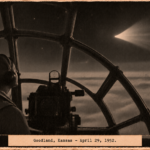
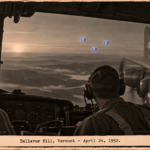
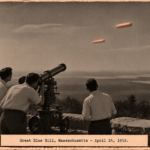
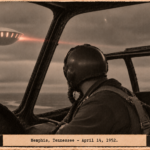
Yellow Sea, October 18, 1951: a Navy Mariner crew chases a swept-wing craft trailing a long flame.
THINK ABOUTIT UFO|UAP SIGHTINGS REPORT
1951: Navy PBM Mariner Crew Chases a Swept-Wing Craft Trailing a Long Flame Over the Yellow Sea
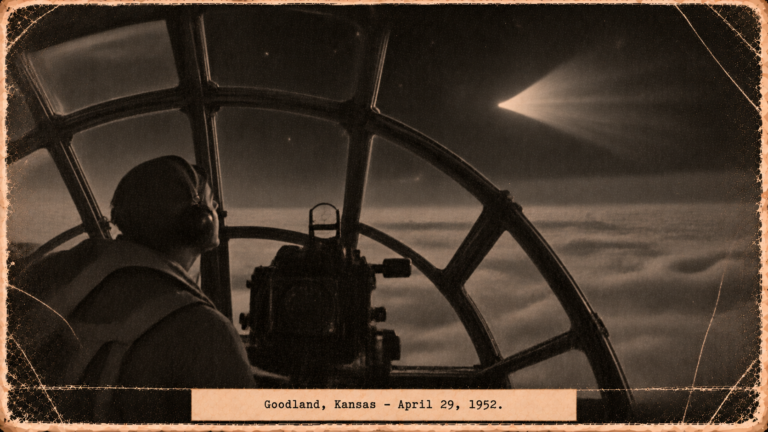
In the early hours of October 18, 1951, a U.S. Navy PBM Mariner on a weather reconnaissance flight over the Yellow Sea during the Korean War had a waist gunner spot a long, cone-shaped flame on the port side, 12 miles away. The radarman confirmed a target at that range. The patrol plane commander turned toward it to silhouette it against a full moon for a photograph, and the craft turned away and kept its 12-mile distance. When he added power and closed to three or four miles, the crew could see a large hull, swept-back wings bent down at the tips and no tail.
The flame changed from red-orange to white-orange as the craft accelerated, slowly at first and then rapidly out to 22 miles, where the radar and then the clouds took it. Far East Air Forces forwarded the debriefing to Washington in November. The Blue Book record card says “Was Aircraft” and “A/C sighting,” but the report describes a flame the commander said looked nothing like a normal jet exhaust.
Date: October 18, 1951
Sighting Time: About 3:33 a.m. Item time (Korea); the card prints 18/0333Z
Day/Night: Night (full moon, moon elevation 74 degrees, visibility good)
Location: Yellow Sea, west of Korea, at about 35°48′ N, 123°16′ E according to the debriefing (the card prints 38.48 N 123.16 E); Navy patrol aircraft heading 194 degrees true at 5,000 feet
Urban or Rural: Rural (open sea)
No. of Entity(‘s): Not Applicable
Entity Type: Not Applicable
Entity Description: Not Applicable
Hynek Classification: Radar-Visual (RV); no entity, landing, or physical effect reported
Duration: About 16 minutes by the card; the commander puts the whole chase at 22 minutes from first radar contact
No. of Object(s): 1
Description of the Object(s): A craft trailing a long conical flame that changed from short and red-orange to long and white-orange as power was added. The hull was very large, about 60 feet long, with wings swept back and down and bent at the tips at about 85 percent of their length, and no visible tail surfaces. It flew at a high nose-up angle of about 25 degrees.
Shape/Size/Color of Object(s): Swept-wing aircraft shape with downturned wingtips and no empennage; hull about 60 feet long; red-orange to white-orange exhaust flame; the commander thought the fuel might be alcohol or a solid propellant
Distance to Object(s): 12 miles by radar at first contact; closed to an estimated 3 to 4 miles visually; then opened to 16 miles and finally 22 miles when radar and visual contact were lost
Height & Speed: About 4,000 feet, against the patrol plane’s 5,000 feet; computed true airspeed about 530 knots just before contact was lost, against the patrol plane’s true airspeed of 170 knots
Number of Witnesses: 4 or more (the waist gunner, the patrol plane commander, the radarman and the rest of the crew)
Special Features/Characteristics: Radar confirmed the visual contact; the craft turned away to keep a 12-mile gap when the patrol plane turned toward it, then accelerated when pursued; it was flying nose-high as if “staggering to keep airborne at a slow speed”; a photograph was not obtained
Case Status: Was Aircraft (Project Blue Book record card; comment “A/C sighting”)
Source: Project Blue Book record card; Far East Air Forces letter “Unidentified Air Contact” (November 12, 1951); Department of the Air Force disposition form to ATIC (December 18, 1951); patrol squadron debriefing extract
Summary/Description: A Navy PBM crew and its radar tracked a swept-wing craft with a long flame for about 20 minutes over the Yellow Sea; it matched their moves and then pulled away at about 530 knots, and Blue Book called it an aircraft.
Related Cases: The Hudson Strait B-36 radar-visual encounter of September 17, 1951, and the Goose Bay GCA radar case of September 1951
Detailed Report
The Contact
The report came from a PBM Mariner on a weather reconnaissance mission for Task Element 95.11 on October 18, 1951, commanded by Ensign George Gregory, and was debriefed by an intelligence officer of Patrol Squadron 46. The patrol plane was at about 35°48′ N, 123°16′ E at 5,000 feet on a heading of 194 degrees true. Cloud cover was 6/10 at 1,000 to 2,500 feet and 4/10 at 5,000 to 8,000 feet, visibility was good, and the moon was full at 74 degrees elevation.
A waist gunner on lookout at the open waist hatch saw a light on the port side and told the commander. The commander saw it too and called the crew’s attention to it. The crew verified it, and the radarman confirmed a contact at 12 miles on a relative bearing of 270 degrees at about 4,000 feet. The light appeared to be a long, conical flame, which suggested the exhaust of a reaction motor such as a rocket or ramjet.
The Chase
The flame changed as they watched. At first it was short and red-orange; later it became longer and white-orange, apparently after power was added. The commander turned left toward it to put it between the aircraft and the moon so a photograph could be taken. The craft turned east and pulled ahead, keeping its 12-mile distance. The commander applied rated power and closed to an estimated three or four miles, where visual contact held but radar contact was lost.
At that range the whole crew could see the hull, and the commander could see the wing shape through binoculars. The hull was very large, estimated at 60 feet. The wings were swept back and down, with a dihedral at the tips that bent at about 85 percent of the wing length, and the tips appeared to serve as a rudder because no vertical tail was visible. The craft was flying “cocked up” at an angle of about 25 degrees, which the commander took to mean a very high-speed machine staggering to stay airborne at a low speed.
The Escape
The craft accelerated slowly to 16 miles, where radar picked it up again, then accelerated rapidly to 22 miles, where radar lost it. Visual contact was lost at about the same time because of clouds. Adding the patrol plane’s true airspeed of 170 knots to the computed relative speed gave the craft a true airspeed of about 530 knots. The chase was discontinued with the Mariner at 8,000 feet and, by the commander’s count, 22 minutes after the first contact. The commander wrote that the flame was extremely bright throughout and that he believed it came from alcohol or a solid fuel, because a normal jet flame is fairly low with a much different appearance.
The Paper Trail
On November 1, 1951, Air Force headquarters radioed Far East Air Forces for more information on the Navy contact. Far East Air Forces replied on November 12 with the debriefing extracts, and the Department of the Air Force sent the letter to the Air Technical Intelligence Center on December 18 for information and retention. The Blue Book card lists the observation as air-visual and air-intercept radar, from a military source, with a duration of 16 minutes, and concludes “Was Aircraft” with the comment “A/C sighting.”
RESEARCHER’S NOTES
Why the Yellow Sea Encounter Still Matters
- Multiple confirmations: A lookout, a pilot, a radarman and the rest of the crew all saw or tracked the contact, and the commander used binoculars. Few 1951 reports have that many trained witnesses.
- The “aircraft” label: The card concludes Was Aircraft, but the file does not name the aircraft or explain how a jet of 1951 would match a 530-knot craft that turned to keep its distance, with a flame the commander said did not look like jet exhaust.
- Korean War context: The flight took place during active air operations over Korea, so an aircraft conclusion is not surprising on its face, but the file does not name the aircraft or the unit that would have flown it.
- The pursuit behavior: When the Mariner turned toward the craft, it turned away and held 12 miles; when the Mariner added power, it pulled ahead. That is the reason this case reads differently from a simple misidentified aircraft.
- Figures that differ: The card prints the position as 38.48 N, but the debriefing letter gives 35°48′ N, which is also what the narrative uses. The card’s Greenwich time, 0333Z, appears to be the Item (Korean) local time. The card gives 16 minutes; the commander says 22.
The file leaves a well-witnessed encounter with a radar-confirmed craft that the Air Force filed under aircraft without identifying one. The 530-knot speed, the flame and the pursuit behavior are what keep it interesting, and the answer likely lies in who was flying over the Yellow Sea that night.
“The craft turned away, maintaining the distance of twelve miles.”
— Far East Air Forces report on a Navy PBM Mariner contact, November 12, 1951