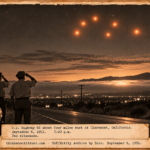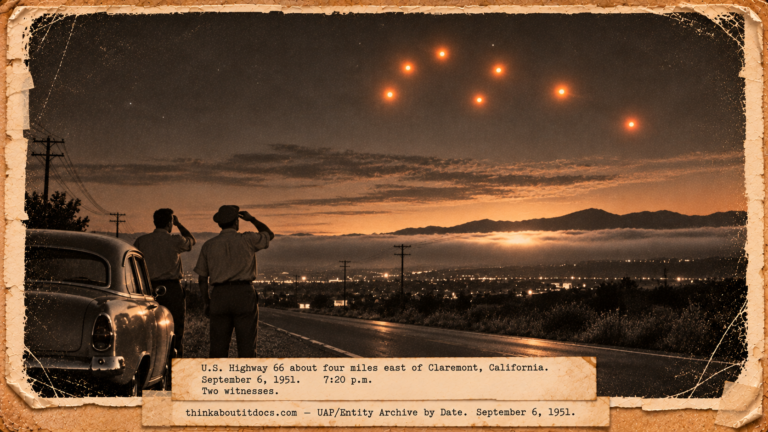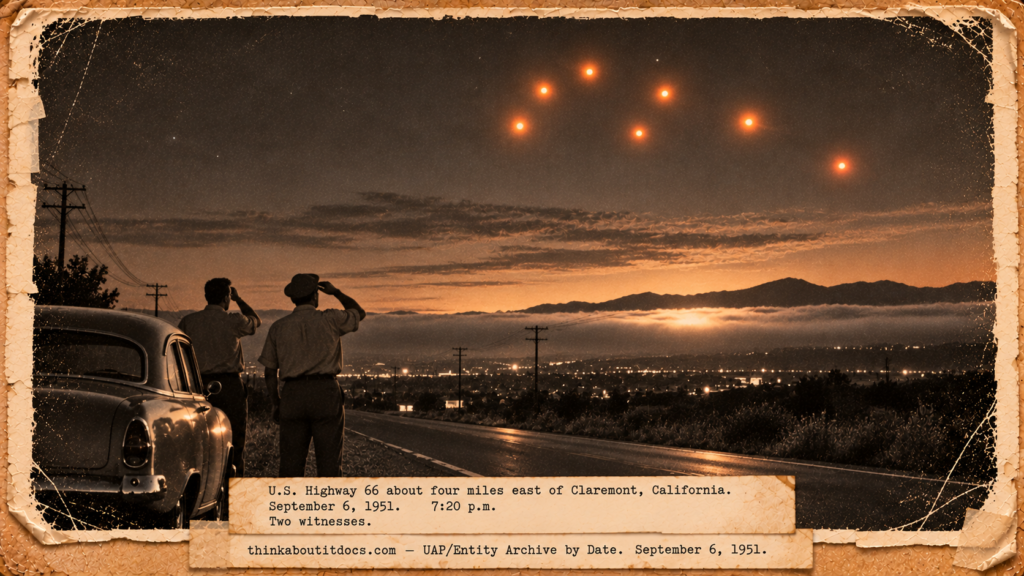
Claremont, California, September 6, 1951: two airmen watch six orange lights cross the dusk sky.
THINK ABOUTIT UFO|UAP SIGHTINGS REPORT
1951: Two Air Force Airmen Watch Six Orange Lights Fly Over Claremont, California
At 7:20 p.m. on September 6, 1951, two Air Force airmen from the headquarters of the 1st Fighter-Interceptor Wing at George AFB were driving west on U.S. Highway 66 toward Los Angeles when they saw six bright orange lights in the sky ahead of them. The lights hung in an irregular, incomplete circle, with the last two set well in toward the center of the formation, and they were far brighter than any reflection of the setting sun. The men stopped the car, stepped out, and watched the Claremont, California UFO formation move straight and level to the west for three to four minutes until it faded into the distance over a coastal fog bank.
Then a seventh light, a single bright orange object, came along the same course. The wing sent its report to the Air Materiel Command under the Air Force’s new unconventional-aircraft reporting rule, calling both men “very reliable” and trained to tell conventional aircraft from anything else. Project Blue Book’s record card for the case ends with one word in capitals: UNIDENTIFIED.
Date: September 6, 1951
Sighting Time: 7:20 p.m. local time (1920)
Day/Night: Dusk (sky darkening; the sun was just below the horizon)
Location: U.S. Highway 66 about four miles east of Claremont, California, with the airmen driving west toward Los Angeles; the formation was seen to the west
Urban or Rural: Rural (open highway at the edge of the Los Angeles basin)
No. of Entity(‘s): Not Applicable
Entity Type: Not Applicable
Entity Description: Not Applicable
Hynek Classification: Nocturnal Light (NL); lights only, no shape, trail or exhaust seen
Duration: 3 to 4 minutes
No. of Object(s): 7 (six in the first group, one in the second)
Description of the Object(s): Six bright orange lights in an irregular, incomplete circle, with the last two objects situated well toward the center of the formation, followed by one lone bright orange light on the same course. No aerodynamic features, trail or exhaust were seen, and the means of propulsion was unknown.
Shape/Size/Color of Object(s): No discernible shape or size because of altitude and distance; bright orange light, brighter than the sun’s reflection at that hour
Distance to Object(s): First group estimated 10 to 12 miles to the west; the single object appeared about 2 miles from the observers
Height & Speed: About 10,000 to 12,000 feet; speed unknown; course about 280 degrees; straight and level flight with no change in course or altitude
Number of Witnesses: 2 (a technical sergeant and a staff sergeant, 1st Fighter-Interceptor Wing, George AFB; names redacted in the file)
Special Features/Characteristics: Formation of six with a single follower; objects faded in the distance over the top of a coastal fog bank and appeared much higher than the fog; passing highway traffic masked any sound; both observers had aircraft-recognition training
Case Status: Unknown (Project Blue Book record card, “Other: UNIDENTIFIED,” Unknown box checked)
Source: Project Blue Book record card; Headquarters, 1st Fighter-Interceptor Wing, George AFB, report under ADC Letter 200-1 with formation diagram; Air Force status report extract; Berliner; FUFOR Index; NICAP chronology
Summary/Description: Two airmen driving toward Los Angeles watched six orange lights in an incomplete circle, then a seventh, cross the sky to the west at roughly 10,000 to 12,000 feet; the Air Force rated the case Unknown.
Related Cases: The Hollywood, California report of September 6, 1951 (two deep-red objects near the Moon, rated psychological by Blue Book); the March AFB intercepts of September 23, 1951
Detailed Report
The Sighting
The 1st Fighter-Interceptor Wing at George Air Force Base filed its report with the Air Materiel Command at Wright-Patterson AFB, citing Air Defense Command Letter 200-1 of April 11, 1951, which told units how to report “unconventional aircraft.” The report says the two airmen were traveling west on U.S. Highway 66, about half a mile east of a point the file redacts and about four miles east of Claremont by the attached diagram, when they saw the first group of lights. The report places the observers near 117 degrees 50 minutes west and 34 degrees 8 minutes north and puts the lights about 10 to 12 miles to the west, on a course of approximately 280 degrees, at an estimated 10,000 to 12,000 feet.
The wing’s description is plain. There was no discernible shape or size because of the altitude and distance. The first sighting involved six lights in an irregular, incomplete circle, with the last two “situated well intoward the center of the formation.” The color was a bright orange light that the airmen’s diagram describes as “far brighter than that of sun’s reflection at that hour.” The lights flew straight and level, with no apparent change in course or altitude. No aerodynamic features, trail or exhaust were seen, and no sound could be assessed because of passing highway traffic. The airmen stopped the car and stood beside it to watch.
A second sighting followed. A single object appeared about two miles from the observers, on the same course and at the same altitude as the first group. All of the objects faded in the distance over the top of a coastal fog bank, which was visible in the west. The weather in the immediate area was clear, there was no wind, and the sky was darkening. The objects appeared much higher than the top of the fog. The observation lasted about three to four minutes.
The Witnesses and the Air Force Evaluation
The wing described both men as “very reliable and sufficiently experienced to recognize the differentiation from conventional type aircraft,” and pointed to the training and familiarity with known aircraft of the technical sergeant. The report answered the form’s questions about photographs, physical evidence and other observers with “negative” or “unknown.” An Air Force status report extract lists the source as “two airmen,” the heading as 280 degrees, and the action as “No investigation.”
Blue Book’s record card lists the source as military, the observation as ground-visual, and the duration as three to four minutes. It rates the case Unknown, with the line “Other: UNIDENTIFIED,” and the comment: “No aerodynamic features, trail or exhaust were seen. Case is UNIDENTIFIED.” Nothing in the file shows a follow-up inquiry, and the card carries no mention of a balloon, aircraft or astronomical explanation.
RESEARCHER’S NOTES
Why the Claremont Lights Still Matter
- Trained observers: Both witnesses worked at the headquarters of a fighter-interceptor wing and had aircraft-recognition training, and the wing vouched for their reliability in writing.
- A formation, not a single light: The airmen drew the six lights in an irregular, incomplete circle with the last two set inward, then described a seventh object following the same course. A formation of that kind is harder to account for with a single balloon or aircraft.
- The brightness clue: The report stresses that the orange color was far brighter than any reflection of the sun at that hour, which speaks against sunlit balloons or high-altitude aircraft catching the last light.
- Unexplained but thin: The Air Force did no field investigation. The file has no radar data, no photographs, and no second set of witnesses, so the Unknown rating rests on two observers and a few minutes of sky.
- Figures that differ: The Air Force card’s Greenwich time field reads 06/1920Z, which looks like the local time entered by mistake; the wing report gives 1920 hours local time, which is used here.
The honest reading is that this is a short, well-described, two-witness report from trained observers that the Air Force could not explain and chose not to pursue. It does not provide a radar track, a photograph or a physical trace. What it does provide is an official Unknown rating on a formation of orange lights seen at dusk over Southern California, one of the cleaner sighting reports of a month that was dominated by radar and pilot cases elsewhere.
“No aerodynamic features, trail or exhaust were seen. Case is UNIDENTIFIED.”
— Project Blue Book record card, Claremont, California, September 6, 1951