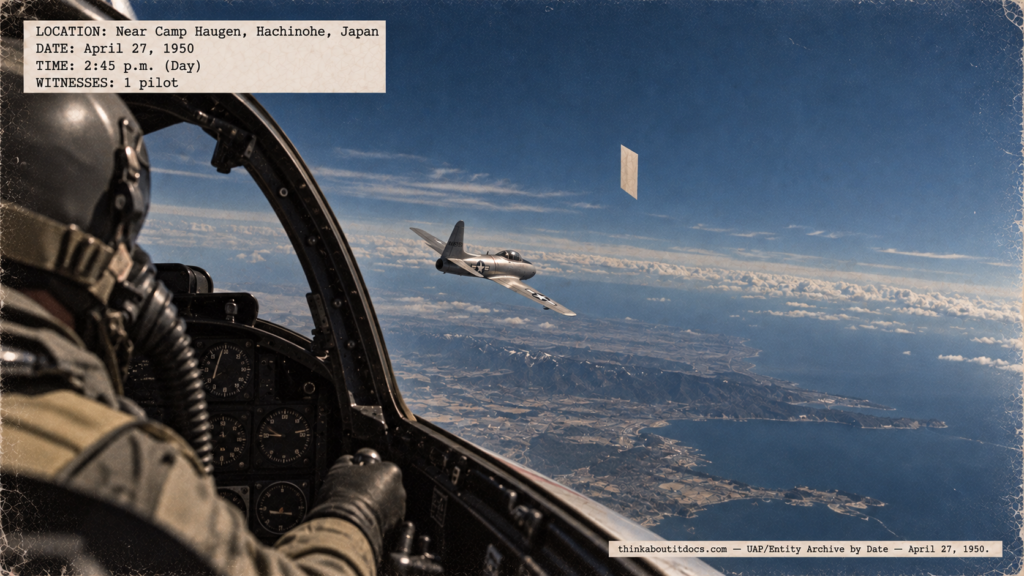
A Misawa F-80C pilot overflew a thin cream-colored rectangle near Hachinohe, Japan, on April 27, 1950; headquarters called it a shock-wave effect.
THINK ABOUTIT UFO|UAP SIGHTINGS REPORT
1950: Misawa AFB F-80 Pilots and the Muslin Object
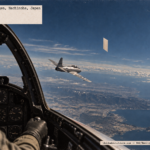
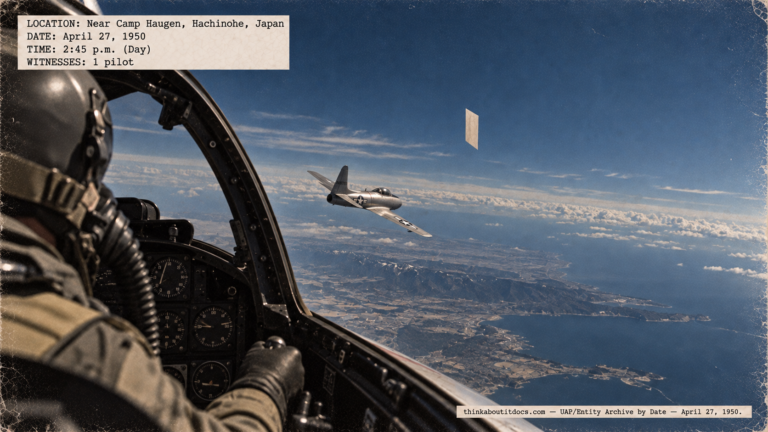
On April 27, 1950, an F-80C pilot from Misawa Air Base, closing on his element leader at 25,000 feet near Camp Haugen, saw what looked like a tow target trailing the other jet, which was odd since his squadron wasn’t firing aerial gunnery that day. He closed in, slid over to its other side to avoid hitting it, and got a close look from the top and both sides for two to three minutes: a cream-colored rectangle about 20 feet high, 60 feet long and no more than two inches thick, made, he thought, of muslin, with no exhaust, no reflection in the bright sun and no density. When the jets turned it accelerated to 600 mph, crossed his nose and was gone.
The next day another Misawa F-80C pilot, tracking a radar target near Wakkanai, saw a thin white square about 12 by 12 feet that circled him and vanished into cloud. Headquarters weighed in with a memo to Gen. Cabell: the pilots saw what they described, but it was not an aircraft, it was a visual effect produced by shock waves from the other F-80s, refracted through air of varying density or ice crystals. Project Blue Book’s card concludes Other (Contrail). NICAP lists both as Blue Book unknowns. The Misawa AFB F-80 muslin-object sightings are the Air Force’s own early shock-wave explanation, and the file keeps both sides.
Date: April 27, 1950 (Hachinohe area) and April 28, 1950 (Wakkanai area)
Sighting Time: 2:45 p.m. local on April 27; 11:30 a.m. and 12:30 p.m. on April 28
Day/Night: Day
Location: About 10 miles northeast of Camp Haugen near Hachinohe, Honshu (40°30′ N, 141°30′ E), and about 2 miles west of Wakkanai, Hokkaido, Japan
Urban or Rural: Airborne over the coast
No. of Entity’s: Not Applicable
Entity Type: Not Applicable
Entity Description: Not Applicable
Hynek Classification: DD (Daylight Disc; close approach)
Duration: 2 to 3 minutes on April 27; about 5 seconds each pass on April 28
No. of Object(s): 1 each day
Description of the Object(s): April 27: a thin, rectangular, cream-colored object that seemed to be made of muslin, oriented vertically, with no density, no reflection, no exhaust and no fluttering. April 28: a white, square, thin object like an aerial tow target, with no propulsion, exhaust or lights
Shape/Size/Color of Object(s): April 27: rectangular, about 20 feet high, 60 feet long and under 2 inches thick, cream; April 28: square, about 12 by 12 feet, white and thin
Distance to Object(s): April 27: first seen about three miles off, then within yards as the pilot overflew it; April 28: about seven miles at first, then circling about a mile away
Height & Speed: April 27: at about 25,000 feet; first at 275 to 300 mph, then accelerated to 600 mph on a heading of 330 degrees; April 28: about 600 to 650 mph, circling
Number of Witnesses: 2 (one F-80C pilot on each day: 2nd Lt. James Henry Petty, 7th Fighter Bomber Squadron, on April 27, per NICAP and Aldrich; 1st Lt. James H. Harvey, 9th Fighter Bomber Squadron, on April 28, per Aldrich)
Special Features/Characteristics: Close-range look by a trained pilot; the pilot suspected hypoxia and raised his oxygen to 100 percent without any other sign of it; second day’s object was being sought after a radar contact (Radar Site #18 could not track it); Headquarters shock-wave explanation
Case Status: Explained. Project Blue Book’s card concludes Other (Contrail) for the two Misawa reports. The Air Force’s explanation was a visual effect from F-80 shock waves. NICAP lists both as BBU.
Source: Fifth Air Force, APO 710, Air Intelligence Information Report, 5 May 1950 (Part I and II; prepared by a 1st Lt. in the Deputy for Intelligence’s office); memo to Gen. Cabell on the F-80C incidents of April 27 and 28; Project Blue Book (Project 10073) record card; NICAP 1950 UFO Chronology (Jan Aldrich; Weinstein)
Summary/Description: On April 27, 1950, a Misawa F-80C pilot at 25,000 feet overflew a thin, cream-colored rectangular object, about 20 by 60 feet and 2 inches thick, that was tracking another jet, then watched it accelerate to 600 mph. On April 28 another F-80C pilot saw a thin white square circle him near Wakkanai. Air Force headquarters concluded the pilots saw a visual effect produced by shock waves, and Blue Book’s card says Other (Contrail).
Related Cases: Tampa, Florida, B-29 (February 8, 1950); Okinawa radar case (March 27, 1950); Santiago, Chile (March 28, 1950)
Detailed Report
April 27: The Muslin Rectangle
The Fifth Air Force report of May 5 says a Misawa F-80C pilot departed at 1430 to join his element leader over Camp Haugen at 25,000 feet, scheduled to fly observer while the leader practiced instrument flying. At 25,000 feet, orbiting left and indicating 320 mph, he saw the object at his 2 o’clock position, ten miles northeast of Camp Haugen. He first saw it at 1445 as he began a turn to intercept his leader, who was about three miles ahead, circling left. When close enough to identify the lead aircraft as a 7th Fighter Bomber Squadron aircraft by the color of its nose, he noticed it seemed to be towing a target. He knew his squadron was not firing aerial gunnery that day. Closing on the lead ship and trying to avoid hitting the supposed target, he gained altitude and slid over to the other side of the object. He had it in sight for a total of two to three minutes and had a very good look at it from the top and both sides.
What He Saw
The object was rectangular, about 20 feet high and 60 feet long and not over two inches thick. It looked made of muslin, and was cream colored. The sun was bright but there was no reflection from the object, which did not seem to have any density at all. It appeared to be tracking the element leader’s aircraft, about 1,000 feet below and behind, and then accelerated to a level position with the lead aircraft and stayed there during the left orbiting turn from 45 to about 260 degrees, at which point it accelerated, took up a heading of 330 degrees and broke away at an estimated 600 mph. There was no evidence of exhaust or any apparent means of propulsion, and the object did not wave or flutter. It was first seen against clouds, but against clear sky as it faded. It seemed to be flying at 275 to 300 mph when first seen. The pilot could not believe what he had witnessed and surmised he was suffering hypoxia, so he increased his oxygen to 100 percent and joined his element leader. The join-up was not erratic and nothing else suggested hypoxia. The intelligence officer wrote that the pilot appeared conservative in his statements and preferred to think out his answers rather than give snap statements, and that he did not get overexcited but tried his best to overtake, observe and report it.
April 28: Wakkanai
According to Jan Aldrich’s summary in NICAP’s chronology, a Misawa 9th Fighter Bomber Squadron pilot, 1st Lt. James H. Harvey, flew an F-80C trying to intercept a target tracked by Radar Site #18, without success for about an hour. At about 12:30, flying north at 30,000 feet about two miles west of Wakkanai, he saw an object about seven miles to his left heading south at 600 to 650 mph, lost it in clouds after about five seconds, then saw it reappear on his right after apparently circling at very high speed, and it continued circling a mile or so in front of him. It was a white, square, 12-by-12-foot, thin, vertically oriented shape that looked like an aerial tow target, without propulsion, exhaust or lights, clear against the ocean below. It was lost after five seconds in low overcast. Radar Site #18, in continuous contact with his aircraft, could not track the object.
Headquarters’ Explanation
A memo prepared for Gen. Cabell, the Air Force’s Director of Intelligence, says the staff was convinced the pilot in each case actually saw what he described. As to what the object was, it was not an aircraft or an aerodynamic device of any sort but a visual effect produced by shock waves from other F-80C aircraft in the area at the time. The events took place at 18,000 to 25,000 feet and could have been caused by light refraction in varying air densities from shock waves, as in Schlieren effects that can be photographed, or by ice crystals formed when shock waves disturb supercooled water vapor, or both. The memo notes that the object was described as having no density, looking like muslin and having no well-defined reflecting surfaces, which suggests a condition in a volume of space, not a solid thing, and that polaroid material in the line of sight could have contributed to its form and color. It compares the case with the excitement caused by “explosions” over Dayton, which aerodynamicists traced to shock waves from a jet aircraft.
The Card
Blue Book’s card for the Misawa reports concludes Other (Contrail). The Blue Book list for the month gives the same answer for the two days.
RESEARCHER’S NOTES
A Muslin Rectangle at 25,000 Feet and an Air Force Answer
- An Explanation With a Mechanism: The shock-wave theory is specific: Schlieren-type refraction or ice crystals around supersonic-capable F-80Cs at altitude. It explains the lack of density and reflection, though not the object’s accelerating away from a pilot flying 320 mph.
- Contrail on the Card, Shock Waves in the Memo: The card says Other (Contrail), while the memo says a shock-wave visual effect. The two are related ideas (condensation and refraction), and the file does not reconcile the wording.
- A Careful Pilot: The pilot suspected hypoxia, tested it by raising his oxygen, and saw no other symptoms. The intelligence officer judged him conservative and unexcited.
- A Tow Target Was His First Thought: On both days the pilots first thought of aerial tow targets, and on April 27 the squadron knew no gunnery was scheduled. The Wakkanai pilot’s object was compared to one directly.
- Two Pilots, Two Squadrons: The April 28 case comes from a different squadron and a radar vector, which adds independence. The file I have contains the April 27 report and the memo; the April 28 details are from NICAP and Aldrich.
- Not Quite Identical: The 12-by-12-foot square on the 28th and the 20-by-60-foot rectangle on the 27th differ in size and shape. Both are thin, vertical, pale and without propulsion.
The Misawa reports are two close-range pilot sightings of a thin, pale, non-reflecting rectangle, answered by headquarters with an unusual explanation: a visual effect of shock waves. It is filed here as Explained, on the Air Force’s and Blue Book’s word, with the caution that the pilots described something with definite shape and size that accelerated away at 600 mph.
“…a visual effect produced by shock waves.”
From the memo to Gen. Cabell on the April 27 and 28, 1950 Misawa F-80C sightings.