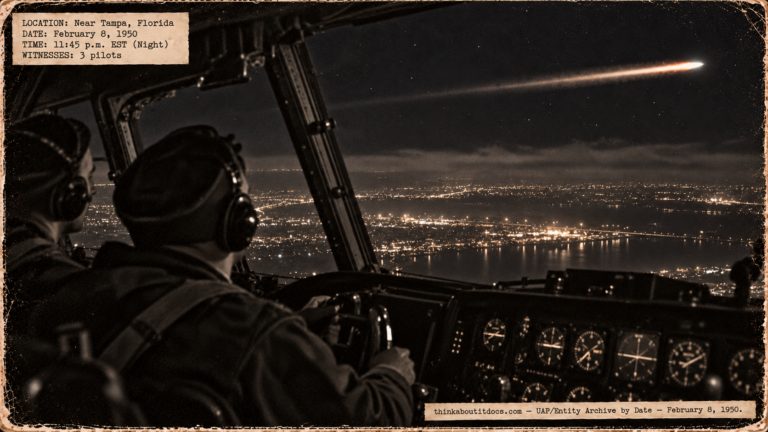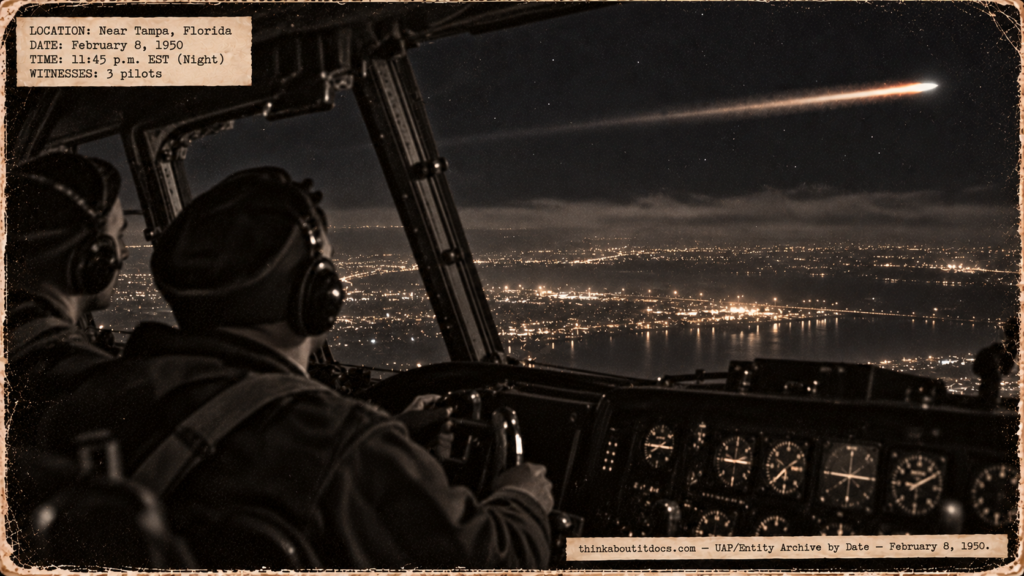
A B-29 pilot and two Eastern Airlines pilots reported a rocket-like object with a 300-foot trail near Tampa, Florida, on February 8, 1950.
THINK ABOUTIT UFO|UAP SIGHTINGS REPORT
1950: Tampa, Florida B-29 Rocket Sighting
At about 11:45 p.m. on February 8, 1950, Maj. Holly W. Anderson was letting down a B-29 into the MacDill AFB traffic pattern near Tampa, Florida, when something crossed the sky from left to right above him at a speed he put at more than 2,000 mph. It had a flame trailing at least 300 feet behind it, ran level and straight, and vanished on its course. “I don’t think this was a meteor,” he wrote the next day. Pilots of two Eastern Airlines flights near Tampa reported the same object, on a westerly heading, to Tampa Approach Control.
The Tampa, Florida B-29 rocket-trail sighting reached Air Materiel Command as a full AF Form 112 report with the pilot’s signed statement, weather data and the names of three witnesses. Project Blue Book’s record card, however, carries a handwritten conclusion: Astro (Meteor). One detail matters for how the case is usually told: the “300 feet long and 30 feet wide” that appears in summaries and on the card is the estimated length and width of the exhaust trail, not the object.
Date: February 8, 1950
Sighting Time: About 11:45 p.m. EST (2345)
Day/Night: Night
Location: In the vicinity of Tampa, Florida, USA; Major Anderson’s B-29 was letting down toward MacDill AFB on a heading of 201 degrees magnetic, with the nose pointed at the southeast side of Tampa
Urban or Rural: Airborne near a city
No. of Entity’s: Not Applicable
Entity Type: Not Applicable
Entity Description: Not Applicable
Hynek Classification: NL (Nocturnal Light)
Duration: A few seconds; the card leaves duration blank
No. of Object(s): 1
Description of the Object(s): A rocket-like object with a long, constant flame or exhaust trail, holding a level, straight course at very high speed
Shape/Size/Color of Object(s): Rocket-shaped; no size or color description given; the exhaust trail was estimated at 300 feet long and about 30 feet wide, ending in a very dull glow
Distance to Object(s): First seen about 18 miles ahead; it passed above the aircraft
Height & Speed: No altitude estimate; Anderson said it was considerably higher than his flight altitude of 7,500 feet; speed estimated at more than 2,000 mph; westerly heading, straight course (card: 270 degrees)
Number of Witnesses: 3 named: Maj. Holly W. Anderson, USAF (pilot of the B-29), and Eastern Airlines pilots L. C. Cloney and J. S. Grier of Coral Gables, Florida; a B-29 pilot passenger may have glimpsed it, and the pilot of Eastern Airlines Flight 509 reported it to Tampa Approach Control
Special Features/Characteristics: Military and airline pilots as independent witnesses; radio report made immediately to Tampa Approach Control; the Jacksonville Air Route Traffic Control Center received the information; clear sky with haze in lower levels; no photographs or sketches
Case Status: Explained. Project Blue Book’s record card carries the handwritten conclusion “Astro (Meteor).” NICAP lists the case as a Blue Book unknown.
Source: Air Intelligence Information Report (AF Form 112), Intelligence Section, 307th Bombardment Wing (M), MacDill AFB, prepared by Maj. Charles J. Beck, 10 February 1950, with statement of Maj. Holly W. Anderson (9 February 1950); Project Blue Book (Project 10073) record card; NICAP 1950 UFO Chronology (Project 1947; FUFOR Index)
Summary/Description: Maj. Holly W. Anderson, piloting a B-29 into MacDill AFB near Tampa, saw a rocket-like object cross the sky at more than 2,000 mph at about 11:45 p.m. on February 8, 1950, trailing a flame at least 300 feet long. Two Eastern Airlines pilots reported the same object on a westerly heading. Blue Book’s card concludes it was a meteor.
Related Cases: Gulf of Mexico B-29 radar case (January 12, 1950); Teaticket, Massachusetts (February 5, 1950); Alameda, California (February 7, 1950); Corona, New Mexico, fireball (January 7, 1950)
Detailed Report
The Statement
Major Anderson, of the 93rd Bomb Group at Castle AFB, California, was flying a B-29 into MacDill. In his signed statement of February 9 he said that at about 11:45 p.m., at 7,500 feet on a heading of 201 degrees magnetic, with the nose pointed at the southeast side of Tampa, he noticed what looked like a meteor approaching from the left of the airplane about 18 miles ahead. It did not burn out. Before it reached directly overhead he noticed that its path looked like a rocket’s, at terrific speed, holding level flight on a straight heading. He followed it across the airplane, exclaimed to the crew, and moved his head to the side of the wheel to see it vanish straight on its course to the right. A pilot passenger may have glimpsed it after hearing him. He estimated the speed at well over 2,000 mph, and said the flame stayed constant behind the nose for at least 300 feet before turning into a very dull glow, with a width of about one-tenth the length, or 30 feet. The sky was clear with haze in the lower levels. He radioed Tampa Approach Control immediately.
The Airline Pilots
Tampa Approach Control received the report from the pilot of Eastern Airlines Flight 509, from Flight 255 and from the B-29, AF-7753, and each reported the object on a straight course in a westerly direction. The Air Force report lists Eastern Airlines pilots L. C. Cloney and J. S. Grier, both of Coral Gables, with Major Anderson. The Jacksonville Air Route Traffic Control Center received the information from Tampa Approach.
The Report
MacDill’s Intelligence Section, 307th Bombardment Wing, prepared the AF Form 112 on February 10 from information obtained through the MacDill Flight Service Center, in compliance with a Fifteenth Air Force teletype and Air Intelligence Requirements Memorandum No. 4. It records weather at Tampa International Airport at 2330 EST of scattered clouds at 6,000 feet, visibility 15 miles, temperature 65 degrees F, dew point 61 degrees and a northeast wind of 8 mph, with no special weather reports between 2330 and 0030. The object was rocket-shaped, with no size or color description, on a westerly heading, holding a straight course, with no sound and a clearly visible exhaust trail estimated at 300 feet long and 30 feet wide. It was not photographed and no sketches were available. The wing’s intelligence officer forwarded it without further investigation, submitting it for information and consideration by higher headquarters.
The Card
The Project 10073 card lists the source as the B-29 crew and Eastern Airlines crew, the shape as “Rocket,” the size as “300′ long – 30′ wide” (a misreading of the trail dimensions), the speed and altitude as high, the course as 270 degrees, and the remark that both sources gave the same description. Its handwritten conclusion is “Astro (Meteor).”
RESEARCHER’S NOTES
A Pilot Who Said It Wasn’t a Meteor, and a Card That Says It Was
- Trail, Not Object: The 300 by 30 feet in most summaries, including the card and NICAP’s, is the exhaust trail the witnesses described. The AF Form 112 says the size of the object itself was not described.
- The Pilot Said It Wasn’t a Meteor: Anderson’s statement says plainly that he did not think it was a meteor. Blue Book’s card concludes otherwise without giving reasons in the file.
- Independent Witnesses: Three pilots from two operators, one military and two airline, each radioed or reported the object to the same approach control facility, and all gave a westerly heading and a straight course.
- What Fits a Meteor: A bright, fast, straight, level-looking streak with a long train, seen at night in clear sky by several observers over a wide area, is in line with a meteor’s behavior. What sits less easily is Anderson’s report that it kept level flight and did not burn out.
- Speed Estimate: The 2,000 mph figure is Anderson’s alone; no radar or ground observation supports it.
- Verification: The report’s weather data show scattered clouds at 6,000 feet with 15-mile visibility and no special weather phenomena reported in the Tampa area in that hour.
The Tampa sighting is a clean, well-documented report from experienced pilots that Blue Book chose to close as a meteor. It is filed here as Explained on the card’s word, with a note that the pilot who saw it most closely disagreed and that the object’s celebrated dimensions belong to its exhaust trail, not to the object.
“I don’t think this was a meteor.”
From Maj. Holly W. Anderson’s signed statement of February 9, 1950, filed with the Project Blue Book Tampa report.