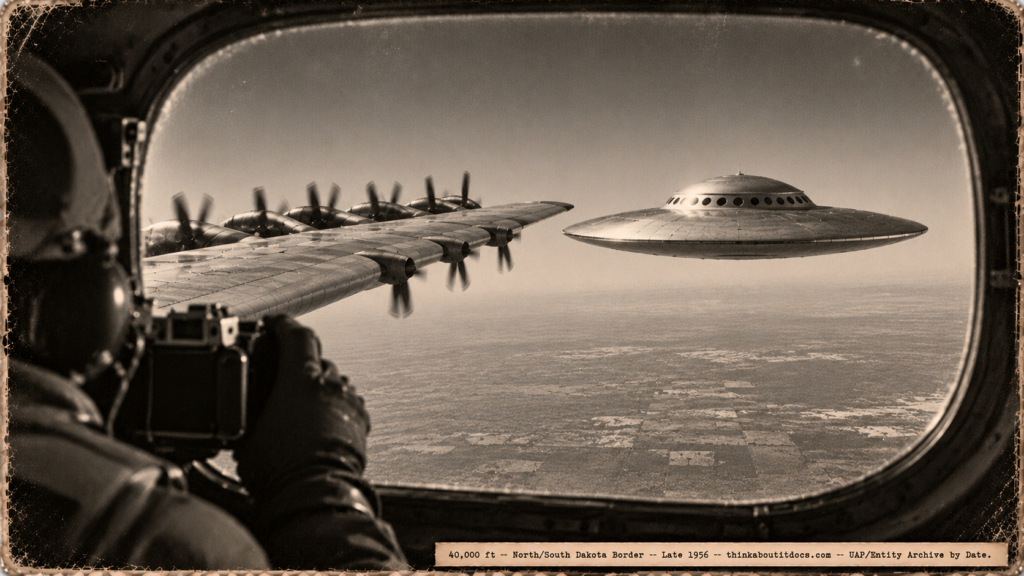
40,000 feet, North/South Dakota border, late 1956: a 100-foot metallic disc flew in tight formation off the RB-36H's left wingtip. Multiple crew members photographed it. The photographs were confiscated.
THINK ABOUTIT UFO|UAP SIGHTINGS REPORT
1956: North/South Dakota Border — The Disc That Flew in Formation With the RB-36H
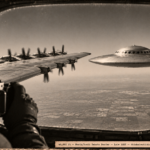
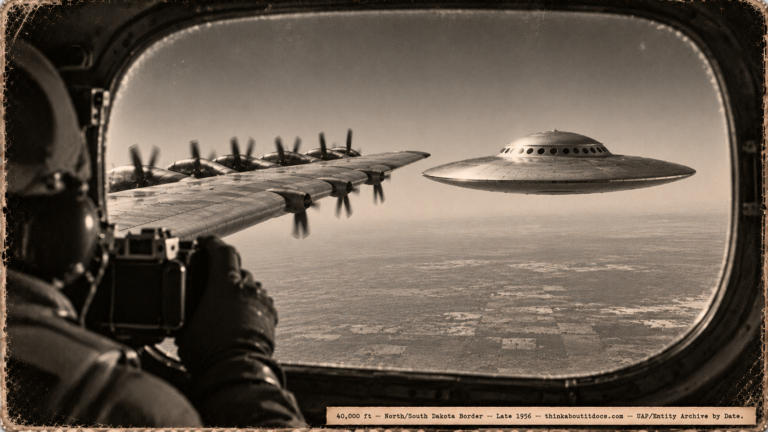
In the latter part of 1956, a Convair RB-36H Peacemaker reconnaissance aircraft of the 718th Squadron was cruising at 40,000 feet and approximately 435 mph in straight and level flight above the border between North and South Dakota when the left scanner in the aft compartment reported something on the intercom. A metallic disc, roughly 100 feet in diameter, had approached from the left side and was now flying in tight formation off the left wingtip — less than 300 feet away. It had a dome on top ringed with portholes. Several crew members reached for their standard-issue 35mm cameras. A ground radar site confirmed the contact. The disc flew alongside the aircraft for the duration of the observation, then departed.
What happened after landing is what elevates this case. Every log, piece of equipment and photograph was surrendered to an intelligence unit called Reci-Tech — Reconnaissance Technology — the central processing unit for the wing. The crew was debriefed by an intelligence officer, reminded of their top-secret clearances, and told not to disclose the information for twelve years. Several weeks later, officers from higher headquarters arrived and delivered the same instruction. When First Lieutenant Lyod — who would later retire as a Colonel — was discharged from active service in 1960, he was reminded a third time. The photographs from that day have never been publicly released.
Date: Late 1956 (specific date not established; approximately noon)
Sighting Time: Approximately noon
Day/Night: Day
Location: Airborne above the border between North and South Dakota, USA (approximately 45°57’N / 103°36’W); crew based at Ellsworth AFB, Rapid City, South Dakota
Urban or Rural: Airborne over remote plains terrain
No. of Entity(‘s): Not Applicable
Entity Type: Not Applicable
Entity Description: Not Applicable
Hynek Classification: CE-I / DD (Daylight Disc in close proximity — object flew in tight formation less than 300 feet from the aircraft wingtip; NICAP Categories 8, 9, 11: photographs, radar confirmation, UFO flew in formation with military aircraft)
Duration: Duration of formation flight not specified; observation long enough for multiple crew members to photograph
No. of Object(s): 1
Description of the Object(s): Metallic disc approximately 100 feet in diameter. Circular shape. Dome on top resembling an observation dome, ringed with portholes. The left scanner first observed it approaching from the left side; it then settled into a fixed position off the left wingtip less than 300 feet away and maintained formation with the aircraft.
Shape/Size/Color of Object(s): Disc/circular; approximately 100 feet diameter; metallic appearance; dome with portholes on top
Distance to Object(s): Less than 300 feet from the left wingtip of the RB-36H (the RB-36H’s wingspan was 230 feet, so the object was approximately 1.3 wingspans away — well within any definition of close formation flight)
Height & Speed: Aircraft altitude: 40,000 feet. Aircraft speed: approximately 435 mph. The object matched the RB-36H’s speed and altitude precisely in formation, then departed.
Number of Witnesses: Multiple crew members of the RB-36H, including First Lieutenant (later Colonel) Lyod (navigator). The left scanner in the aft compartment was the first to observe and report. Multiple other crew members saw and photographed the object. A ground radar crew independently confirmed the contact.
Special Features/Characteristics: Formation flight — the object maintained a fixed position off the left wingtip in tight formation with a large military reconnaissance aircraft at 40,000 feet. Multiple crew photographs taken with standard-issue 35mm cameras. Ground radar confirmation of the object flying in formation. Post-landing intelligence collection: all logs, equipment and photographs surrendered to Reci-Tech (Reconnaissance Technology), the wing’s central intelligence processing unit. Three separate reminders of a 12-year non-disclosure requirement: at initial debriefing, at higher-headquarters follow-up weeks later, and again at Colonel Lyod’s 1960 discharge.
Case Status: Unexplained. Photographs and logs confiscated by Air Force intelligence and not publicly released. Case documented by Dr. Richard F. Haines and the NICAP A-Team from Colonel Lyod’s testimony.
Source: Dr. Richard F. Haines, “RB-36H Navigator Describes UFO Encounter in Late 1956” (files and article); Colonel Lyod testimony; Jan Aldrich / Francis Ridge, NICAP A-Team communication, July 30, 2009; NICAP report archive (nicap.org/reports/560000dakotas_report.htm)
Summary/Description: A metallic 100-ft disc flew in tight formation off the left wingtip of a USAF RB-36H at 40,000 feet over the Dakotas. Multiple crew members photographed it; ground radar confirmed it. All photographs and logs were confiscated by Air Force intelligence on landing; the crew received three separate 12-year non-disclosure reminders.
Related Cases: 1956: December UFO|UAP & Entity Sightings Archive; 1956: McLeod, Alberta RCAF F-86 Photograph (August 27, 1956); 1956: Westover AFB Disc Intercept (March 26, 1956)
Detailed Report
The Convair RB-36H Peacemaker was the reconnaissance variant of the largest piston-engine bomber ever built — 230-foot wingspan, ten engines (six piston, four jet), capable of reaching 40,000 feet and operating intercontinental missions. The 718th Squadron at Ellsworth AFB in Rapid City, South Dakota was one of the units flying it in Strategic Air Command’s reconnaissance role in the mid-1950s. The aircraft carried gang cameras, oblique cameras, radar cameras and electronic countermeasures equipment; crew members were issued standard-issue cameras and special Blue Book reporting forms and operated on a discrete frequency for reporting unusual sightings in flight.
In the latter part of 1956, one such RB-36H was cruising at approximately 435 mph and 40,000 feet in straight and level flight above the border between North and South Dakota, at approximately noon. The left scanner in the aft compartment — the crew member responsible for watching the aircraft’s left side and rear — observed a metallic disc approaching from the left and immediately reported it on the intercom. The object approached and then took up a fixed position off the left wingtip less than 300 feet away. It was flying in formation with the RB-36H.
The object was circular, approximately 100 feet in diameter. On its top was a dome resembling an observation dome, ringed with portholes. Its overall appearance was metallic. The RB-36H’s wingspan was 230 feet; the object at less than 300 feet from the wingtip was flying at approximately 1.3 wingspans’ distance from the aircraft — close enough for detailed visual observation. Several crew members, including First Lieutenant Lyod (the navigator), photographed the object using their standard-issue 35mm cameras. A ground radar site tracking the flight confirmed that an object was flying in formation with the aircraft.
The object eventually departed. The RB-36H continued its mission and returned to Ellsworth AFB. On landing, the entire crew was required to turn in all logs, all equipment and all photographs — including the 35mm images taken during the flight — to Reci-Tech, the Reconnaissance Technology unit that served as the wing’s central intelligence processing facility. The crew was then debriefed by an intelligence officer, reminded of their top-secret clearances, and instructed not to disclose any information about the incident for a period of twelve years.
Several weeks after the initial debriefing, officers from higher headquarters arrived at Ellsworth and conducted a second debriefing of the crew, delivering the same twelve-year non-disclosure instruction. When First Lieutenant Lyod was discharged from active service in 1960 — four years after the encounter — he received a third reminder of the restriction before leaving.
The case was documented by Dr. Richard F. Haines, a research scientist and former NASA researcher who spent decades investigating pilot UFO reports, in an article titled “RB-36H Navigator Describes UFO Encounter in Late 1956.” Colonel Lyod’s testimony formed the primary basis of the account. Jan Aldrich and Francis Ridge of the NICAP A-Team subsequently published the case summary through the NICAP archive network in July 2009.
RESEARCHER’S NOTES
What the Suppression Protocol Tells Us — and What It Doesn’t
- The aircraft as context: The RB-36H was not a routine transport or training aircraft. It was one of the most sophisticated and classified reconnaissance platforms in the USAF inventory, designed to photograph denied territories from maximum altitude at intercontinental range. Its crew members held top-secret clearances as a baseline condition of their assignment. The fact that a crew of this caliber, operating this aircraft at 40,000 feet at noon, observed and photographed a 100-foot metallic disc in formation with them is not a case involving uncertain or inexperienced observers.
- Ground radar confirmation: The independent radar track of the object flying in formation with the RB-36H is the strongest corroborating element after the photographs. A radar return in tight formation with a known aircraft, observed by a ground station that was presumably tracking the RB-36H’s transponder return, is a physical confirmation that something was there — not an optical illusion, not a reflection, not a misidentified cloud feature. The combination of multiple airborne visual witnesses, multiple photographs and a ground radar track places this case in the same evidentiary tier as Lakenheath-Bentwaters and the RCAF McLeod photograph.
- The three-stage non-disclosure protocol: Standard post-flight intelligence procedures for unusual aerial observations in the mid-1950s involved debriefing and report submission, but not typically three separate reminders of a time-specific non-disclosure period across four years. The initial debriefing, the higher-headquarters follow-up weeks later, and the discharge reminder in 1960 suggest the case was treated with unusual seriousness at multiple command levels. The twelve-year period (which would have expired in approximately 1968) is notable — 1968 was the year the Condon Committee report was published, after which the Air Force formally closed Blue Book (December 1969).
- The photographs: Multiple crew members photographed the object with standard-issue 35mm cameras. The RB-36H also carried gang cameras, oblique cameras and radar cameras in its pressurized bomb-bay camera compartment. Whether any of the aircraft’s own high-resolution camera systems captured the object during the encounter is not addressed in Colonel Lyod’s account — the navigator’s position would not necessarily give him visibility into which aircraft systems were recording. The 35mm crew photographs were confiscated; the fate of any camera-system imagery is unaddressed.
- RB-47 vs. RB-36H: Some secondary summaries of this case describe the aircraft as an RB-47. The NICAP A-Team report and Dr. Haines’ article both specify RB-36H. The two are completely different aircraft — the RB-47 is a six-engine jet; the RB-36H is a ten-engine piston/jet hybrid — and the RB-36H designation is consistent with the 718th Squadron assignment at Ellsworth in the mid-1950s. The RB-36H identification is used throughout this report.
The RB-36H Dakotas case has three elements that individually would make it notable and together make it exceptional: a named military officer of established credibility, a ground radar track confirming the formation contact, and a multi-stage intelligence suppression protocol that treated the encounter as worthy of three separate non-disclosure reminders across four years. The photographs exist — or existed. What is on them has not been publicly disclosed.
“The object had a dome on top, like an observation dome, that had some portholes around it and it was circular in shape, approximately 100 ft in diameter. It flew just a few hundred yards off the aircraft wingtip in formation with it.”
Colonel Lyod (then First Lieutenant, navigator, 718th Squadron, Ellsworth AFB), describing the encounter over the North/South Dakota border, late 1956 — via Dr. Richard F. Haines, “RB-36H Navigator Describes UFO Encounter in Late 1956”; NICAP A-Team report, July 30, 2009