September 1953: Hull writes the saucer's obituary. November 14, 1956: he watches one perform lazy eights over Alabama. Condon Committee could not explain it.
THINK ABOUTIT UFO|UAP SIGHTINGS REPORT
1956: Capital Airlines Flight 77
The Man Who Wrote the UFO’s Obituary Watched One Perform
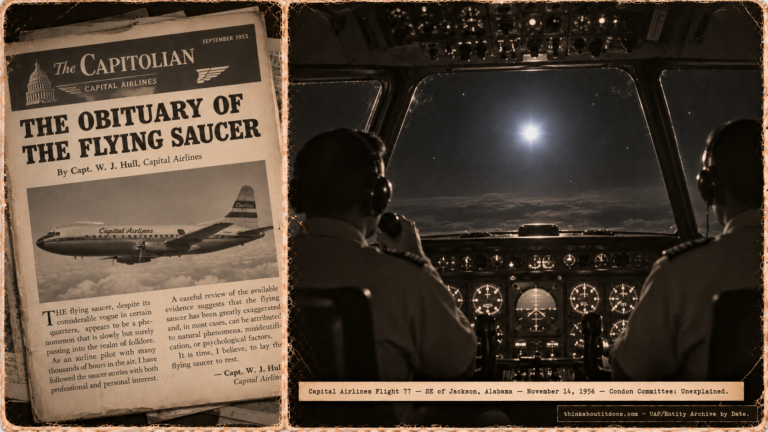
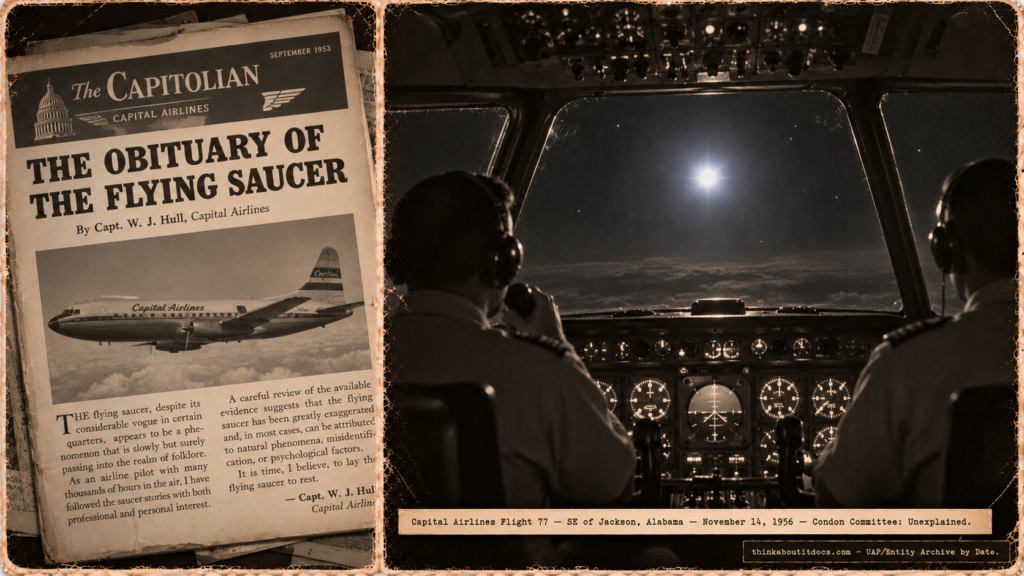
In September 1953, Captain W.J. Hull of Capital Airlines published an article in The Airline Pilot magazine called “The Obituary of the Flying Saucer.” It was a professional debunking piece — the kind that pilots who wanted to be taken seriously wrote in the early 1950s. Hull had 17 years and roughly three million miles behind him. He knew what aircraft looked like. He knew what planets and weather balloons looked like. He was objectively skeptical and cynically critical, as he would later describe himself, of most purported saucer sightings. He wrote the obituary because he thought the subject deserved one.
On the night of November 14, 1956, Hull was flying a Vickers Viscount at 10,000 feet, descending toward Mobile, Alabama, when a brilliant bluish-white light descended diagonally across their windshield from left to right and stopped dead ahead of the aircraft. Over the next two minutes, as Hull radioed Bates Field and as Bates Field radioed back, the light performed instant 90-degree turns, lazy eights, square chandelles, undulating arcs and a hovering pause — and then shot south over the Gulf of Mexico in a steep climb at fantastic speed until it disappeared. Hull wrote a letter about it to the president of the CSI-NY civilian investigation group. He said he was flabbergasted and confounded. He asked: was this a machine based on earth? The Condon Committee examined the case and could not explain it.
Date: November 14, 1956
Sighting Time: 10:10–10:12 p.m. (local)
Day/Night: Night
Location: Southeast of Jackson, Alabama (airborne); aircraft descending toward Mobile, Alabama on heading approximately south-southwest
Urban or Rural: Airborne over rural Alabama
No. of Entity(‘s): Not Applicable
Entity Type: Not Applicable
Entity Description: Not Applicable
Hynek Classification: NL (Nocturnal Light) with active maneuvers — the object’s performance characteristics go well beyond a simple light observation; some researchers classify as RV given the Bates Field tower contact
Duration: Approximately 2 minutes of active observation (10:10–10:12 p.m.); the initial descent was the opening of the event
No. of Object(s): 1
Description of the Object(s): A brilliant bluish-white light of estimated visual magnitude −7 (brighter than Venus at its brightest, which is approximately magnitude −4.6; magnitude −7 is comparable to the International Space Station at closest approach or a very bright bolide). It first appeared descending diagonally from west-southwest at azimuth 315°, becoming visible at the top of the windshield and falling to dead ahead at azimuth 205°, where it stopped. No shape or structure was described — the object appeared as a pure light source throughout.
Shape/Size/Color of Object(s): Point or small disc of bluish-white light; magnitude −7; no structural detail visible
Distance to Object(s): Not determined; the object appeared at an elevation of 30–40 degrees when stationary ahead of the aircraft
Height & Speed: Aircraft at 10,000 feet descending at 300 mph. The object descended steeply at approximately 45 degrees before stopping. It then performed maneuvers with apparent instantaneous direction changes. Final departure: steep climb south over the Gulf of Mexico at “fantastic speed” until disappearing from view.
Number of Witnesses: Captain W.J. Hull (pilot in command); First Officer Peter MacIntosh (copilot). Bates Field tower near Mobile also had the object in view and radioed Hull during the observation.
Special Features/Characteristics: The object performed two distinct series of maneuvers. The first series (approximately 30 seconds): rising and falling, darting back and forth, instant 90-degree turns, then hovering motionless. The second series (triggered when Bates Field radioed back): lazy eights, square chandelles, undulating motion — the full vocabulary of aerobatic maneuvers. It then executed a steep southward climb over the Gulf and disappeared. No sound was reported. The Bates Field tower contact provides independent ground confirmation of the object’s presence.
Case Status: Condon Committee unexplained case (CR pp. 127–129). Blue Book case (BBU). Not explained in any official investigation.
Source: Condon Committee Scientific Study of Unidentified Flying Objects, Case pp. 127–129 (unexplained); Hynek-CUFOS / Willy Smith files; NARCAP; The UFO Evidence (NICAP), Section I; Captain W.J. Hull letter to CSI-NY (Civilian Saucer Intelligence, New York)
Summary/Description: Capital Airlines Flight 77, Viscount, New York to Mobile. Captain W.J. Hull — author of the 1953 anti-UFO article “The Obituary of the Flying Saucer” — and copilot MacIntosh observed a magnitude −7 bluish-white light perform two distinct sequences of aerobatic maneuvers over approximately 2 minutes southeast of Jackson, Alabama, before it departed south at fantastic speed. Condon unexplained. Blue Book unknown.
Related Cases: 1956: November UFO|UAP & Entity Sightings Archive; 1956: Monroe Louisiana T-33 Near-Collision (May 22, 1956)
Detailed Report
Capital Airlines Flight 77 was a scheduled service from New York to Mobile, Alabama. On the night of November 14, 1956, it was operating as a Vickers Viscount — a four-engine turboprop then considered one of the most modern airliners in American domestic service — with Captain W.J. Hull as pilot in command and First Officer Peter MacIntosh as copilot. The aircraft was at 10,000 feet, descending at 300 mph on a south-southwest heading, when the event began at 10:10 p.m.
A brilliant bluish-white light appeared at the top of the windshield, coming in from the west-southwest at azimuth 315 degrees, descending at a steep diagonal — approximately 45 degrees — from left to right across the windshield’s field of view. Hull estimated its visual magnitude at −7, an extraordinary brightness for an unidentified aerial object at night. The light descended to dead ahead at azimuth 205 degrees, at an elevation of 30 to 40 degrees, and stopped. Hull radioed Bates Field tower near Mobile to look for the object. At that moment — apparently coinciding with Hull’s transmission — the object began its first sequence of maneuvers: 30 seconds of rising and falling, darting back and forth and executing what Hull described as instant 90-degree turns, before coming to a complete hover again at the same or slightly higher altitude.
Bates Field radioed back. At that moment the object began a second sequence: lazy eights, square chandelles and undulating motion — the formal aerobatic figures that pilots learn in advanced training. Then it shot southward over the Gulf of Mexico in a steep climb at what Hull described as fantastic speed, and disappeared. Total active observation: approximately two minutes. Hull later wrote that the second series of maneuvers, triggered precisely as Bates Field responded on the radio, struck him as a kind of performance — as if the object were responding to the radio communication, or at least to the attention being directed at it.
Hull subsequently wrote a detailed letter about the encounter to the president of CSI-NY, the Civilian Saucer Intelligence group based in New York. In it he described himself as having been “objectively skeptical and cynically critical of most of the purported saucer sightings” and said he was “flabbergasted and confounded” by what he and MacIntosh had seen. He asked, directly: “Was this a machine based on earth?” The letter, signed with his name and credentials, became one of the most-cited pilot accounts in the 1950s UFO literature precisely because of its source — the man who had formally declared the flying saucer dead in print, three years earlier.
RESEARCHER’S NOTES
Why This Case Is in a Different Category — And What the Condon Report Said
- The skeptic-reversal factor: Hull’s 1953 article was not a casual dismissal — it was a professional, published statement in a trade publication read by fellow airline pilots. Writing it carried reputational weight. Reversing it three years later, in a signed letter to a civilian research group, carried equal weight in the opposite direction. Hull did not have to write that letter. He chose to, and he identified himself fully. The evidentiary value of a named witness who had previously and publicly committed to disbelief cannot be overstated in any rational assessment of witness credibility.
- The Condon Report treatment: The Condon Committee examined this case and listed it among its unexplained cases at pages 127–129 of the Scientific Study of Unidentified Flying Objects. The committee’s analysis could not identify the object or account for its described behavior through any known natural or man-made phenomenon. Given that the Condon Report is routinely cited as a debunking exercise, its failure to explain a case is a meaningful finding.
- Magnitude −7: Hull’s estimate of visual magnitude −7 would place the object far brighter than Venus (typically −4.6 at maximum), and comparable to the Moon at first quarter (approximately −9) or a very bright fireball. For a stationary or slow-moving object at night that then performs aerobatics, a magnitude −7 estimate from an experienced pilot with 17 years and three million miles is a specific, calibrated observation, not a vague description of brightness.
- The Bates Field tower contact: The case is sometimes described as purely an air-visual observation, but Hull radioed Bates Field during the event, and Bates Field radioed back — implying the tower had some awareness of or contact with the object during the sighting. Whether the tower had independent visual or radar confirmation is not fully specified in the available Condon Report summary, but the bidirectional radio exchange during the active maneuver sequence is documented.
- The maneuver vocabulary: Hull used the precise language of aerobatics — lazy eights, square chandelles — to describe the object’s movements. These are not casual metaphors. A lazy eight is a specific figure-eight maneuver combining climbing and descending turns; a square chandelle is a 180-degree climbing turn with a specific pitch and bank profile. Hull was describing what he saw in the most exact technical language available to him. An object performing these maneuvers is under controlled flight guidance, not following any known natural trajectory.
W.J. Hull wrote the flying saucer’s obituary in 1953. Three years later, southeast of Jackson, Alabama, he watched something perform lazy eights at magnitude −7 while he had Bates Field on the radio. The Condon Committee could not explain it. Neither has anyone else.
“I was flabbergasted and confounded. I have been objectively skeptical and cynically critical of most of the purported saucer sightings. Was this a machine based on earth?”
Captain W.J. Hull, Capital Airlines Flight 77, in a signed letter to CSI-NY following the November 14, 1956 encounter — author of “The Obituary of the Flying Saucer,” The Airline Pilot, September 1953