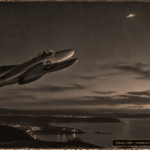
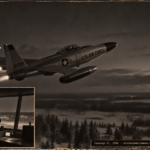
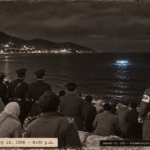
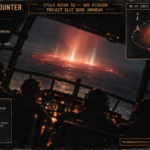
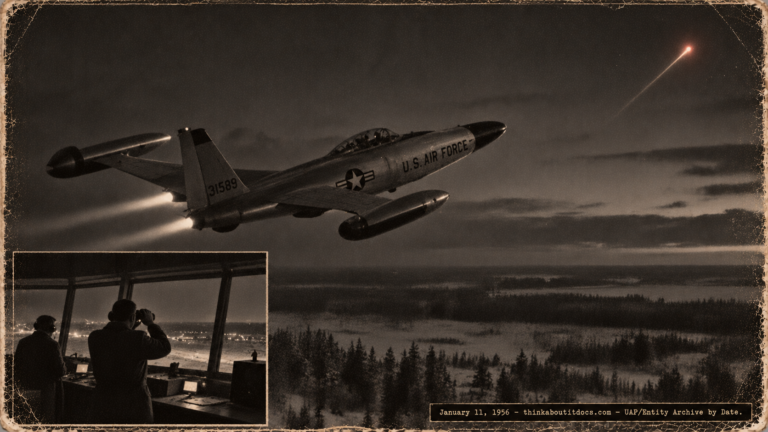
Southwest Wales, February 1956: test pilot Eric "Winkle" Brown's Vampire could not climb high enough to reach the object.
THINK ABOUTIT UFO|UAP SIGHTINGS REPORT
1956: Captain Eric “Winkle” Brown and the UFO Over the Bristol Channel
Few people in aviation history were harder to impress than Captain Eric “Winkle” Brown of the Royal Navy. He flew 487 different aircraft types, a world record. He made the first jet landing on an aircraft carrier. He flew captured German jets and the rocket-powered Me 163 at the end of the war. In February 1956 he was sent up in a de Havilland Vampire jet fighter to intercept an unidentified object over southwest Wales, and he could not reach it. The object was far above him, well over 40,000 feet, beyond what the Vampire could manage.
In the half-light of dusk, Brown could not make out what it was. He was sure it was not a cosmic-ray research balloon, the only conventional explanation he could think of. He added that the same shape was reported along the whole Bristol Channel coast that evening and was never explained. Decades later he described the encounter in his autobiography, Wings on My Sleeve, and said it changed his mind about UFOs from scoffing to open.
Date: February 1956 (exact day not given)
Sighting Time: Dusk
Day/Night: Dusk
Location: Airspace over southwest Wales and the Bristol Channel coast; Don Berliner places it near Fishguard
Urban or Rural: Airborne (over coastal and rural Wales)
No. of Entity(‘s): Not Applicable
Entity Type: Not Applicable
Entity Description: Not Applicable
Hynek Classification: DD (Daylight Disc), seen at dusk
Duration: Unknown
No. of Object(s): 1
Description of the Object(s): A high-altitude “shape” that Brown could not identify in the fading light. Don Berliner’s summary describes it as a disc.
Shape/Size/Color of Object(s): Disc (per Berliner); size and color not recorded
Distance to Object(s): Unknown; well above the Vampire’s reach
Height & Speed: Well over 40,000 feet, above the Vampire’s performance ceiling. Speed not recorded; Brown could neither climb to it nor catch it.
Number of Witnesses: 1 airborne (Capt. Eric Brown, Royal Navy); plus unnamed observers along the Bristol Channel coast who, Brown said, reported the same shape that evening
Special Features/Characteristics: A deliberate interception attempt by a record-holding test pilot. The object stayed above a jet fighter’s ceiling. Brown ruled out a cosmic-ray research balloon, and reports came from along the Bristol Channel coast.
Case Status: Unexplained
Source: Eric Brown, Wings on My Sleeve (2nd expanded edition, Weidenfeld & Nicolson, 2006), as quoted by Duncan Lunan, “Space Notes: Capt. Eric ‘Winkle’ Brown, RN,” The Orkney News, April 9, 2023; Don Berliner
Summary/Description: Royal Navy test pilot Eric Brown took a Vampire jet up to intercept a UFO over southwest Wales at dusk. It was well over 40,000 feet, beyond his reach. He could not identify it, was certain it was not a research balloon, and said it was seen along the Bristol Channel coast that evening.
Related Cases: 1956: February UFO|UAP & Entity Sightings Archive
Detailed Report
By 1956, Captain Eric Melrose Brown, known throughout the service as “Winkle,” was already a legend. Born in Leith, he had test-flown captured German aircraft during and after the Second World War, and he was the only Allied pilot to fly the Messerschmitt Me 163 Komet rocket fighter under power. He made the first jet landing on an aircraft carrier, landed a Vampire wheels-up on an experimental rubber flight deck, and set world records for aircraft types flown and carrier landings. He was a trained, skeptical observer with an engineer’s eye.
In February 1956 Brown was sent up in a de Havilland Vampire to try to intercept an unidentified flying object over southwest Wales. He found it, but it was far above him, well over 40,000 feet and higher than his Vampire could climb. He could get no closer. In the half-light of dusk he could not identify what he was looking at.
Brown considered the one conventional explanation he thought possible, a high-altitude cosmic-ray research balloon, and rejected it. He was certain that was not what he had seen. He also noted that the same shape had been reported along the entire Bristol Channel coast that evening, and that no explanation for it ever came out. He summed up the effect on his own thinking in a single line that has since been widely repeated.
The encounter appears in the second, expanded edition of Wings on My Sleeve, published in 2006, fifty years after the event. UFO researcher Don Berliner’s summary describes the object as a disc and places the interception near Fishguard.
RESEARCHER’S NOTES
An Unimpeachable Witness, a Late Record
- Witness credibility: Few UFO witnesses of any era match Brown’s qualifications. He was an engineering-trained test pilot, famously unflappable, who had flown more aircraft types than anyone in history and knew the performance limits of every contemporary design.
- Late and personal record: The known account comes from Brown’s own autobiography, published decades later. No contemporary Royal Navy or RAF report, radar record or press story from February 1956 has yet been found, and the exact date is not given.
- What Brown did and didn’t say: In the passages quoted from his memoir, Brown describes a “shape” he could not identify in the dusk, not a clearly seen disc. The “disc” label comes from Berliner’s summary, and the Fishguard location is Berliner’s too. Brown himself refers to the Bristol Channel coast. Popular retellings that add a radar-directed scramble or a sharp visual of a saucer go beyond the sourced account.
- The balloon question: Large plastic research balloons were flying above 40,000 feet in the mid-1950s and could look solid and disc-like at dusk, when they catch sunlight after the ground is dark. Brown knew about them and explicitly ruled one out, but he also admitted he couldn’t identify the object. The reports along the coast would fit a very high, slow object seen from a wide area, which is consistent with a balloon, though not proof of one.
- Research lead: Brown’s statement that the shape was seen along the entire Bristol Channel coast points to South Wales and Somerset newspapers from February 1956. Those would pin down the date and may name other witnesses.
The Winkle Brown sighting matters less for what was seen than for who saw it and how it changed his mind. One of the most experienced and skeptical pilots who ever lived chased an object he couldn’t reach and couldn’t identify, rejected the only explanation he could think of, and came away with an open mind. The case remains unexplained until the Bristol Channel reports are found.
“Where I once scoffed – I now have an open mind.”
Captain Eric “Winkle” Brown, Royal Navy, Wings on My Sleeve (2006)