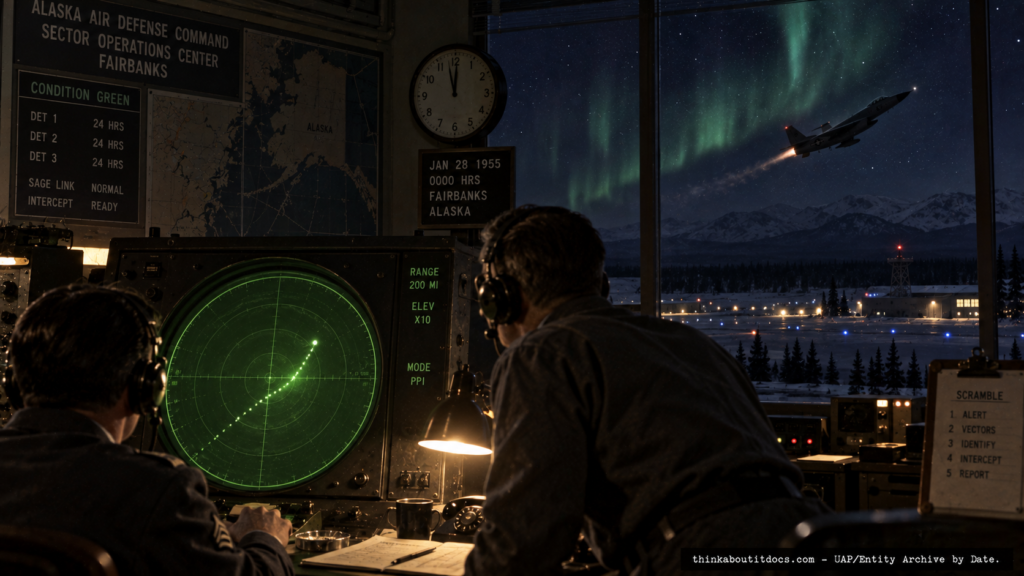
The January 28, 1955 Fairbanks, Alaska radar chase, sourced to a single 1967 APRO letter.
THINK ABOUTIT UFO|UAP SIGHTINGS REPORT
Fairbanks, Alaska 1955: The ADC Radar Chase With a Quadrupling Target Speed
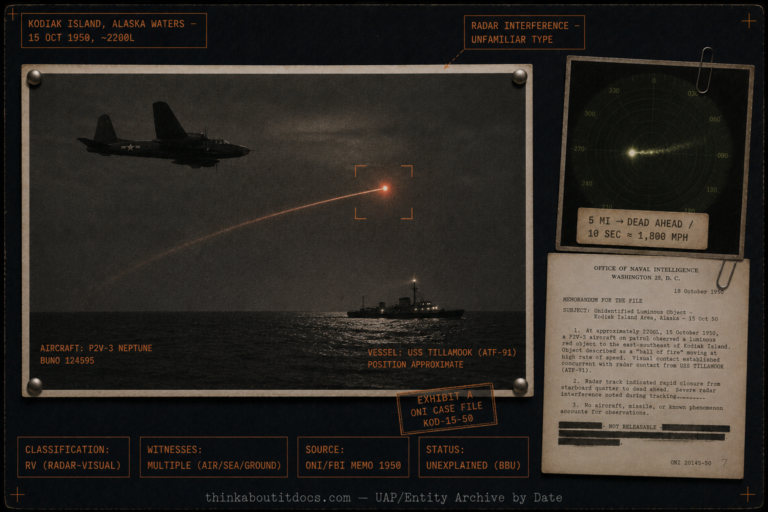
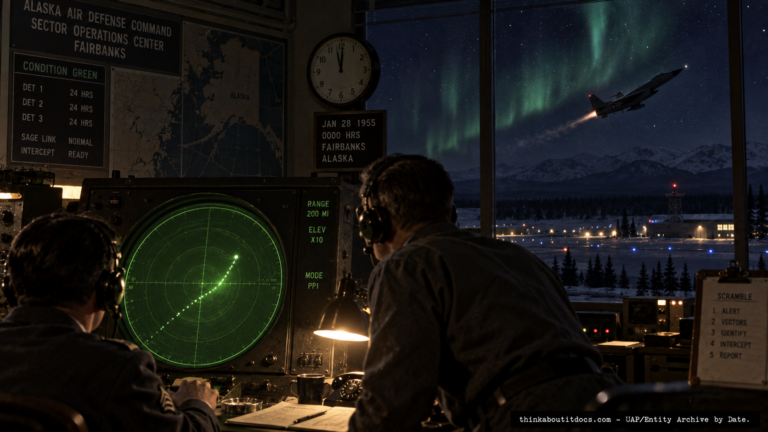
Just after midnight on January 28, 1955, an Air Defense Command interceptor scrambled out of Fairbanks, Alaska against a ground-radar unknown that shouldn’t have been possible: over roughly ten minutes, the target’s computed speed climbed in four successive readings — 2,800, then 3,200, then 3,600, and finally 4,800 knots — before crossing out of intercept range entirely. A second pilot airborne nearby reported a “blood red” glow in the exact patch of sky where the unknown should have been. The case survives only through a single letter written to APRO twelve years after the fact, a thin foundation for one of the more extraordinary speed readings in the Cold War-era radar record.
Date: January 28, 1955
Sighting Time: Midnight (scramble at 12:01 AM)
Day/Night: Night
Location: Fairbanks, Alaska
Urban or Rural: Rural (Air Defense Command radar/airfield site)
No. of Entity(‘s): Not Applicable
Entity Type: Not Applicable
Entity Description: Not Applicable
Hynek Classification: RV (Radar/Visual) — with the visual component being a secondhand, indirect report of a colored glow rather than a direct sighting of a discrete object
Duration: Approximately 10 minutes, from scramble to loss of contact
No. of Object(s): 1
Description of the Object(s): No object was ever visually resolved. The primary data is a GCI radar track; the only visual element is a secondhand report of a “blood red” glow in the sky.
Shape/Size/Color of Object(s): Shape and size unknown; color reported only as “blood red,” secondhand
Distance to Object(s): The target crossed the interceptor’s track while still outside airborne radar range and out of visual sight
Height & Speed: Above 30,000 ft and climbing; speed recomputed across four GCI readings from 2,800 to 3,200 to 3,600 to 4,800 knots over roughly ten minutes
Number of Witnesses: 2 named-by-role but unnamed individuals (the intercepting pilot and a second airborne pilot who reported the red glow), plus unspecified GCI radar personnel
Special Features/Characteristics: The target’s computed speed increased across four successive readings rather than holding steady, and it out-climbed the pursuing interceptor before contact was lost
Case Status: Undocumented / single-source — not located in Project Blue Book files or any contemporaneous record; the only known source is a letter written to APRO twelve years after the event
Source: Letter to APRO from Herbert B. Johnson Jr., Rt. 1, Box 244, Grand Rapids, Minnesota 55744, dated March 6, 1967; APRO files, photocopy in Loren Gross files
Summary/Description: An Air Defense Command pilot on “number one alert” at Fairbanks was scrambled at 12:01 AM against a GCI-radar unknown tracking on a heading of 135 degrees. Over roughly ten minutes the target’s speed was recomputed four times, climbing from 2,800 to 4,800 knots, before it crossed the interception track while still beyond airborne radar and visual range. A separate pilot airborne at the time reported seeing a “blood red” glow in the part of the sky where the unknown should have been. The object remained above 30,000 feet and was still climbing when the intercept was abandoned.
Related Cases: None identified
Detailed Report
The account comes from a March 6, 1967 letter sent to the Aerial Phenomena Research Organization by a Minnesota resident, Herbert B. Johnson Jr., who wrote that he had been “involved in an occurrence” while a member of the Air Defense Command stationed at Fairbanks, Alaska in January 1955. The letter’s phrasing leaves some ambiguity about whether Johnson was the pilot himself or was relaying an account he had been told by someone else in his unit — the case file as preserved does not resolve this.
As described, Johnson and his pilot were on “number one alert” — the highest state of readiness for an immediate scramble — when the alert bell sounded at 12:01 AM. Ground-controlled intercept (GCI) radar had already picked up an unidentified track heading 135 degrees. The target’s speed was recomputed several times over the following ten minutes: first at 2,800 knots, then 3,200, then 3,600, and finally 4,800 knots — nearly seven times the speed of sound, and a rate of change with no conventional aircraft explanation available in 1955 or since. The target crossed the interceptor’s projected track while still beyond the range of the jet’s own airborne radar and beyond visual range as well, meaning the crew that scrambled never themselves saw or radar-locked the object.
The one piece of secondhand visual corroboration in the letter is that another pilot, airborne elsewhere at the time, told Johnson he had seen a “blood red” glow in the part of the sky where the unknown should have been. This second pilot is not named, and no independent account from him survives in the file. The object was reported above 30,000 feet and still climbing when the pursuit was called off.
No Project Blue Book case number, official Air Force report, or contemporaneous press account for this incident has been located. The case exists in the record solely because of Johnson’s 1967 letter, written twelve years after the events it describes.
RESEARCHER’S NOTES
The Fairbanks Radar Chase — 1955 Alaska and the Limits of a Single-Source Case
- The Speed Escalation. The case’s most striking feature is that the target’s speed wasn’t a single dramatic figure but a series of four recomputed readings climbing steadily upward — a pattern that, if accurately recorded, is harder to dismiss as a single instrument glitch than a one-off high-speed reading would be.
- A Twelve-Year Gap. The letter that is this case’s sole source was written in 1967, twelve years after the reported event, by a correspondent who does not clearly establish whether he was a direct participant or relaying another airman’s account.
- No Primary File Located. Despite the case’s dramatic content, no Project Blue Book case number or original Air Force incident report has been located to corroborate it. The letter appears to be the entirety of the documentary record.
- Unnamed Corroborating Witness. The one independent visual element — the “blood red” glow reported by a second pilot — comes from an unnamed individual whose account is only known secondhand, through Johnson’s letter.
- Institutional Context. Fairbanks-area Air Defense Command radar sites, including Murphy Dome AFS just northwest of the city, were newly operational in this period as part of the broader Alaskan early-warning buildup against a possible Soviet attack, giving the general setting some independent historical grounding even where the specific incident cannot be corroborated.
Taken on its own terms, the Fairbanks case describes one of the more extraordinary tracked-speed readings in the 1950s radar-visual record. But it rests entirely on a single letter written over a decade after the fact, with no located Blue Book file, no named corroborating witness, and some ambiguity even about who the letter’s author actually was. It is preserved here as a documented claim, not a verified case.
“The target, at first report was travelling at 2,800 knots; in the space of some ten minutes the target’s speed had been recomputed as 3,200, 3,600, and finally 4,800 knots.”
— Herbert B. Johnson Jr., letter to APRO, March 6, 1967