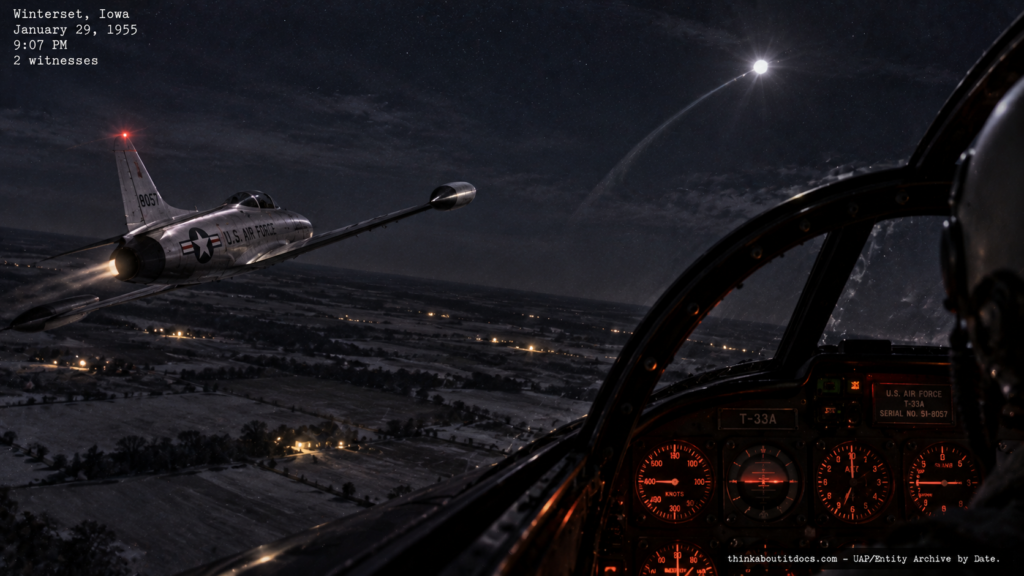
The January 29, 1955 Winterset, Iowa Air National Guard jet encounter.
THINK ABOUTIT UFO|UAP ENCOUNTER REPORT
1955: Winterset, Iowa
A T-33 Jet’s Head-On Encounter and Failed Pursuit
On the night of January 29, 1955, two named Iowa Air National Guard pilots flying a T-33A jet trainer found themselves on a direct head-on collision course with a flashing white light over Winterset, Iowa — and watched it climb and out-turn their aircraft the instant they gave chase. With a named unit, a named crew, and even the aircraft’s own tail number on record, this is one of the better-documented Blue Book-era intercept reports of early 1955, even though the original case number itself has not been located.
Date: January 29, 1955
Sighting Time: 9:07 PM CST
Day/Night: Night
Location: Winterset, near Des Moines, Iowa
Urban or Rural: Rural (airborne over farmland en route from Des Moines)
No. of Entity(‘s): Not Applicable
Entity Type: Not Applicable
Entity Description: Not Applicable
Hynek Classification: NL (Nocturnal Light)
Duration: A few minutes, from the head-on pass through the failed pursuit
No. of Object(s): 1
Description of the Object(s): A white light flashing at a set rate, with no trail, holding level flight on a direct collision course with the jet
Shape/Size/Color of Object(s): No solid shape recorded — described only as a white light
Distance to Object(s): Closed to a near head-on pass before the object rose and flew directly over the jet at the last instant
Height & Speed: Initial pass at 20,000 ft; the object then climbed rapidly to 35,000 ft. The T-33A was flying at 290 knots (330 mph) on a heading of 30 degrees at the time.
Number of Witnesses: 2, both named: Maj. A. Packer and Lt. D. Myers, 132nd Fighter Bomber Group, Iowa Air National Guard
Special Features/Characteristics: The object appeared to anticipate the jet’s flight path, out-climbing and out-turning the T-33A once the pilot attempted pursuit — behavior the original source describes as “seemingly using radar or similar means to track” the aircraft
Case Status: Project Blue Book-era (BBU) report, compiled via Project 1947 and NARCAP; no original Blue Book case number has been located in this pass
Source: Project 1947; NARCAP
Summary/Description: Iowa Air National Guard pilots Maj. A. Packer and Lt. D. Myers of the 132nd Fighter Bomber Group were flying a T-33A jet (serial number 52-9590) at 20,000 ft, heading 30 degrees at 290 knots, when they saw a white light flashing at a set rate, with no trail, on a direct head-on collision course. At the last instant the object rose and passed over the jet, climbing rapidly to 35,000 ft. When Packer tried to pursue, the object out-climbed and out-turned the T-33A, appearing to track and anticipate the jet’s own maneuvers.
Related Cases: None identified
Detailed Report
At 9:07 PM CST on January 29, 1955, Maj. A. Packer and Lt. D. Myers of the 132nd Fighter Bomber Group, Iowa Air National Guard, were flying a T-33A jet trainer (tail number 52-9590) near Winterset, southwest of Des Moines. Cruising at 20,000 ft on a heading of 30 degrees at 290 knots, the crew spotted a white light flashing at a steady, set rate ahead of them, with no visible trail — on what quickly became a direct head-on collision course, in level flight at their same altitude.
At the last possible instant before what would have been a collision, the object rose sharply and passed directly over the jet, then continued climbing rapidly to roughly 35,000 ft — well above the T-33A’s operational ceiling for a sustained chase. When Packer attempted to pursue, the object consistently out-climbed and out-turned the jet. The original source material describes the object as behaving as though it were “using radar or similar means” to track the T-33A, allowing it to counter the pilot’s maneuvers with what the report calls “excess” speed and altitude — language suggesting the crew felt the object was responding directly to their own flight inputs rather than simply outrunning them in a straight line.
The account carries more identifying detail than most entries from this period — named pilots, a named unit, and a specific aircraft tail number — but no original Project Blue Book case number has been located to confirm official Air Force processing of the report; it is known through the Project 1947 and NARCAP compilation efforts rather than a primary case file.
RESEARCHER’S NOTES
The Winterset Intercept — 1955 Iowa and a Pattern of Apparent Anticipation
- Named Specificity. Unlike many entries from this era, the case carries named pilots, a named Guard unit, and a specific aircraft serial number — details that lend the report more documentary weight than the era’s typical anonymous sighting.
- The Anticipation Pattern. The object’s apparent ability to counter the T-33A’s own maneuvers, described in the source as tracking “by radar or similar means,” echoes a recurring motif across Air Defense Command-era intercept reports of this period, in which pursued objects seem to respond directly to the pursuing aircraft’s actions rather than simply outrunning it.
- Sourcing Gap. Despite the specificity of the account, no original Blue Book case number has been located in this pass — the report survives through the Project 1947 and NARCAP secondary compilations rather than a primary Air Force file.
- Institutional Context. The 132nd Fighter Bomber Group was an active Iowa Air National Guard unit flying T-33 and F-84 aircraft in this period, giving the unit and equipment details independent historical grounding even where the incident itself remains uncorroborated by a primary file.
The Winterset case is one of the more credibly anchored reports in the January 1955 record — named crew, named unit, and a specific aircraft, describing a genuinely alarming near head-on encounter. Its weak point is not the witnesses but the paper trail: without a located primary Blue Book case file, it is best treated as a well-documented secondary account rather than a fully verified official case.
“At the last instant the object rose and flew over the jet, climbing rapidly to 35,000 ft.”
— Project 1947 / NARCAP case summary, Winterset, Iowa, January 29, 1955