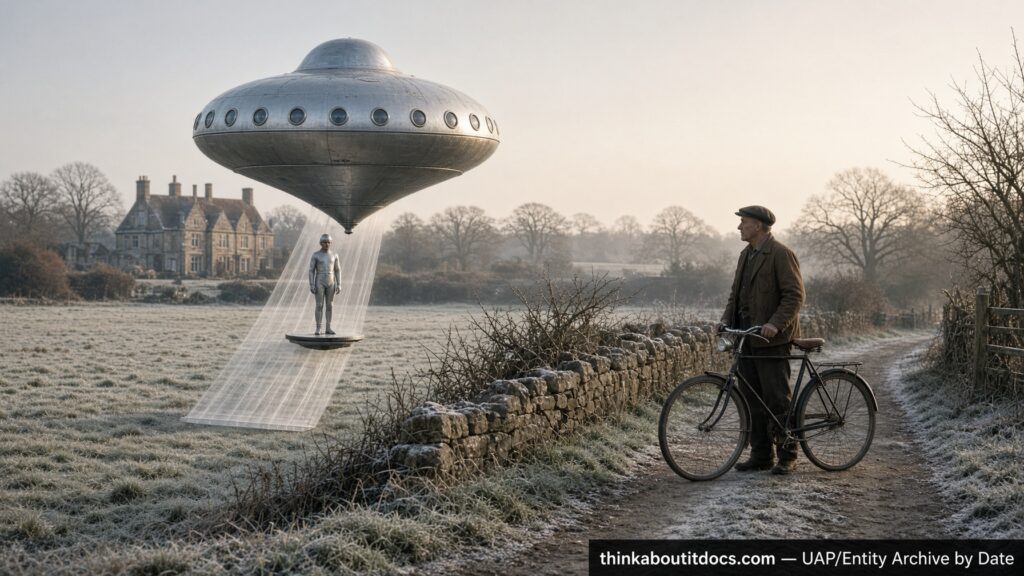
The February 23, 1955 Broadlands, Hampshire encounter, investigated by Lord Mountbatten.
THINK ABOUTIT
UFO|UAP & ENTITY ENCOUNTER REPORT
The Broadlands Case: Lord Mountbatten‘s Personal UFO Investigation, 1955
On the morning of February 23, 1955, a bricklayer cycling to work on Lord Mountbatten’s own Hampshire estate watched a silvery, spinning-top-shaped craft descend a humanoid figure on a platform beam — and was knocked to the ground by a blue flash before the craft departed at jet-like speed. What sets this case apart from almost every other entry in the archive is who investigated it: Mountbatten himself, a senior British military and royal-family figure with a genuine personal interest in the UFO subject, personally interviewed the witness, searched the field for evidence, and took a signed statement — giving Broadlands a depth of contemporaneous, high-status investigation that most 1950s cases never received.
Date: February 23, 1955 (with a separately-sourced follow-up episode reported for February 24, 1955)
Sighting Time: Approximately 8:30 AM
Day/Night: Day
Location: Broadlands Estate, Romsey, Hampshire, England
Urban or Rural: Rural (private country estate grounds)
No. of Entity(‘s): 1
Entity Type: Humanoid
Entity Description: A humanoid figure, described in secondary sources as small (around 5’6″) and fair-haired, seen wearing a dark overall or coverall and a close-fitting helmet, standing on a platform lowered from the craft on a central shaft/column
Hynek Classification: CE-III (Close Encounter, Third Kind — occupant observed)
Duration: Several minutes
No. of Object(s): 1
Description of the Object(s): A metallic craft shaped like a large spinning top or “child’s huge humming-top,” with a row of portholes around the middle
Shape/Size/Color of Object(s): Spinning-top/humming-top shape, 20-30 ft in diameter, silvery metallic
Distance to Object(s): The witness watched from under 100 yards away and approached further, dismounting his bicycle near the field
Height & Speed: Hovered roughly 80 ft above the ground; departed vertically at a speed the witness compared to the fastest jet aircraft he had seen, or faster, with no noise until the moment of departure
Number of Witnesses: 1, named: Frederick Briggs, a retired British Army Sergeant working as a bricklayer/maintenance man on the Broadlands estate
Special Features/Characteristics: No sound whatsoever until the craft began to move; a bluish light flash from one of the portholes knocked the witness down and left him briefly unable to move; ground search conducted afterward by Lord Mountbatten personally
Case Status: Personally investigated by Lord Mountbatten, who interviewed Briggs, searched the meadow, and took a signed statement — among the more thoroughly investigated single-witness UK cases of the decade, though still resting on one witness account
Source: Timothy Good, Above Top Secret: The Worldwide UFO Cover-Up; Lord Mountbatten’s own investigation report as referenced in multiple later UFO histories
Summary/Description: Frederick Briggs was cycling to work at Broadlands on the morning of February 23, 1955 when he saw a large, silvery, spinning-top-shaped object hovering over a nearby field. He dismounted and approached; a shaft descended from the object’s center with a small humanoid figure standing on a platform at its base. A bluish flash from a porthole then knocked Briggs to the ground, paralyzed, until the shaft retracted and the object departed vertically at high, near-silent speed. Lord Mountbatten, Briggs’s employer and a longtime UFO enthusiast, personally interviewed him, searched the field, and produced photographs of other reported UFOs to see if any matched what Briggs had seen.
Related Cases: A second episode reported for February 24, 1955, in which Briggs described encountering the same humanoid figure on the road and being telepathically invited aboard the craft for a trip to see the Pyramids of Egypt — see caution below; treated as a distinct, later-sourced account rather than a continuation of the original statement
Detailed Report
At about 8:30 AM on February 23, 1955, Frederick Briggs — a retired British Army sergeant then working as a bricklayer and maintenance man on Lord Mountbatten’s Broadlands estate near Romsey, Hampshire — was cycling to work along the estate drive, the ground lightly dusted with snow. Between the Romsey Lodge and the main house, near where the drive forks toward Middlebridge Lodge, he saw an object hovering stationary over a field, shaped like a large spinning top, roughly 20-30 ft in diameter, with a row of portholes around its middle.
Briggs dismounted his bicycle and watched from a distance of under 100 yards. A shaft or tube descended from the center of the object, and at its base, on a small platform, stood a humanoid figure — described in secondary retellings as small and fair-haired, wearing overalls and a close-fitting helmet. As the figure descended and appeared to notice Briggs watching, a bright bluish flash came from one of the portholes. Briggs was knocked to the ground and found himself unable to move, as though held by some force, though he reported no physical pain — only dizziness, as if he had taken a glancing blow to the chin.
The shaft withdrew quickly back into the craft, which then rose vertically — as fast as, or faster than, the fastest jet aircraft Briggs said he had ever seen — and vanished into the clouds almost instantly. There had been no sound at all until the moment the craft began to move, and even then the noise was compared to a small rocket firework rather than anything mechanical. As the object departed, Briggs found he could move again. He picked up his bicycle and continued on to the house, where Mountbatten’s chauffeur reportedly remarked on how shaken he looked.
Mountbatten, upon hearing the account, took it seriously enough to personally interview Briggs, walk the field himself looking for physical traces, and produce an array of photographs of other reported UFOs to ask whether any resembled what Briggs had described. Mountbatten subsequently prepared a written statement detailing Briggs’s account. A version of the story was reportedly set to run in the Sunday Graphic newspaper before the editor pulled it at the last moment to avoid embarrassing the Mountbatten family.
A note on the February 24 episode: In discussions with ufologist Desmond Leslie, a further story surfaced describing Briggs encountering the same humanoid figure again the following day, standing in the road, who allegedly took his hand and telepathically invited him aboard the craft for what Briggs described as a brief trip to see the Pyramids of Egypt. This account did not come from Briggs’s original 1955 statement to Mountbatten — it is documented separately, through Desmond Leslie and Flying Saucer Review years later, and by at least one account Mountbatten himself was reportedly skeptical of this second story. It is preserved here as part of the case’s fuller record but kept clearly distinguished from the original, Mountbatten-investigated February 23 statement.
RESEARCHER’S NOTES
The Broadlands Encounter — 1955 Hampshire and the Limits of High-Status Investigation
- Investigated by a Genuine Insider. Few 1950s cases anywhere in the world were investigated, in person and on the day, by someone of Mountbatten’s standing — a fact that gives Broadlands unusual documentary weight even though it remains a single-witness account.
- A Named, Employed Witness. Briggs was not an anonymous caller but a known, employed member of the estate staff, personally known to his employer both before and after the event — a different reliability profile than most anonymous or pseudonymous reports of the era.
- The Suppressed Newspaper Story. That a British national newspaper reportedly prepared to run the story before pulling it to protect the Mountbatten family name is itself a small, separately interesting data point about how such cases involving prominent families were handled in the press at the time.
- The Second-Day Problem. The February 24 telepathic-invitation episode is a genuinely different kind of claim — spaceflight to Egypt via telepathic invitation — sourced only through Desmond Leslie’s later retelling rather than Mountbatten’s own investigation, and by some accounts doubted by Mountbatten himself. Treating it as a separate, lower-confidence addendum rather than folding it into the original statement keeps the case’s strongest element — Mountbatten’s own contemporaneous investigation — from being diluted by a much shakier follow-up story.
- Single-Witness Limitation. For all its investigative pedigree, the core February 23 account still rests on one witness’s testimony; Mountbatten’s involvement lends credibility to the seriousness with which it was taken at the time, not independent corroboration of the events themselves.
Broadlands stands out in this archive less for the strangeness of what was reported — a hovering craft, a descending occupant, a disabling light — than for who took it seriously at the time. A signed statement personally taken by Lord Mountbatten is a rare thing in UFO literature. The original February 23 account, kept separate from the far shakier February 24 addendum, deserves to be read as one of the better-anchored single-witness cases of 1955, even as it remains, in the end, one person’s testimony.
“I suddenly saw an object hovering stationary over the field… shaped like a child’s huge humming-top.”
— Frederick Briggs, statement to Lord Mountbatten, February 23, 1955