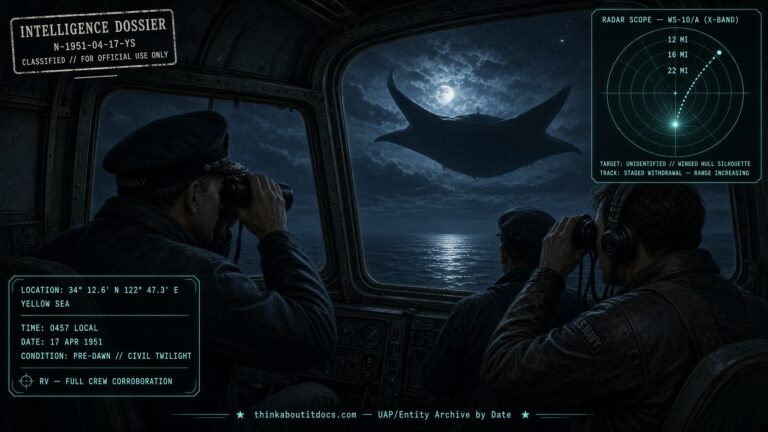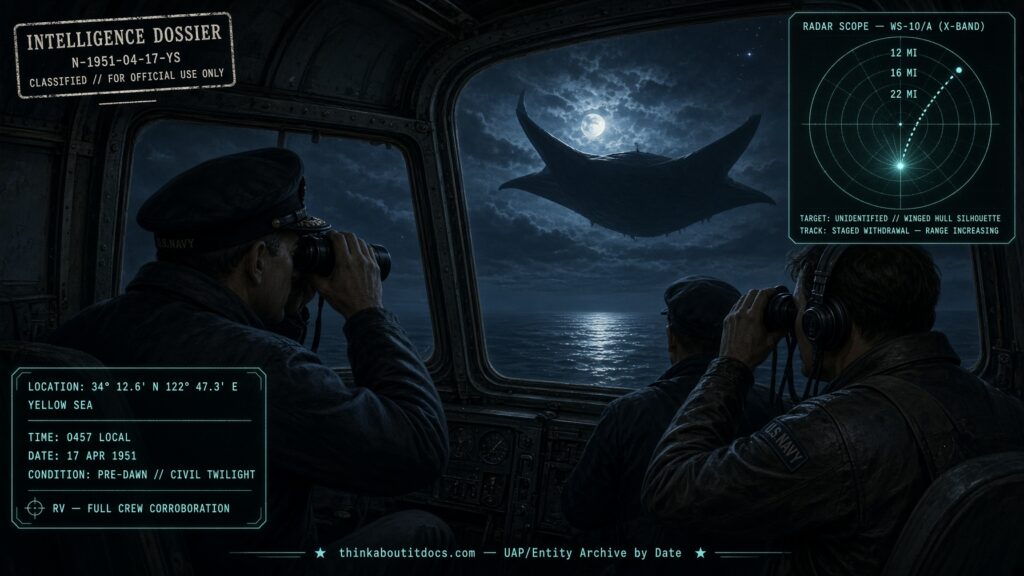
The October 18, 1951 Yellow Sea pursuit, in which a Navy PBY crew tracked a large, swept-wing object for 22 minutes off the coast of Tsingtao, China
THINK ABOUTIT UFO|UAP SIGHTINGS REPORT
1951: The Yellow Sea Pursuit — Off the Coast of Tsingtao, China
In the pre-dawn darkness of October 18, 1951, the crew of a U.S. Navy patrol plane on station over the Yellow Sea spent 22 uninterrupted minutes tracking an object that was, by any conventional standard, exactly the kind of thing a maritime patrol crew was trained to identify — and could not. A waist gunner’s first sighting of a light off the port side grew, through a deliberate and methodical sequence of maneuvers by the plane’s commander, into a sustained, radar-corroborated, binocular-confirmed observation of a large, winged hull that kept pace with the aircraft, allowed itself to be approached to within a few miles, and then pulled away and vanished. Every crew member aboard reportedly saw the same thing. It stands as one of the best radar-visual-corroborated night pursuits in this archive’s early Cold War record.
Date: October 18, 1951
Sighting Time: 3:33 a.m. local time
Day/Night: Night
Location: Over the Yellow Sea, approximately 140 miles from Tsingtao, China
Urban or Rural: Airborne, over open ocean
No. of Entity(‘s): Not applicable
Entity Type: Not applicable
Hynek Classification: RV (Radar/Visual)
Duration: Approximately 22 minutes
No. of Object(s): 1
Description of the Object(s): A large, hull-like body with swept-back wings featuring a dihedral (upward angle) at the wingtips, observed in enough detail through binoculars for all crew members to independently confirm the same hull shape
Shape of Object(s): Winged, hull-bodied, aircraft-like in general configuration but with swept-back, dihedral wingtips unlike any known Navy or contemporary aircraft type
Size of Object(s): Hull estimated at approximately 60 feet long
Color of Object(s): Not specified beyond an initial light sighted from the aircraft
Distance to Object(s): Ranged across the encounter from an initial radar confirmation at 12 miles, closing to 3-4 miles as the PBY applied power, then the object pulling away to 16 miles (radar-confirmed) and finally 22 miles, where all contact was lost
Height & Speed: The object held a steady altitude of approximately 4,000 feet throughout; its speed was not given numerically, but it was able to match the PBY’s maneuvering, pull ahead when the aircraft turned, and then accelerate away twice in succession, expanding its range from 3-4 miles to 22 miles within the observation’s final minutes
Number of Witnesses: The full crew of the patrol aircraft, including the waist gunner who first sighted it, Patrol Plane Commander Ensign George Gregory, and the radar operator; described as “all hands on board” observing the hull shape
Special Features/Characteristics: The PBY crew deliberately maneuvered to place the object between their aircraft and the moon in an apparent attempt to silhouette it for better visual identification; the object responded by turning as well and pulling ahead to 12 miles, suggesting an awareness of and reaction to the pursuing aircraft’s positioning; the object allowed the PBY to close to 3-4 miles before accelerating away in two further stages, first to 16 miles and then to 22 miles, where contact was lost.
Case Status: Unexplained
Source: Project 1947; FUFOR Index
Summary/Description: At 3:33 a.m. local time on October 18, 1951, a waist gunner aboard a U.S. Navy PBY patrol plane, flying roughly 140 miles from Tsingtao, China over the Yellow Sea, sighted an unidentified light off the aircraft’s port side and notified Patrol Plane Commander Ensign George Gregory. The plane’s radar operator confirmed the contact at a range of 12 miles. The object held a steady altitude of about 4,000 feet, with a large hull, estimated at 60 feet long, and wings swept back and down with a dihedral angle at the tips. The pilot turned the aircraft to place the object between it and the moon, hoping to silhouette it more clearly; the object responded by turning as well and pulling ahead to a 12-mile range. The PBY then applied power and closed the distance to roughly 3-4 miles, during which the crew observed the object’s hull shape through binoculars, with all hands aboard confirming the same profile. The object then accelerated, its range confirmed by radar at 16 miles, before rapidly pulling away further to 22 miles, at which point all contact — visual and radar — was lost. The total observation lasted approximately 22 minutes.
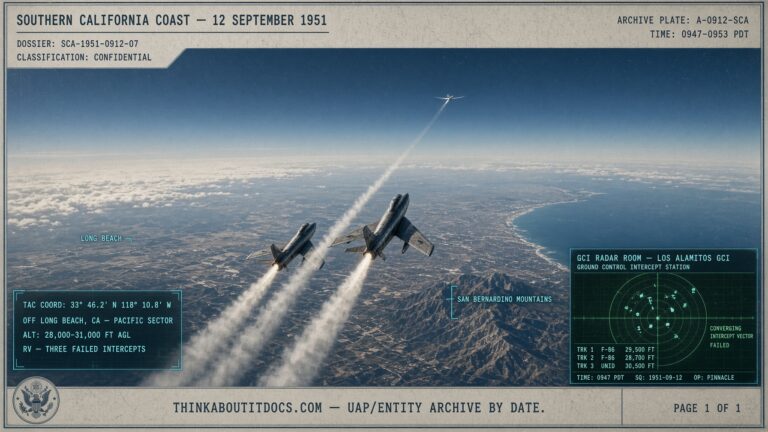
Related Cases: 1950: The Mt. Vernon, Virginia DC-6 Near-Collision | 1951: The March Field Intercept, California (comparable sustained pursuit-and-evasion structure)
Detailed Report
What distinguishes the Yellow Sea pursuit from many nocturnal military sightings of the era is the methodical, almost experimental character of the crew’s own response. Rather than simply reporting a light and losing it, Ensign Gregory’s crew conducted a deliberate visual-confirmation maneuver — positioning the object against the moon to silhouette it — that reflects genuine tactical training and a serious intent to resolve the object’s true nature rather than merely record an impression. That the object appeared to respond in kind, turning to match the PBY’s repositioning, is either a remarkable coincidence of independent flight paths or a suggestion that whatever was out there was itself tracking and reacting to the patrol plane’s movements — a detail with real analytical weight, since it describes not a passive object being observed but an interactive one.
The hull-and-wing description — a roughly 60-foot body with swept-back, dihedral-tipped wings — does not match any Navy patrol or fighter aircraft of the period, nor does it resemble a flying boat or amphibious type that might plausibly have been operating, authorized or not, in the same airspace at 3:30 in the morning over international waters near a sensitive Cold War frontier. The Yellow Sea in October 1951 was an active Korean War theater, and the surrounding region was under close aerial surveillance by multiple nations; an unauthorized aircraft of any known type operating in the area would itself have been a significant, and separately documentable, security incident, yet no such incident appears in the available record.
The staged nature of the object’s departure — pulling away first to 16 miles, confirmed independently by radar, and then further to 22 miles before contact was lost entirely — describes a controlled, deliberate withdrawal rather than a sudden panic-driven flight. Combined with the object’s earlier willingness to let the PBY close to within 3-4 miles for a sustained visual look, the overall behavioral pattern reads as an object that was, if anything, unconcerned about being observed at moderate range but unwilling to allow closer approach, accelerating away only once the patrol plane pressed nearer.
RESEARCHER’S NOTES
The Yellow Sea Pursuit — 1951 and the Value of a Deliberate Visual Confirmation Maneuver
- Classification issues: RV is squarely correct — the case combines an initial visual sighting, sustained radar tracking at multiple confirmed ranges, and a close-range binocular visual confirmation by the full crew, one of the more thoroughly cross-corroborated cases of its type in this archive.
- Source chain assessment: The case is preserved through Project 1947 and the FUFOR Index, both serious ufological compilation efforts drawing on period military records; the level of operational detail (specific ranges, specific personnel roles, a described tactical maneuver) is consistent with a genuine after-action account rather than an embellished retelling.
- Pattern context: The case’s structure — approach, close observation, staged withdrawal in response to pursuit — recurs across a number of this archive’s best-documented military pursuit cases (see the March Field, California intercept from the same year), suggesting a recurring behavioral pattern across otherwise unrelated 1951 sightings worth further comparative study.
- Physical evidence and evidentiary weight: No photograph or film survives, but the combination of an entire aircrew’s visual corroboration, independent radar confirmation at three separate ranges, and a documented tactical maneuver by the aircraft commander gives this case unusually strong multi-witness, multi-method evidentiary weight for a single nighttime sighting.
- Geographic and historical context: The Yellow Sea in October 1951 was an active Korean War patrol corridor, placing this sighting within a broader pattern of Korean War-theater UFO reports this archive has documented from the same period (see the December 1950 USS Gardiners Bay case and the January 1951 USS Passumpsic escort case), suggesting the intensity of military aerial activity in the theater may have made genuine anomalies more likely to be noticed, tracked, and reported by trained personnel.
The Yellow Sea pursuit stands as one of the most thoroughly cross-corroborated nighttime sightings in this archive’s early Cold War record — an entire patrol crew’s visual confirmation, radar tracking at three independently logged ranges, and a deliberate, tactically sound identification maneuver by the aircraft’s commander, all converging on an object that ultimately outmaneuvered and outran its pursuers. No known aircraft type of the period matches the described hull and wing configuration, and no record of an authorized or unauthorized conventional aircraft operating in the area at that hour has been located. It is catalogued here as Unexplained: a methodically pursued, thoroughly corroborated sighting that resisted every conventional explanation available to its own trained observers.
“All hands on board observed the hull shape.”
— Account of the October 18, 1951 Yellow Sea pursuit, off the coast of Tsingtao, China