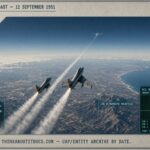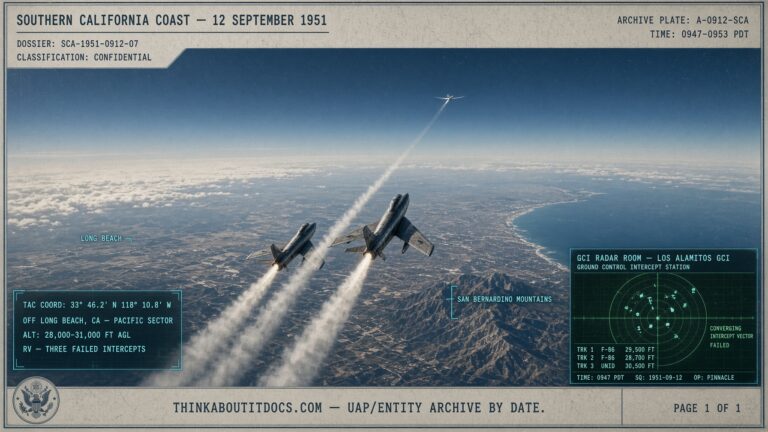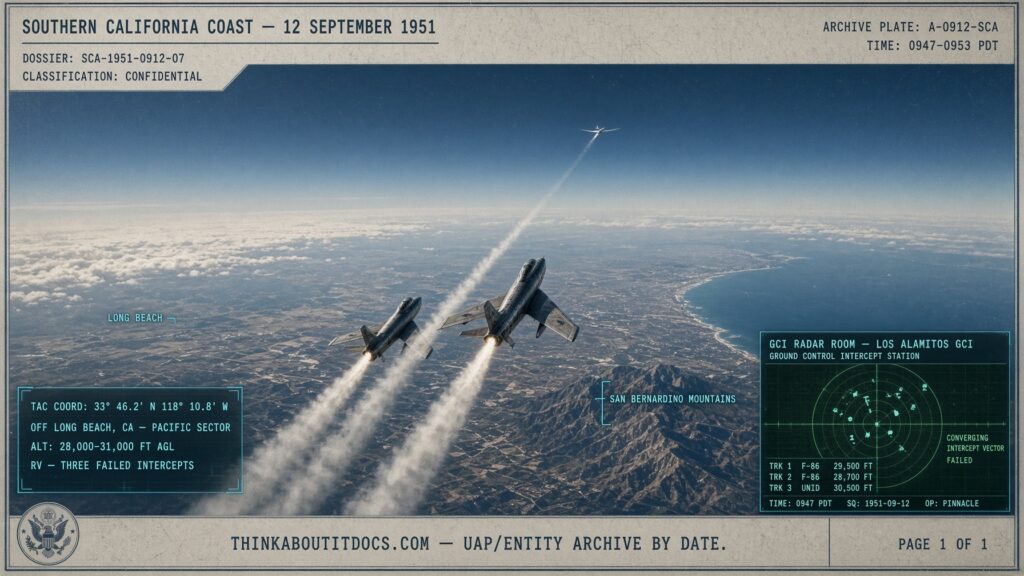
Three separate F-86 flights failed to intercept a swept-wing object orbiting above 50,000 feet over Southern California on September 23, 1951.
THINK ABOUTIT UFO|UAP SIGHTINGS REPORT
1951: The March Field Intercept — Southern California
On the morning of September 23, 1951, the U.S. Air Force scrambled not one but three separate pairs of F-86 jet interceptors, over the course of roughly two hours, in a sustained and ultimately unsuccessful attempt to catch a swept-wing object that kept pace with them from over 50,000 feet above Southern California‘s coast. Radar controllers vectored flight after flight toward the object; pilots repeatedly climbed as high as their aircraft allowed only to watch it climb faster and stay just out of reach. The case is documented in the Air Force’s own Project Grudge reports and in Capt. Edward J. Ruppelt’s personal account of his time running the government’s UFO investigation — making it one of the best institutionally-documented failed intercepts of the entire Cold War UFO record.
Date: September 23, 1951
Sighting Time: Approximately 7:55 a.m. to 9:25 a.m. PDT
Day/Night: Day
Location: Off the coast near Long Beach Airport, over Camp Pendleton, and near March AFB, Riverside, California
Urban or Rural: Airborne, over the greater Los Angeles/Southern California coastal and inland corridor
No. of Entity(‘s): Not applicable
Entity Type: Not applicable
Hynek Classification: RV (Radar/Visual) — the object was tracked by ground GCI radar and simultaneously observed visually by multiple flights of pilots
Duration: Approximately 90 minutes to two hours across the full sequence of three intercept attempts
No. of Object(s): 1 (the same object apparently tracked and re-sighted across all three intercept attempts)
Description of the Object(s): A bright, silvery aircraft-like object with highly swept-back wings, at an estimated 45-degree sweep angle, resembling in profile a swept-wing jet aircraft but performing well beyond the capability of any known aircraft of the period
Shape of Object(s): Swept-wing, aircraft-like silhouette
Size of Object(s): Not established
Color of Object(s): Bright, silvery
Distance to Object(s): Consistently observed well above the pursuing F-86s, at altitudes the fighters could not close on before running low on fuel
Height & Speed: Maintained a controlled orbit at roughly 50,000-55,000 feet, well above the F-86s’ operational ceiling at the time; consistently climbed away or accelerated whenever the pursuing jets attempted to close the distance
Number of Witnesses: Multiple — at least three separate two-pilot F-86 flights (six or more pilots total), plus GCI ground radar controllers
Special Features/Characteristics: The object maintained a controlled, deliberate orbiting flight pattern rather than a straight-line course; it was independently re-sighted by three separate flights of fighters scrambled roughly 20-45 minutes apart, suggesting either a single object loitering over a wide area for an extended period or, less likely, multiple similar objects; each intercept attempt failed for the same underlying reason — the object’s operating altitude exceeded what the F-86s could reach before exhausting their fuel.
Case Status: Unexplained
Source: Project Grudge Reports 1 and 2; Edward J. Ruppelt, The Report on Unidentified Flying Objects, pp. 94-95
Summary/Description: At approximately 9:25 a.m. PDT on September 23, 1951, two F-86 jet interceptors were scrambled from George AFB near Victorville, California, and vectored by air defense GCI radar toward a target roughly 30 miles off the coast west of Long Beach Airport. Circling and heading east toward Long Beach, the pilots spotted an object at their twelve o’clock high position around 7:55 a.m., in a left orbit approximately 50,000 feet above them — a bright, silvery aircraft with highly swept wings. When the F-86s attempted to climb and intercept, the object climbed away in response. A second pair of F-86s was scrambled around 8:00 a.m. as the first flight, low on fuel, was released to return to base; the second flight was vectored by GCI radar to a position near Camp Pendleton, arriving around 8:10 a.m. at 43,000 feet, where they spotted the object to the north toward Muroc/Edwards AFB, still holding its orbit at roughly 50,000-55,000 feet, appearing as a swept-wing aircraft that accelerated whenever the fighters tried to close the distance; the object was subsequently tracked near March AFB, Riverside, before this flight broke off its intercept around 8:20-8:25 due to low fuel, landing at 8:45. A third flight of two F-86s, scrambled from George AFB around 8:45, spotted the object shortly after takeoff heading south, and made climbing turns to as high as 43,500 feet in pursuit of the object, reportedly around 55,000 feet over the San Bernardino Mountains, before breaking off the intercept around 9:25 a.m. A seventh F-86 was separately scrambled toward Long Beach but found the object already gone. Across three separate intercept attempts by six or more pilots, spanning roughly ninety minutes, no aircraft was able to close the distance on the object before running low on fuel.
Related Cases: 1951: The Fort Monmouth UFO Case, New Jersey (same year, comparable radar-visual case with major institutional consequences) | 1950-1951: The Oak Ridge/Knoxville Flap, Tennessee (comparable pattern of repeated failed intercepts)
Detailed Report
The March Field intercept’s defining feature is its persistence: this is not a single failed scramble but three, conducted by different flight crews across nearly two hours, all converging on the same basic outcome — an object holding a controlled orbit at an altitude the F-86, one of the most capable Air Force interceptors of 1951, simply could not reach in time. The F-86A’s service ceiling was officially rated around 48,000 feet, and reaching even that altitude took precious minutes of climb time that ate directly into a fighter’s limited fuel margin. An object loitering at 50,000-55,000 feet was, in practical terms, safely out of reach of 1951-era American fighter aircraft regardless of how many were scrambled — which is precisely what this case demonstrates played out in real time, repeatedly, over the better part of a morning.
The object’s behavior — maintaining a stable orbit rather than fleeing outright, and specifically climbing or accelerating only when a fighter attempted to close distance — describes a pattern that reads as attentive and responsive rather than either aggressive or passively drifting. This is a meaningfully different behavioral profile than either a balloon (which would not respond to an approaching aircraft) or a conventional aircraft under any nation’s control in 1951 (which would have had no reason to repeatedly loiter over populated Southern California while evading identification across multiple intercept attempts).
That the same basic pattern recurred across three independently scrambled flights, coordinated by GCI ground radar controllers rather than by the pilots simply following each other’s initial reports, adds meaningful weight to the case: this was not one confused pilot’s fleeting impression but a sustained, radar-corroborated tracking effort involving multiple radar stations, multiple flight crews, and enough institutional seriousness that the Air Force’s own Project Grudge organization filed detailed reports on the full sequence. Ruppelt’s own inclusion of the case in his book, written after he had run the Air Force’s UFO investigation and had every institutional incentive to downplay unresolved cases, is itself a notable data point in the case’s favor.
No satisfactory conventional explanation for a swept-wing, aircraft-shaped object loitering at 50,000+ feet over Southern California in September 1951 has ever been definitively established. Experimental American aircraft of the period did reach comparable altitudes in test conditions, but a routine, unscheduled, multi-hour loiter directly over populated coastal and inland Southern California, evading three separate coordinated intercept attempts, would represent an extraordinary security and safety lapse if it were in fact a classified U.S. test aircraft — a possibility this archive cannot rule out but which the available record does not confirm either.
RESEARCHER’S NOTES
The March Field Intercept — Southern California 1951 and the Limits of 1951-Era Interception
- Classification issues: RV is squarely correct — the case combines sustained ground radar tracking with multiple independent visual sightings by trained military pilots, one of the stronger radar-visual correlations in this archive’s collection.
- Source chain assessment: This case is documented directly in the Air Force’s own Project Grudge Reports 1 and 2, and separately corroborated in Edward J. Ruppelt’s personal, published account of his tenure running the Air Force’s UFO investigation — a rare instance of two independent institutional-era sources for the same case, giving it stronger sourcing than the great majority of entries in this archive.
- Pattern context: The case’s repeated-scramble, repeated-failure structure closely echoes this archive’s Oak Ridge/Knoxville Flap from the preceding year — a recurring pattern across the early 1950s of objects apparently able to consistently evade era-appropriate interceptor aircraft, whether through genuine performance advantage or simply through operating at altitudes those aircraft were not designed to efficiently reach.
- Physical evidence and evidentiary weight: No photograph or film survives, but the combination of sustained GCI radar tracking, three independent flight crews’ visual corroboration, and direct documentation in official Air Force Project Grudge records gives this case unusually strong institutional evidentiary weight for an unresolved 1951 sighting.
- Geographic and historical context: The Southern California coastal and inland corridor — home to numerous Air Force and Navy test and operational facilities, including Edwards AFB (referenced directly in witness accounts of the object’s position) — was one of the most militarily active and closely monitored regions of the country in this period, making a genuine classified-test-aircraft explanation at least geographically plausible, even without direct confirmation.
The March Field intercept stands as one of the best institutionally documented failed pursuits in the early Cold War UFO record — not a single ambiguous sighting but a sustained, two-hour, radar-coordinated effort involving three separate fighter flights, all defeated by the same basic altitude gap between what the object could reach and what 1951-era American interceptors could match in time. Its direct documentation in both official Air Force records and Ruppelt’s own published account gives it a stronger evidentiary foundation than most cases from this era. It is catalogued here as Unexplained: a persistent, multi-witness, radar-corroborated pursuit that Cold War-era American air defense simply could not resolve.
“The F-86’s tried to climb to intercept the object but it climbed away in response.”
— Project Grudge account, on the September 23, 1951 March Field, California intercept sequence